Alito’s climate recusal and December arguments define the new term
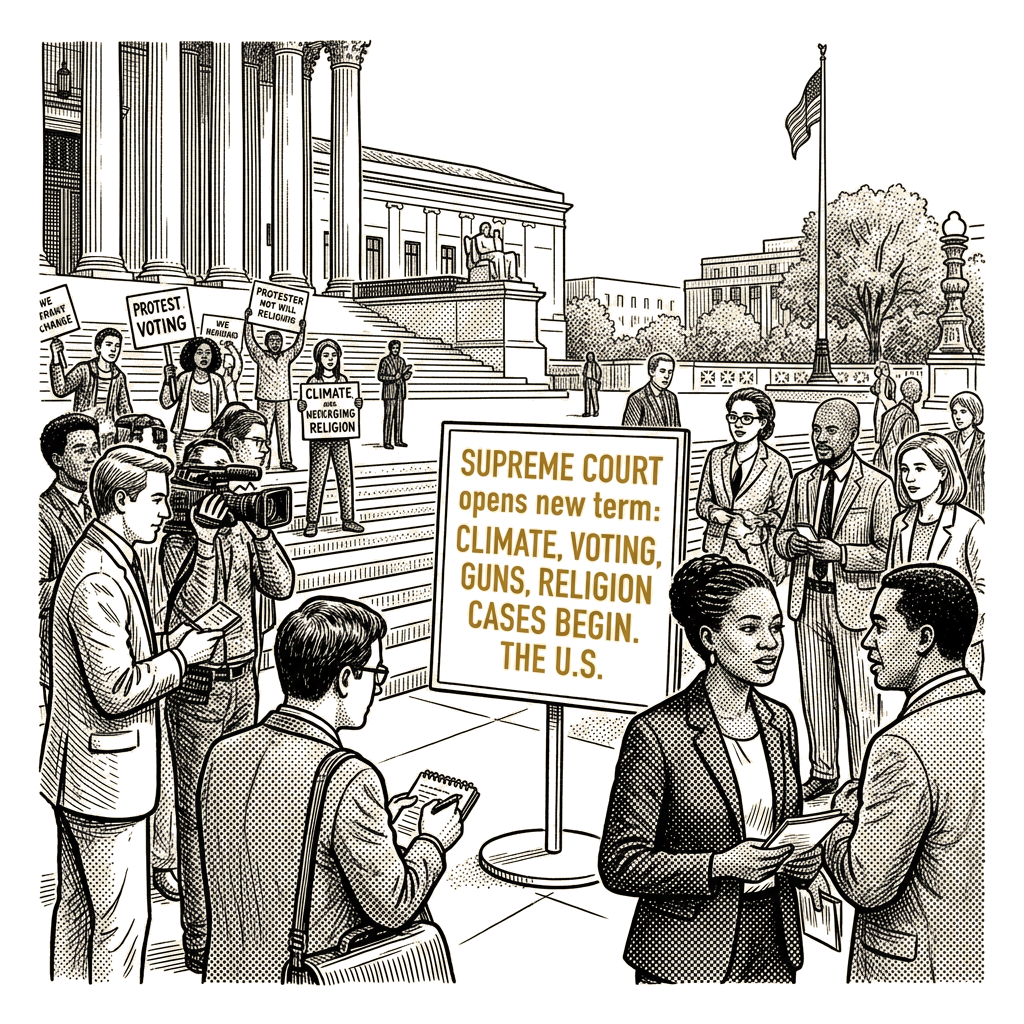
The U.S. Supreme Court convenes Monday for a new term that will test the boundaries of federal climate-change liability, the scope of state authority over voter rolls, the reach of the Second Amendment, and the limits of religious schools’ access to public preschool funding. The court has accepted more than 20 cases for argument in the term, according to United Press International.
Among the first cases the justices will hear is Suncor Energy Inc. vs. County Commissioners of Boulder County, Colorado. The case asks the court to weigh whether federal law takes precedence over state law when a claim is brought against an energy company for injuries related to climate change.
Boulder County and the city of Boulder are seeking millions in damages from Suncor and ExxonMobil for expenses they have faced as a result of climate change, UPI reported. Suncor and Exxon argue that Boulder and other localities across the country are attempting to impose a carbon tax that would have an immense impact on the energy industry, according to the wire service.
The Colorado Supreme Court has ruled that the case can move forward, which the U.S. Supreme Court may determine differently, UPI reported. Before the high court addresses the underlying federal question, it must consider whether it is the appropriate venue to hear the case at this stage; no state court has ruled on the arguments, according to the wire service. The larger issue at hand, the wire service wrote, is whether energy companies can be held accountable for the harms of climate change.
Justice Samuel Alito has recused himself from the Boulder case. Alito holds stock in about two dozen energy companies that could be affected by the outcome, UPI reported, though he does not hold a financial stake in Suncor or ExxonMobil directly. Alito announced his recusal last week, according to the wire service.
The court’s voting-rights docket includes Republican National Committee vs. Mi Familia Vota, scheduled for argument Dec. 8. The case presents two questions: first, does the National Voter Registration Act prohibit Arizona from requiring applicants for voter registration to show proof of citizenship; second, does the NVRA prohibit Arizona from canceling the registrations of voters who are not citizens within 90 days of a federal election.
Arizona’s legislature approved proof-of-citizenship requirements in 2022, before President Donald Trump returned to office. Advocacy groups including Mi Familia Vota immediately challenged the policies, arguing that the NVRA prohibits such measures. A 2018 consent decree between the Campaign Legal Center, Arizona’s secretary of state and Maricopa County required local election officials to accept voter registrations without proof of citizenship, UPI reported. Lower courts have sided with the plaintiffs, and the RNC is appealing to the Supreme Court.
Proof-of-citizenship requirements have been a key policy of the Trump administration during his second term, and UPI reported that the administration has ramped up unfounded claims of widespread non-citizen voting ahead of the November midterm elections.
On guns, the court has consolidated Viramontes vs. Cook County and Grant vs. Higgins to consider whether bans on assault rifles are constitutional. The Cook County case challenges a local ban on assault rifles under the Second and 14th Amendments, with plaintiffs arguing that the 14th Amendment’s incorporation doctrine extends Second Amendment restrictions that were originally placed on the federal government by the Constitution to states as well.
Lower courts have held that semiautomatic rifles like the AR-15 are not protected by the Second Amendment, UPI reported. Gun rights advocates argue that innovations in firearms were assumed to come by the framers of the Constitution and that the right to possess firearms regardless of their capabilities is guaranteed. The Supreme Court has not previously found that the right to possess any and all types of weapons is guaranteed by the Constitution, according to the wire service, and the court’s understanding has been that Second Amendment rights do not apply to weapons that are not typically possessed and used for law-abiding purposes. In other words, UPI reported, if a weapon is typically used for the act of a crime, it is not protected by the Second Amendment. The court will hear the consolidated case in December.
The religion-and-schools case is St. Mary Catholic Parish vs. Roy. Catholic preschools under the Archdiocese of Denver argue they are victims of religious discrimination because Colorado excluded them from a statewide universal preschool program. The program provides financial support to families with children in public and private preschools, UPI reported.
Colorado argues that the Archdiocese of Denver preschools are not eligible for the program because they do not allow families into their schools if they disagree with the church’s stance on gender and sexuality, and because the schools failed to sign the nondiscrimination agreement the state requires for eligibility, UPI reported. Under the agreement, preschools must accept students without discriminating against them or their families on the basis of “race, ethnicity, religious affiliation, sexual orientation, gender identity, lack of housing, income level, or disability.” The schools say the nondiscrimination agreement is a violation of their First Amendment rights. Lower courts have sided with the state, ruling that the Catholic preschools can be denied eligibility in the state program as it does not target or single out the schools based on their religious affiliations.
The case arrives after the Trump administration announced last week the launch of its own school-choice program, the Education Freedom Tax Credit, which offers tax credits to individuals and nonprofit organizations that donate to education expenses, including private school tuition, UPI reported. Republican-led states and the Trump administration have sought to fund private schools, mostly Christian schools, with tax dollars in recent years, with states using school choice voucher programs to do so, according to the wire service.