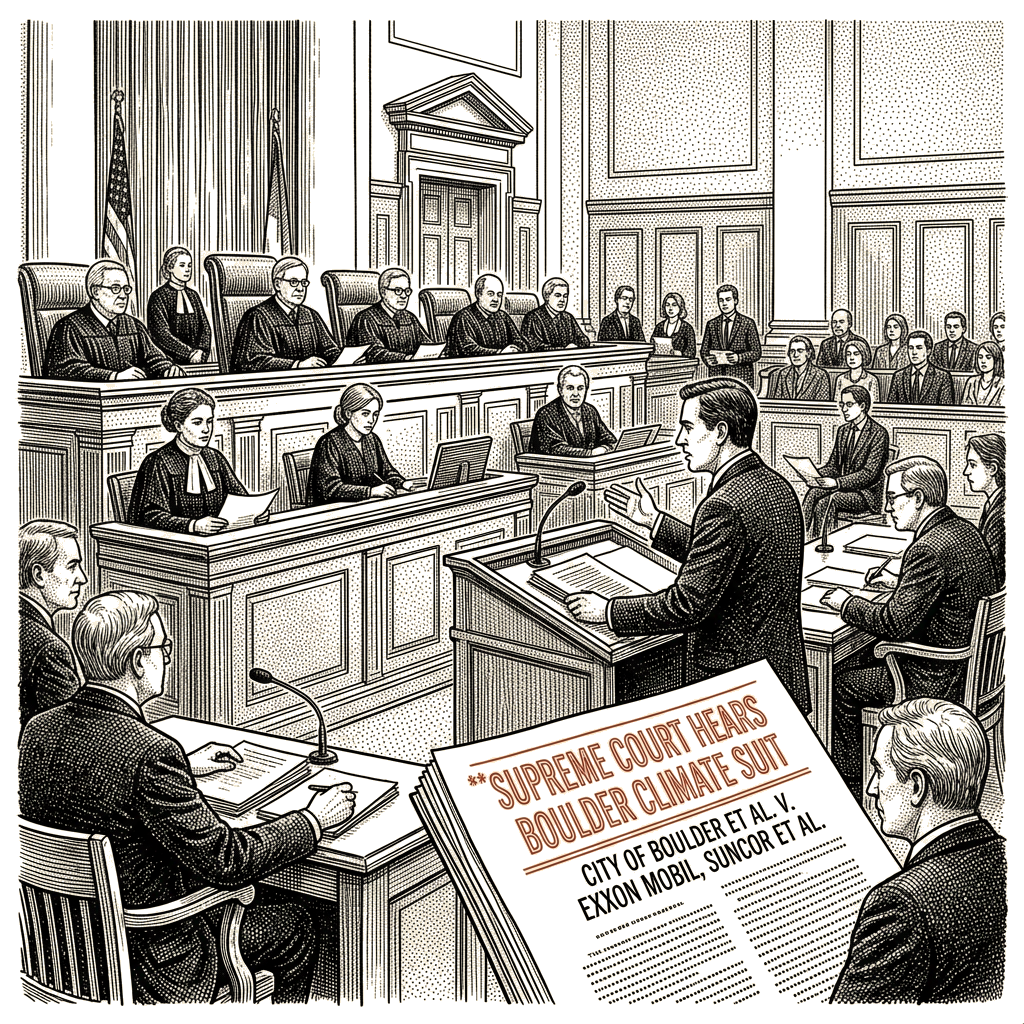
Alito recuses over energy stock ties, leaving eight justices on the case
The U.S. Supreme Court on Monday is set to hear arguments in a Colorado county’s attempt to hold two of the world’s largest oil companies financially responsible for the costs of climate-driven disasters, a case that could reshape how state courts police cross-border harms from major industries.
Boulder County sued Exxon Mobil and Suncor Energy in 2018, along with a trade group, arguing that the companies knew for decades that fossil fuels would worsen environmental damage and failed to warn the public. The county is seeking to recover past and future costs of repairs, emergency services, and property damage.
The case carries particular urgency in Boulder because of the Marshall Fire, which swept across the county in late December 2021. High winds, severe drought, and warm temperatures drove the historic wildfire. Daryl McCool, a Boulder County resident, said she left her home so quickly during the fire that she could not remember whether she had locked the front door. “There’s basically nothing left,” McCool said. “A 2,000-degree fire burns everything, like coins were melted, bicycles melted.” The 1901 house where she raised her son had turned to ash. McCool spent years helping her neighbors file insurance papers and apply for grants to rebuild their homes. Now, she tries to educate people about the human costs of climate change.
Boulder’s lawsuit has not yet gone to trial; it remains in the early stages of the Colorado court system. Exxon and Suncor are asking the Supreme Court to throw out the case now, arguing that only the federal government has the power and expertise to address something as large as climate change. Allowing the case to proceed, the companies say, would have huge implications.
Exxon referred questions to the company’s court filings. Suncor did not respond to an email requesting comment. The Trump administration is siding with the energy companies, arguing global warming is a global issue.
Legal experts on both sides of the dispute are framing the case in broad terms. Todd Zywicki, a professor at the Antonin Scalia Law School at George Mason University, said in a recent webinar: “This is about whether a bunch of rich hippies in Boulder County are allowed to dictate environment and energy policy to the entire rest of the world.” Sai Prakash, a law professor at the University of Virginia who filed a friend-of-the-court brief backing Suncor and Exxon, said: “Essentially Boulder claims that Colorado can reach around the United States, the entirety of the United States, and to my mind, regulate production everywhere by attaching liability to it. If Boulder can attach liability to these two companies, I think it can attach liability to thousands of others as well.”
Boulder argues it is not suing to regulate greenhouse gas emissions; it wants to recover past and future costs of repairs, emergency services, and property damage. Jonathan Adler, a law professor at the College of William and Mary, noted in court papers that Congress has the authority to override state laws in this area but has not done so. Corey Riday-White, legal director at the Center for Climate Integrity, which supports communities suing oil companies, said: “This case represents whether or not we believe as a society that corporations should be held to the same standards that all of us are, right? If you know you are going to cause harm, and you don’t tell someone, then you should help clean up that harm.” Riday-White said the energy companies “can’t point to any legal doctrine, any statute, any part of the Constitution that backs up” their claim that such cases belong exclusively in federal court.
The case has drawn attention beyond the energy industry because the justices’ eventual ruling on the boundaries of state power could affect litigation over opioids, pollution from “forever chemicals,” and nuisance suits related to AI data centers. Deepak Gupta, a lawyer who regularly argues before the Supreme Court, said at a briefing sponsored by Georgetown’s Supreme Court Institute: “Pollution by forever chemicals, nuisance suits over AI data centers, opioids litigation, all of these are about the local effects of conduct that runs across borders.” The court’s conservative supermajority may be uncomfortable allowing state juries to decide such issues, legal experts said, though they added that observers were uncertain how the justices might shape a decision in the Boulder case.
A late change to the court’s lineup has added another layer. The court notified lawyers one week before arguments that Justice Samuel Alito would not participate. The clerk’s office provided no explanation. Environmental organizations and watchdog groups had called for Alito’s recusal because of his investments in Phillips 66 and ConocoPhillips. Justin Kloczko of the group Consumer Watchdog called the decision “the right decision, and one he should have made from the start.” Kloczko said in a written statement: “The public should not have to wonder whether a justice’s personal investments could benefit from a ruling that shields the fossil-fuel industry from liability.”
With Alito stepping aside, eight justices will hear the case. In the event of a 4-4 tie, the decision of the Colorado Supreme Court allowing Boulder’s lawsuit to proceed would prevail. The justices also left themselves another option: among the questions they said they will consider is whether they have jurisdiction to hear the Suncor case at all, given that it is still at an early stage in Colorado state courts.
Louie Delaware, who lost his Boulder-area home in the Marshall fire, said he plans to be at the Supreme Court on Monday for arguments. Delaware said he tried to fight the fire with a garden hose but lacked protective gear and realized he needed to drive away quickly. “You know it’s our responsibility to leave things better for the next generation,” Delaware said. “And the way we’re going right now is counter to what that’s been in the past.”