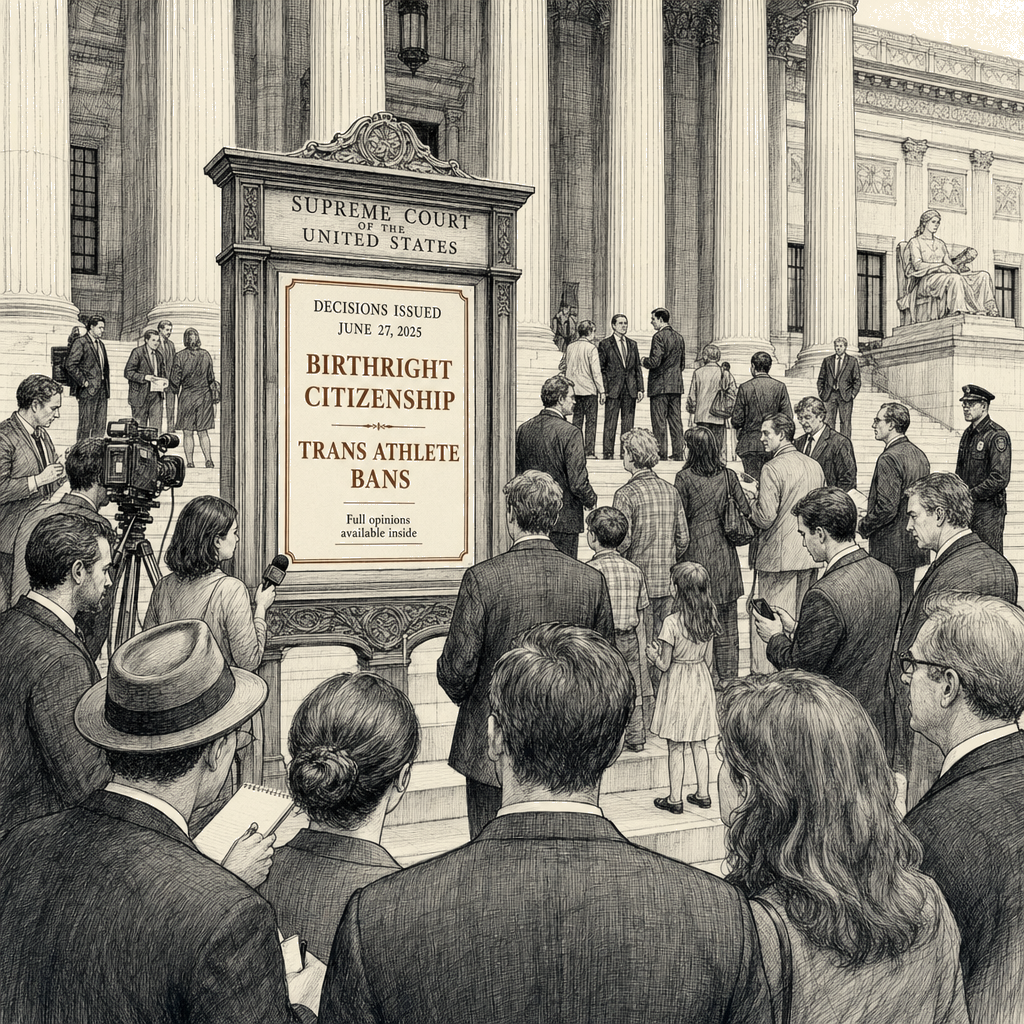
The U.S. Supreme Court is expected on Tuesday to release two of its most anticipated rulings of the term, deciding President Donald Trump’s challenge to birthright citizenship and state laws restricting transgender athletes from competing in women’s and girls’ sports. The decisions are expected on the final day of the court’s current session.
The birthright citizenship case stems from an executive order Trump signed early in his presidency directing federal agencies to deny citizenship to children whose parents were in the country illegally or on temporary visas. The order challenged a legal principle — known by the legal term “jus soli,” or “right of the soil” — that has been enshrined in U.S. law since the 14th Amendment was added to the Constitution in 1868, originally to grant citizenship to formerly enslaved people after the Civil War.
At the heart of the dispute is the interpretation of the 14th Amendment’s Citizenship Clause, which states: “All persons born or naturalized in the United States, and subject to the jurisdiction thereof, are citizens of the United States and of the state wherein they reside.” The Trump administration argued that the phrase “subject to the jurisdiction thereof” means the amendment excludes children of people not in the country permanently or lawfully. The American Civil Liberties Union, which filed a class action lawsuit challenging the order, argued the clause refers to the physical presence of people born on U.S. soil, not their parents’ legal status.
During oral arguments in April, several justices appeared skeptical of Trump’s efforts to end birthright citizenship. Justice Elena Kagan said at the time that the administration was seeking to undo a legal tradition dating back to English common law. “What the 14th Amendment did was accept that tradition and not attempt to put any limitations on it. That was the clear rationale,” Kagan said.
MSI previously reported that the court heard arguments in the case in late March, when the justices weighed Trump’s appeal of a lower-court ruling that struck down the executive order.
Trump has described birthright citizenship as a “scam” that allows wealthy foreigners and undocumented immigrants to exploit the system. The ACLU argued that ending the practice would create “a permanent subclass of people born in the United States.”
A second major decision expected on Tuesday involves laws in Idaho and West Virginia that require public school and college sports teams to be organized according to sex recorded at birth. Over two dozen states have enacted similar bans. The challengers argued the bans violate equal rights protections in the U.S. Constitution and contradict civil rights laws. During more than three hours of oral arguments in January, at least five of the justices appeared to favor upholding the bans, according to reports. The court has a 6-3 conservative majority.
Proponents of the bans argue that transgender women have a biological advantage over athletes who were recorded female at birth. The International Olympic Committee announced in March it was limiting the women’s category of Olympic sports to biological females, stating its working group had reviewed the latest scientific evidence over 18 months and found a “clear consensus” that “male sex provides a performance advantage in all sports and events that rely on strength, power and resistance.” Opponents argue the bans unfairly discriminate against transgender students and dispute whether a scientific consensus exists that transgender women and girls have an inherent advantage.
The court’s remaining docket this term includes cases on presidential power to fire members of the Federal Reserve Board and the counting of late-arriving mail-in ballots. The court recently allowed the Trump administration to withdraw Temporary Protected Status from hundreds of thousands of Haitian and Syrian migrants.