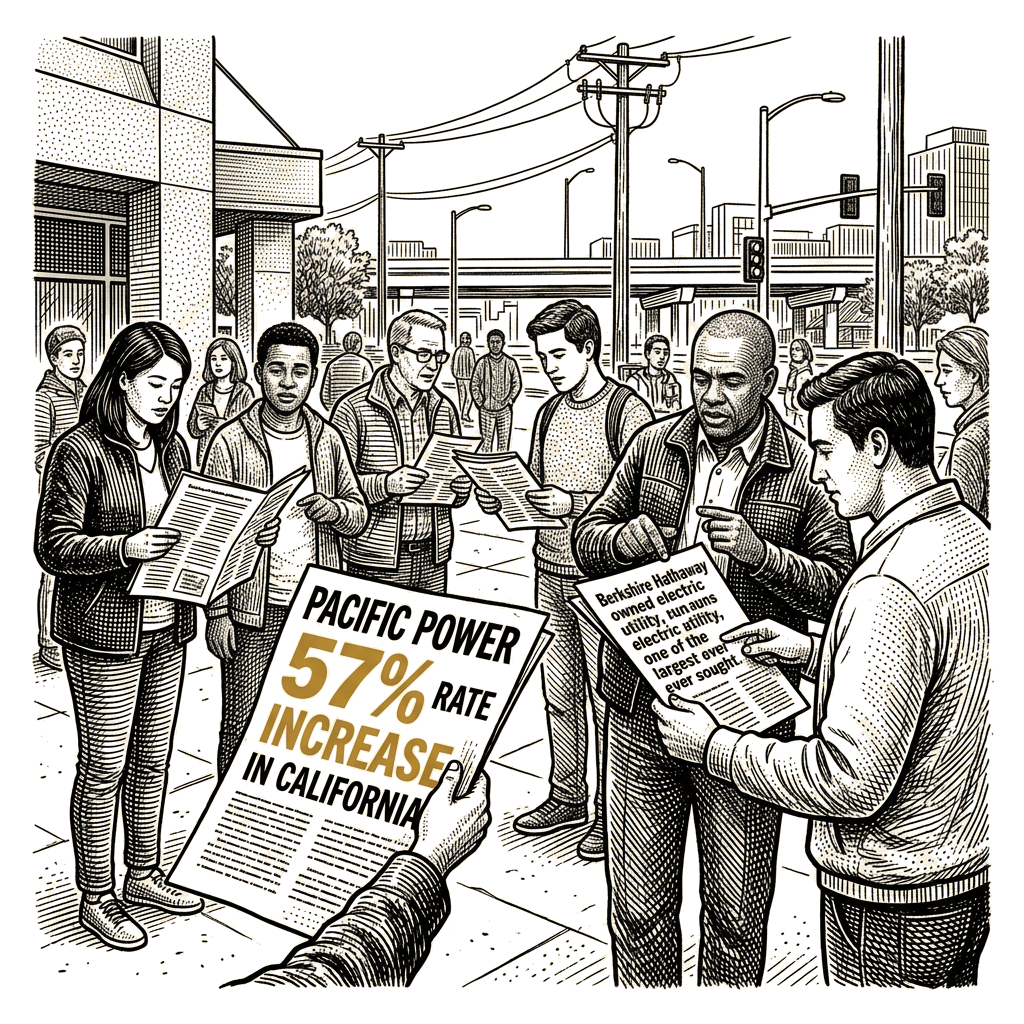
Typical residential bills would rise $120 a month, the company says
Pacific Power, part of Berkshire Hathaway-owned PacifiCorp, asked California regulators on Friday to approve a 57% rate increase that would lift its base revenue by $103 million a year — one of the largest ever sought by an investor-owned U.S. utility. Under the request, the typical monthly residential bill would rise by $120, according to the utility.
The utility serves about 46,000 customers across 11,292 square miles of Northern California, from the coast to the Nevada border. “It’s a rugged territory; it’s densely forested; it’s dry,” said Ryan Flynn, the utility’s president. “We have about four customers per square mile.” Pacific Power also operates in Oregon, where it serves about 630,000 customers.
The filing highlights a dilemma facing utilities across the American West as they raise spending to guard against catastrophic wildfires while debating with regulators over how customers and shareholders should share the costs of past disasters. Pacific Power says much of the $103 million it seeks reflects capital spending already under way to safeguard the grid.
Pacific Power’s equipment has allegedly been tied to two California fires: the 2020 Slater Fire, which burned more than 150,000 acres and killed two people, and the 2022 McKinney Fire, which burned 60,000 acres and killed four.
Flynn said the company is replacing wooden power poles with steel and fiberglass structures and swapping hundreds of miles of bare wire for insulated, fire-resistant conductor. The utility also faces steep increases in insurance premiums and general operational inflation, he said.
Beyond the rate case, Pacific Power faces about $637 million in liability claims and legal expenses stemming from the 2020 and 2022 fires. It is asking regulators to let it recover $340.5 million of that sum from customers. The company disputes responsibility for the blazes but has settled claims nonetheless.
If that recovery request is approved, the average monthly residential bill for most customers would rise an additional $46, or about 19%, the company has said. Pacific Power plans to ask for approval to securitize the costs — a strategy utilities often use for storm or fire recovery — which could soften the bill impact by spreading payments over a long period.
Regulators will consider both proposals in 2027. They previously approved a 24.4% rate increase that took effect in 2024. Customers could also see some offsetting relief: adjustments to fuel and power charges early next year could trim bills by about $31 a month, or 14%, according to Pacific Power.
“We recognize the magnitude of this request, and protecting communities is the right thing to do. Doing nothing is not an option,” Flynn said, calling the requests “the beginning of a process.”
The debate over wildfire liability costs remains contentious in California, where a bid by Gov. Gavin Newsom to reduce utilities’ exposure recently failed in the state legislature. About one-third of Pacific Power’s California customers receive discounts under the state’s low-income energy assistance program.
Electricity-cost increases are outpacing many other types of inflation across the United States, adding to strains on households already facing higher food and gasoline costs. Utilities have requested more than $23 billion in rate increases so far this year, after seeking $31 billion in 2025, according to PowerLines, a consumer education group. Over the past two years, some of the highest utility requests ranged from 12% into the high-20% range, according to PowerLines — well below Pacific Power’s 57% ask.
One of the largest recent requests came in 2024 from Rocky Mountain Power, another PacifiCorp unit, which initially proposed a 29% increase. Utah Gov. Spencer Cox called the proposal “laughable if it wasn’t so dangerous” in a post on X. Rocky Mountain Power lowered its request and ultimately received an increase of about 4% under a settlement earlier this year.
Warren Buffett warned shareholders in 2024 that Berkshire might rethink utility investments in states at high risk of wildfire. “We will not knowingly throw good money after bad,” he wrote in his annual letter. A Berkshire Hathaway representative did not immediately respond to a request for comment.
PacifiCorp has halted dividend payments to Berkshire and agreed earlier this year to sell much of its Washington service area, power generation and infrastructure to Portland General Electric for $1.9 billion to raise capital. S&P has lowered PacifiCorp’s issuer credit rating to BBB-minus, the lowest investment-grade rating.