Forest Service expects rescission to be finalized next year
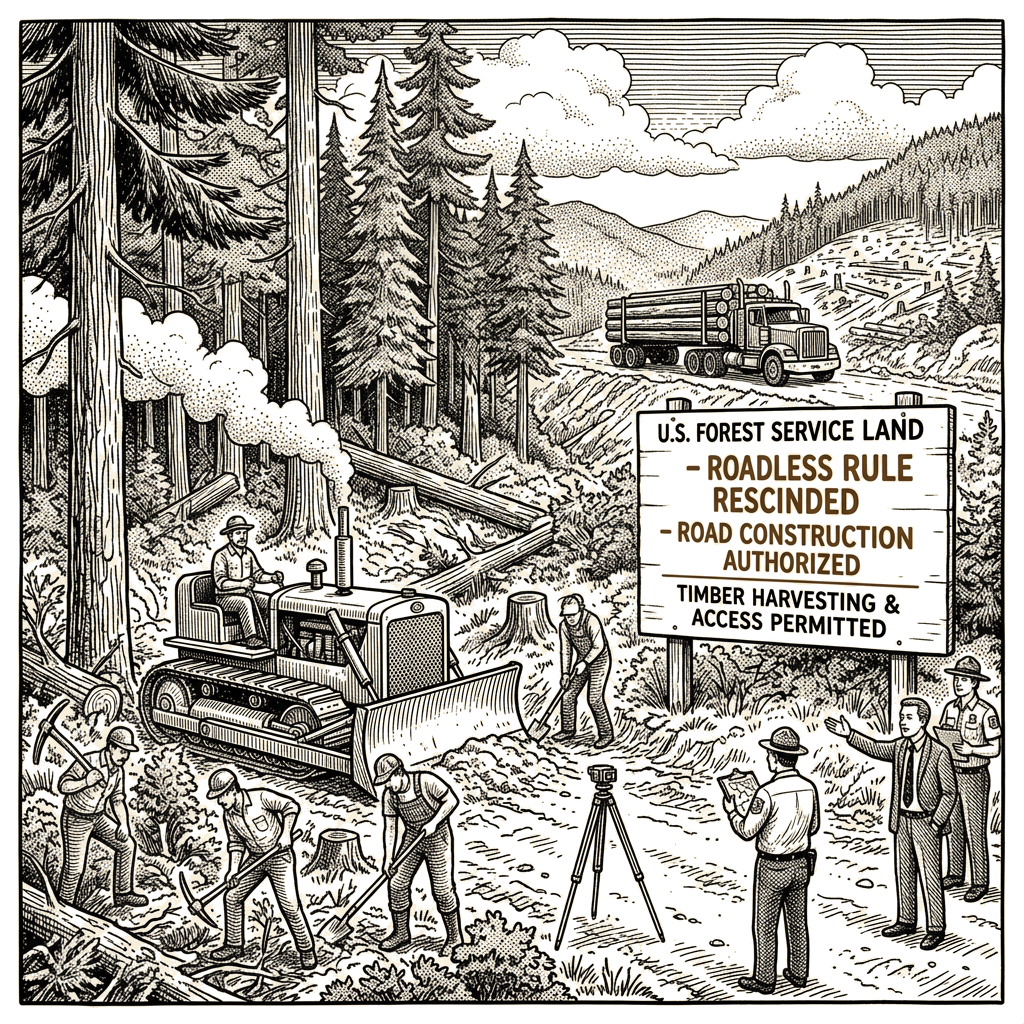
The Trump administration is working to rescind the Roadless Rule, and the Forest Service expects to finalize the rescission next year. For decades, the administrative rule banned new road building and logging across millions of acres of national forest lands, and it blocks road construction in some national forests. NPR reported that the move is controversial in places like Alaska’s Tongass National Forest and could affect that forest.
NPR host Ayesha Rascoe introduced the report by member station KTOO reporter Alix Soliman, who covered the story from Juno. Soliman reported that around half of the Tongass National Forest in Southeast Alaska has no active roads — more than 9 million acres. The Tongass is the largest national forest in the United States.
On a recent afternoon, Judith Daxootsu Ramos walked through a roadless area. Ramos is a Tlingit anthropologist from Yakutat, a small Alaska Native village, and she said the forest supports a number of Tlingit traditions, including harvesting berries and hunting deer. “Without this, we’re going to lose our traditional medicines, our traditional art styles, our traditional foods. And all of that is really connected to the forest,” Ramos said.
Ramos sits on the board of the Southeast Alaska Conservation Council, a local nonprofit advocating to keep the Roadless Rule in place. She visited Prince of Wales Island, a heavily logged part of the forest, and said the trees that grew back in old-growth clearcuts looked sterile. “It’s a very different forest. And there was no animals, no birds there, and it was kind of really quiet. And so it was kind of scary,” she said.
Others in the region oppose lifting the Roadless Rule because they worry it will hurt ecotourism or undermine the Tongass’s climate benefits. The forest holds a third of all carbon stored in intact U.S. national forests.
The U.S. Department of Agriculture says it wants to roll back the Roadless Rule to give firefighters access to fight wildfires and remove what it calls outdated regulatory barriers. Many in Southeast Alaska think the aim is instead to increase logging. The Trump administration has tried to boost national timber production in the past, and the first Trump administration temporarily rolled back the rule in just the Tongass.
Tessa Axelsen, executive director of the Alaska Forest Association, a group that advocates on behalf of timber companies in the state, supports the administration’s move. “There certainly is a piece that would make some supply available. It is not significant volume that is going to fix the challenges the industry has,” Axelsen said. The Forest Service has said fewer than 200,000 acres of roadless land in the Tongass could be suitable for logging, and Axelsen said that is not enough.
At a recent economic forum, Axelsen said the policy could change again with the next presidential administration. “When we have the back-and-forth on a four-year cycle, it doesn’t matter which side. It creates so many challenges for our communities,” she said.
Axelsen also said transportation costs put Southeast Alaska at a disadvantage when timber is shipped out of state to the Lower 48. “We’re always at a disadvantage in the Southeast in terms of when we’re sending anything out of the state into a place like the Lower 48 because of the cost of transportation,” she said. Building roads is expensive, and a lot of Alaska’s timber has to be transported by boat to be milled elsewhere, which is also expensive.
Susan Alexander, a retired Forest Service economist who worked in the Tongass, said past reversals of the rule did not increase logging there. They did, however, prompt the agency to prepare timber sales that never sold. “There was a heck of a lot of money spent trying to set up timber sales in units that were then taken out because somebody in a later administration rescinded the rule,” Alexander said.
According to the Forest Service press office, no timber sales occurred in roadless areas within the Tongass when the forest was last exempted from the rule by Trump.