Second presentation of £36bn savings first outlined at party conference last month
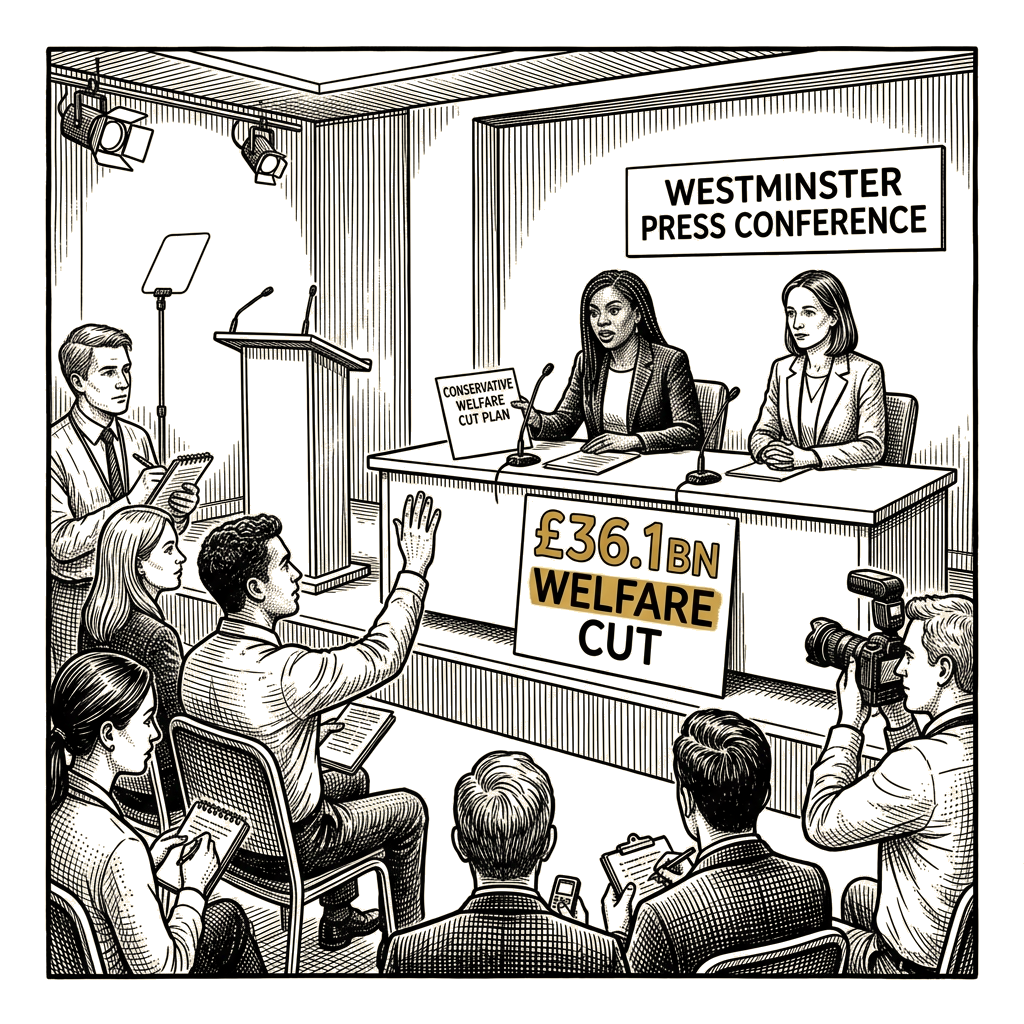
At a Westminster press conference on Tuesday morning, Conservative leader Kemi Badenoch and shadow work and pensions secretary Helen Whately set out plans to cut £36.1bn from the welfare budget. Because the Conservatives sit in opposition, the event laid out a party policy proposal rather than a program taking effect.
Much of the package had been seen before. Badenoch and Whately discussed £36bn in savings at the Conservative party conference last month, and Tuesday’s total of £36.1bn added £0.1bn to that figure. Guardian sketch writer John Crace, whose politics sketch covered the event, suggested the extra £0.1bn existed so the package could be presented as “fully costed down to the last 50p” rather than numbers plucked “from thin air.”
Crace wrote that Whately was there to talk through the numbers — “though not the ones that really counted,” such as how the welfare bill almost doubled under the Conservatives. Cutting the bill, he observed, is “far easier” to do in opposition. He traced Whately’s route since first entering parliament, from a “wetter than wet Cameroon” well on the left of the Tory party to a position that has since slid to the right, and noted that she talks these days of “getting people back to work,” while wondering aloud whether the only job that really interested her was her own.
He judged the re-announcement “almost certainly doomed to fail,” writing that no one takes the costings of an opposition party particularly seriously. He advised readers not to be surprised if a further press conference arrived before Christmas to “re-announce the re-announcement. Third time lucky.”
The plan carried narrow exceptions. Badenoch said people who were terminally ill and those well past retirement age would still receive benefits — what Crace called a “token nod to compassion” — while the sketch presented everyone else as facing a “rude wake-up call.” His sketch mocked the exceptions, joking that a claimant might forgo “a last goodbye to your family” when “a productive day’s work” awaited instead.
There were whoops and cheers, Crace reported, from a “surprisingly large audience” as Badenoch approached the lectern — a crowd he described as of an age and a wealth that left it with no better place to be at 10.30am on a working day. His sketch rendered the leadership’s outlook as “KemiWorld,” a frame in which welfare is “very much a one-way balance sheet,” in which “the double amputee who ran a marathon” stands as the model, and in which most disabled people “just sit at home and moan” rather than get out and do something.
The sketch’s central objections concerned what the presentation left out. Crace wrote that there was no acknowledgment that cutting benefits by up to £10,000 per household might create further costs — that people might lose their homes, forcing councils to accommodate them in bed and breakfasts. Nor, he wrote, was there any acknowledgment of the Netherlands, where funding measures to get young people into work had achieved “great success”; his argument was that it might be “an idea to invest in opportunities” rather than treat claimants as “debit sums in the ledger.”
Charities’ claims also drew a response. Crace reported that charities said the changes would lead to a “massive surge in child poverty,” and that Badenoch dismissed the claims. He characterized the dismissal as writing off the charities as groups “that would say that, wouldn’t they?”
The media’s questions, Crace wrote, “slipped by easily enough.” Badenoch refrained from attacking Ed Miliband and Lucy Powell over their “fatal attraction” to Russell Brand more than a decade ago, and she said she would not be cutting benefits for people from the EU with settled status. “So there is a heart there, somewhere,” Crace concluded.
Crace also noted that Badenoch has taken to holding press conferences almost as often as Nigel Farage, that her approval ratings poll considerably higher than the Conservative Party’s own, and that he characterized her roughly twenty-person team in unflattering terms.
Tuesday’s event marked the second outing in a month for the same welfare savings, first outlined at the party conference and re-presented at £36.1bn. The presentation put the opposition’s claimed costings in public view alongside the objections Crace recorded: the near-doubling of the welfare bill under the Conservatives, which he said went undiscussed, and the projected consequences for child poverty and housing.