Trump called Massie ‘a stone cold loser’ the day before the briefing
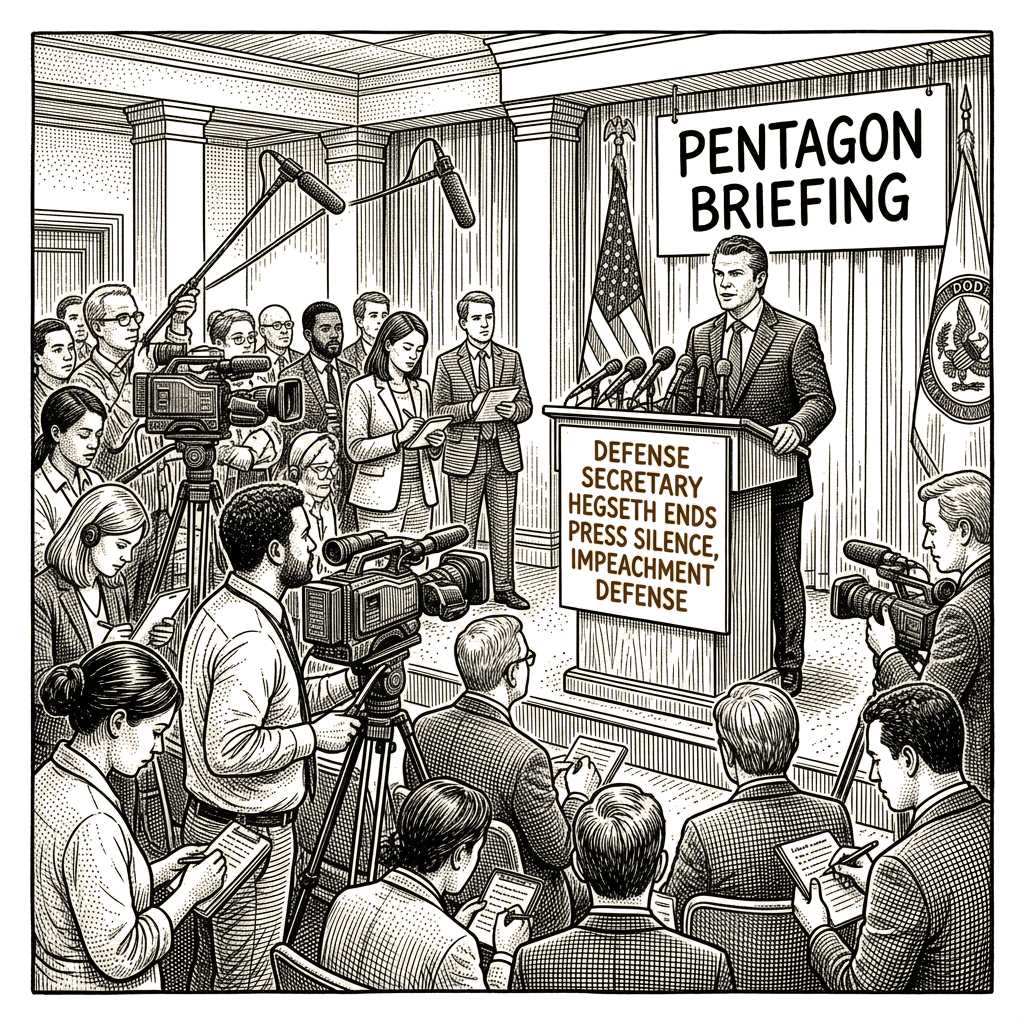
Pete Hegseth held his first Pentagon press briefing in nearly six months on 10 November 2026, convening reporters at 8 a.m. on a Tuesday for a 25-minute defense of the military operations named in Thomas Massie’s eight articles of impeachment. The Guardian reported that Hegseth had avoided holding a single press briefing during that stretch while an Iran war the outlet described as unpopular continued through the election campaign, and attributed the sudden summons to the impeachment effort.
Hegseth faced a press corps he commonly dismisses as the “fake news,” according to The Guardian — a defense secretary who has railed against beards and poor grooming in the military. The Guardian noted there was no talk at the briefing of “weirdos or beardos,” two among several categories Hegseth has made it known are unwelcome in the US armed forces under his watch.
Across the 25 minutes, Hegseth never mentioned Massie’s name, The Guardian reported. Instead he applied the adjective “disgruntled” to his unnamed critic several times — a label The Guardian suggested probably represented a syntactic upgrade on Donald Trump’s description of Massie the day before as “a stone cold loser.”
Massie, the outgoing Republican representative from Kentucky, introduced the eight articles citing high crimes and misdemeanors in Hegseth’s stewardship of the military, The Guardian reported. The articles are likely to find support from Democrats — and maybe some fellow Republicans.
The Guardian described the articles as containing serious charges, including violating the US Constitution and waging war against Iran without congressional authorization. Hegseth is also accused of violating Congress’s war powers resolution, which requires the withdrawal of US forces from unauthorized hostilities after 60 days.
The accusations continue with carrying out illegal military strikes against suspected drug traffickers in the Caribbean, unlawfully capturing Venezuela’s president, Nicolás Maduro, unauthorized military strikes against Yemen and ignoring laws intended to minimize civilian casualties. A photo caption on the Guardian’s report noted that US law enforcement officials moved Maduro and his wife, Cilia Flores, out of a helicopter toward a court in Manhattan in January 2026. Finally, the articles accuse Hegseth of abusing his power by retaliating against Mark Kelly, a Democratic senator who had urged members of the military to disobey illegal orders.
Hegseth dismissed the impeachment effort as “farce and a stunt.” “In the 250 years of our American republic, no secretary of war or secretary of defense has ever been impeached for carrying out lawful military operations, and in our case, successful ones at that,” he said.
“Not once, war powers resolution or not, not under Reagan in Lebanon, not under Clinton in Kosovo, not under Obama in Iraq and Syria, not under Biden in Iraq and Syria. That’s the standard,” he said, arguing that Massie sought to turn that precedent upside down “over policy disagreements.” “That’s what it is,” Hegseth said. “Not high crimes, not misdemeanors, not treason, not bribery, not the kinds of offenses the founders intended when they wrote the impeachment clause.”
Hegseth also noted that impeachment had not been used against Lloyd Austin, his Democratic predecessor at the Pentagon, after Austin oversaw the withdrawal from Afghanistan and later underwent treatment for cancer.
He asserted “this isn’t about me,” saying the fight was at least partly about America’s “brave warriors.” “Put the secretary on trial today and the men and women who carry out the orders tomorrow,” Hegseth said, adding that anyone who wanted to go after the warriors would find “they are going to have to come through me.”
Much of the address defended Trump, who was impeached twice during his first presidency. “Now they’re trying a third time, this time against a member of his cabinet,” Hegseth said. “If standing with President Trump puts me in that company, I’ll take that company every day of the week.”
He accused the media of being unable to acknowledge Trump’s military success against Iran “because they hate the president more than they love our country or our troops.” At that point, The Guardian observed, it became clear that the audience Hegseth was primarily addressing sat not in the Pentagon briefing room but in the White House.
The fervent defense of Trump was also, in the Guardian’s account, a defense of Hegseth himself, all the more so amid speculation that the president could still make him the fall guy for last week’s Republican midterm defeats. The outlet noted that Trump has so far stuck by Hegseth as a man who “won two wars.”
Asked about Stephen Miller, Trump’s chief policy adviser and newly appointed chief of staff, Hegseth called him “An incredible American patriot.” “We’ve got no better friend at the department of war than Stephen Miller,” he said. “He’ll be a fantastic chief of staff.”
The tone shifted markedly, per The Guardian’s account, when a reporter asked about Vice President JD Vance, who has blamed the Iran war for the Republicans’ defeat and whom the outlet described as widely assumed to harbor presidential ambitions. “I respect the vice-president greatly, and I’m certainly not going to exchange any finger pointing,” Hegseth said, before adding a quick aside: “Thankfully, politics is not really my thing.”
By The Guardian’s account, the 25-minute appearance amounted to a broad legal and political defense rather than a response to each of Massie’s articles: the operations were lawful and successful, the effort arose from policy disagreements, and Hegseth stood with Trump.