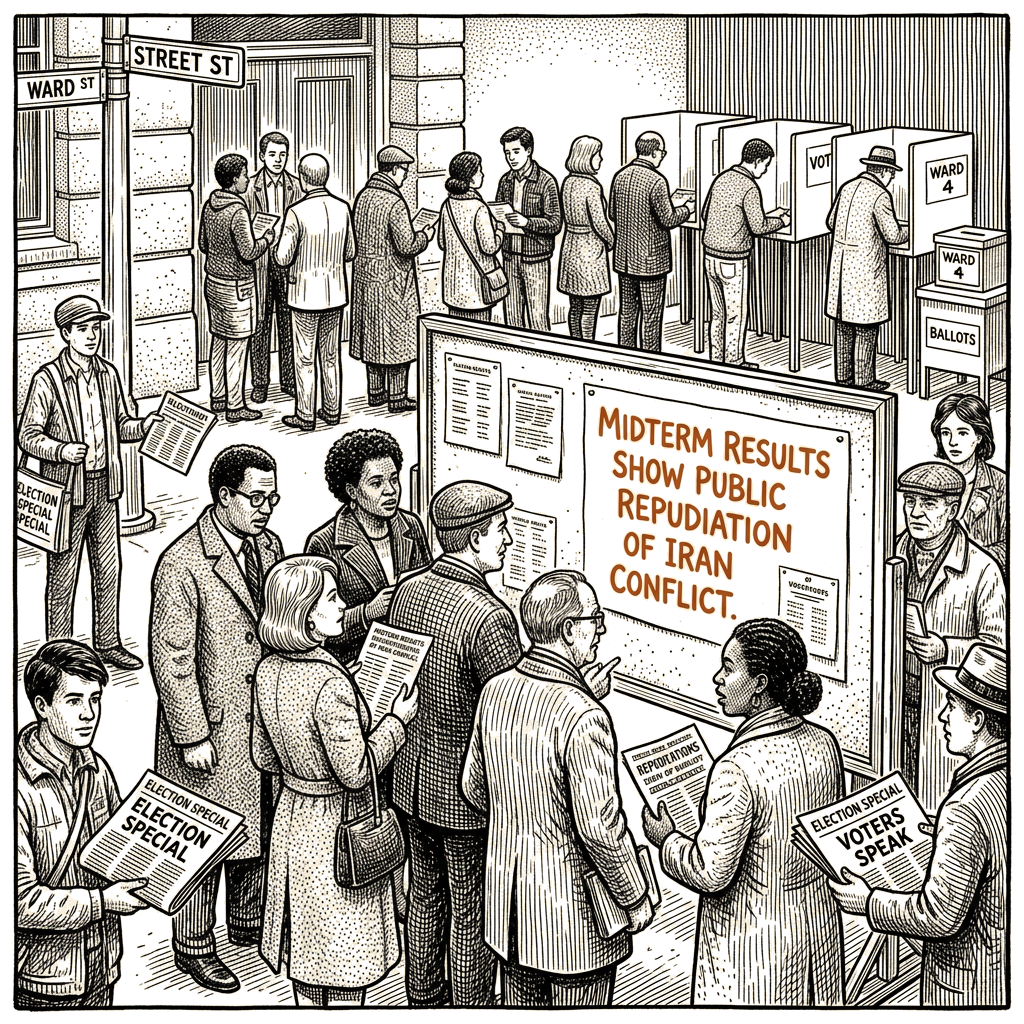
Exit poll: 63% of voters call the attack on Iran the wrong decision
Mohamad Bazzi, a Guardian US columnist, argued that the war President Donald Trump launched against Iran eight months ago may have cost Republicans control of Congress. The midterm elections, Bazzi wrote, amounted to “a massive public repudiation” of the conflict and of the US legacy of “forever wars” that followed the terrorist attacks of September 11, 2001.
The argument rests on exit polling, pre-war opinion surveys and the on-record statements of Trump and Vance — a vice president who blames the war outright, and a president who calls that assessment largely true while standing by the attack.
Exit polling conducted by NBC News found that 74% of voters said the war was a “crucial” or “major” factor in their vote for Congress. In the same polling, 63% said the Trump administration made “the wrong decision” by taking military action against Iran.
Opposition to a new war was broad before the fighting started, Bazzi noted. A January poll by Quinnipiac University found 70% of voters opposed an attack on Iran — a reversal, he wrote, from public opinion ahead of the 2003 invasion of Iraq, when polls showed 72% of Americans supported that war in its early days.
Bazzi recounted a conflict that began with a joint US-Israeli attack. Iran fought hard for its survival, he wrote, retaliating by destroying oil pipelines and other energy infrastructure in neighboring Gulf countries and largely closing the Strait of Hormuz, through which more than a fifth of the world’s oil and natural gas supplies passed each day before the conflict. The war drove up energy prices and other costs worldwide, and voters took out their anger over the economic fallout on Trump and his Republican Party.
In Bazzi’s telling, Trump was “blinded by hubris,” convinced he could achieve a quick military victory and overthrow the government that took power after Iran’s 1979 Islamic revolution. The column contrasts that decision with the record Trump built by attacking his predecessors’ wars: Trump called George W. Bush’s decision to invade Iraq in 2003 “the worst single mistake ever made in the history of our country” and regularly derided the occupation of Afghanistan as “a total disaster,” Bazzi wrote.
Trump won the presidency in 2024 promising to negotiate an end to Russia’s invasion of Ukraine and Israel’s war against Gaza — conflicts he argued had been prolonged by his Democratic opponents, Joe Biden and Kamala Harris. “If Kamala wins, only death and destruction await because she is the candidate of endless wars. I am the candidate of peace,” Trump said at a November 2024 rally in Michigan, according to the column.
Michigan was a swing state Trump won partly with support from Arab and Muslim American voters, many of whom have relatives in the Middle East and were angry at the Biden administration’s unwavering support for Israel as it expanded its war from Gaza into Lebanon and other countries in the region. Beyond his campaign rallies, Bazzi wrote, Trump used his most important speeches to portray himself as an “America First” president who opposes foreign military adventurism, a stance that became a cornerstone of his Make America Great Again movement. “I’m not going to start a war. I’m going to stop wars,” Trump declared in his 2024 election night victory speech in Florida, Bazzi noted.
As the extent of Republican losses in House, Senate and gubernatorial races nationwide became clear last week, Vance posted a lengthy statement on Twitter/X blaming the defeat on the conflict. “The reason we lost is the war,” Vance wrote, explaining that voters who had backed Trump in 2024 showed up in the midterms to vote for Democrats because they were angry about the war, higher prices and other economic fallout.
Vance also suggested the administration had abandoned its “America First” agenda — which Bazzi read as an attempt by the vice president to lay claim as the legitimate heir to the Make America Great Again movement after Trump, who cannot run for re-election in the 2028 presidential race. But the movement itself, Bazzi argued, “may have fractured irreparably” because of the Iran war and the devastating Republican losses in the midterms.
Bazzi traced Vance’s own path from Trump critic to running mate. Vance helped promote the narrative to a weary American public that Trump would avoid getting embroiled in new conflicts, unlike his Democratic opponents, Bazzi wrote. In 2023, Vance endorsed Trump with a Wall Street Journal opinion article headlined “Trump’s Best Foreign Policy? Not Starting Any Wars.” “My entire adult lifetime has been shaped by presidents who threw America into unwise wars and failed to win them,” Vance wrote at the time, citing failed US interventions in Afghanistan, Iraq, Libya and elsewhere. His record as a US Marine who served in Iraq and later turned against the war made him appealing to Trump’s base as he sought the running-mate role, Bazzi wrote.
Yet Vance did not publicly break with Trump at the start of the Iran war in late February, Bazzi argued — the moment when, in the columnist’s assessment, dissent would have carried greater political risk but given Vance a bigger chance to shape the conflict’s trajectory.
Trump acknowledged the political cost when he was asked about Vance’s assessment on November 4. “I think it’s largely true because it drove the gasoline [prices] up a little bit short-term,” Trump said. Speaking the day after the midterms while touring his half-finished White House ballroom, he added: “If I had to do it again, I’d have to do it again.” “You can’t let Iran have a nuclear weapon,” Trump said.
Bazzi wrote that Trump never made a robust case to Americans, or even to Congress, explaining how Iran posed a threat to US interests that would justify a new war in the Middle East. Unlike the Bush administration in the lead-up to Iraq, Trump did not try to build his case “based on lies and manipulated intelligence,” the columnist noted. American voters, he wrote, swiftly punished Trump and his party for dragging the US “into yet another open-ended war.”
Bazzi is a Guardian US columnist and directs the Center for Near Eastern Studies at New York University, where he is also a journalism professor.