Law professor says Kennedy’s actions are geared toward setting up profitable litigation
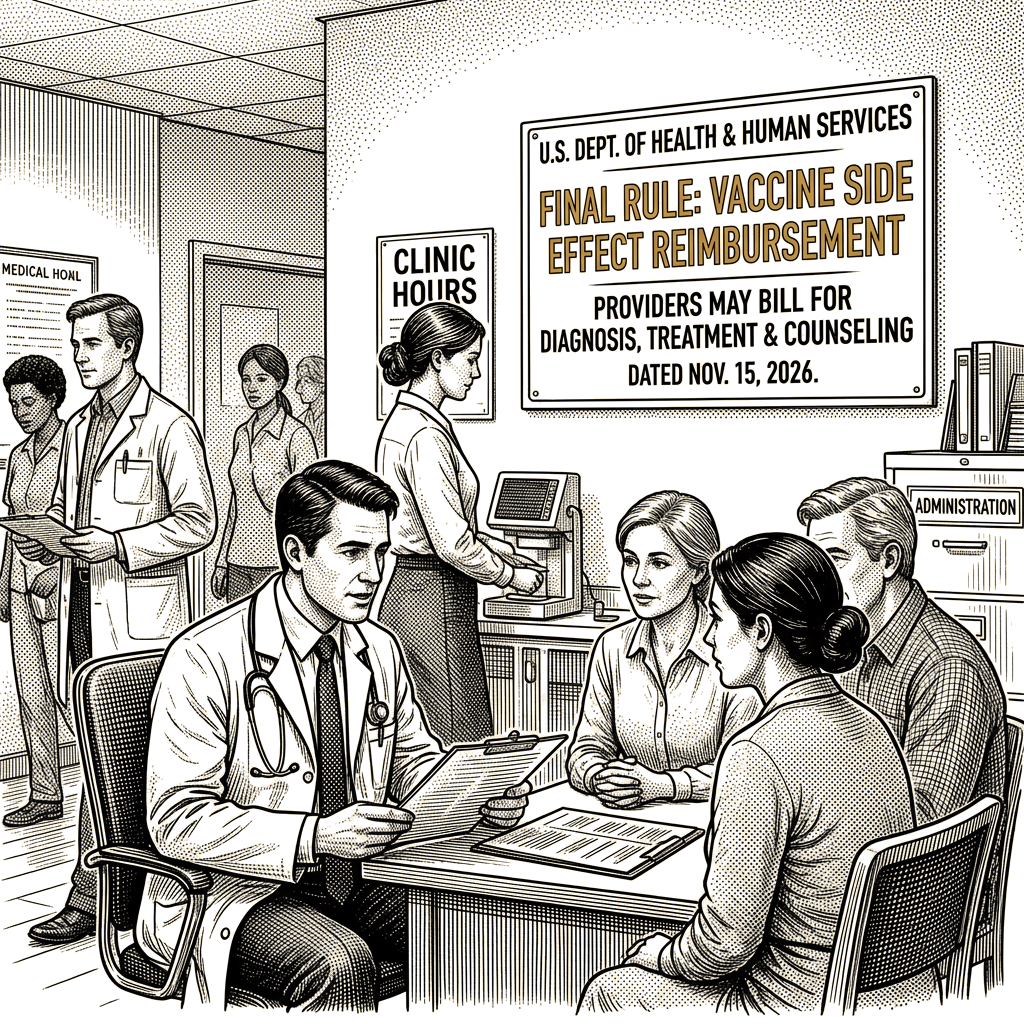
The Trump administration is finalizing a rule to reimburse doctors who diagnose, treat and counsel patients with side effects from vaccines, The Guardian reported on November 15, 2026. The newspaper quoted experts who believe the change is an attempt to undermine trust in vaccines and to create an evidence base on their purported risks.
Kennedy’s NIH research center and planned changes to the vaccine injury program
Robert F Kennedy Jr, the secretary of the US Department of Health and Human Services (HHS), has also announced the creation of a vaccine “injury” research center at the National Institutes of Health and has sought to reshape the Vaccine Injury Compensation Program (VICP), The Guardian reported. The newspaper said those actions point to Kennedy’s longtime activism against vaccination as well as the profits he and his network have made from vaccine lawsuits.
The Guardian also reported that Kennedy and his allies have profited from what it described as growing misinformation peddled through books, paid speaking events and the supplement industry.
Kennedy’s financial disclosures and outside income
Kennedy disclosed $2.5m in income from referrals for vaccine-related lawsuits before his confirmation hearing in January 2025, and at the hearing he would not commit to forgoing compensation from vaccine lawsuits after he leaves office, The Guardian reported. Elizabeth Warren, a Democrat from Massachusetts, listed several ways in which Kennedy’s actions, some of which have now happened, could influence future litigation.
“Kennedy can kill off access to vaccines and make millions of dollars while he does it,” Warren said at the hearing. “Kids might die. But Robert Kennedy can keep cashing in.” Warren pointed to Kennedy’s involvement in litigation against Merck for its HPV vaccine — lawsuits that were settled for more than $50m in June 2026. After the confirmation hearing, Kennedy said his son would receive the money, expected to be 10% of the total; it’s unclear if he did.
“For most of us, money going to our children isn’t exactly money not going to us,” said Dorit Reiss, a professor of law at UC Law San Francisco. “There’s a dozen ways he and his family could benefit” from Kennedy’s actions, she added.
The Guardian reported that Kennedy has long profited from what it describes as anti-vaccine misinformation. Tony Lyons, Kennedy’s publisher and a central figure in the constellation of Maha political organizations, reportedly paid Kennedy $4m in book advances over the past year. The publisher also paid Kennedy $451,000 in consulting fees before he became HHS secretary. That’s on top of other book sales and paid speaking engagements over the years. Kennedy also earned $326,000 for the 15 weeks he served as chairman of Children’s Health Defense in 2023 — more than half of his $510,000 salary in 2022.
More recently, Kennedy received free flights and trips on a yacht from a former donor to his presidential campaign, who is now under investigation by the Senate for the gifts totaling some $250,000, the newspaper reported. As HHS secretary, Kennedy has also loosened regulations on peptides, a booming part of the largely unregulated wellness industry.
The litigation pathway via Aaron Siri
Aaron Siri, Kennedy’s former lawyer who represents people who say they have experienced severe side effects, has advocated for changing all vaccines to “shared clinical decision-making”. If those changes took place, Siri could argue that the vaccines are not covered under the VICP and therefore open to litigation.
“A lot of what he is doing is geared toward setting up a more profitable litigation atmosphere,” Reiss said.
Siri did not respond to The Guardian’s question about profiting from litigation, but instead argued that “if vaccines are as ‘safe’ as touted by the government, then there should be no need for immunity to liability and, likewise, there should be very few, if any, successful cases”.
Expert criticism and the HHS response
“I do think he’s a real ideologue – he really believes in this,” Reiss said of Kennedy. But Kennedy and his allies are likely “very happy to make money doing it”, she said.
Peter Hotez, professor and dean of Baylor College of Medicine’s National School of Tropical Medicine, agreed, saying Kennedy’s actions are likely a combination of “being an ideological zealot and making money either for himself or for his associates”.
Emily Hilliard, an HHS spokesperson, said the department “categorically reject claims that Secretary Kennedy is pursuing personal gain or seeking to dismantle American medicine”.
Hotez said Kennedy is doing what everyone knew he was going to do. Kennedy, before and during his tenure as leader of HHS, has been “chipping away at public confidence in vaccines and immunizations in favor of products that can be sold by the wellness industry”, Hotez said.
Years ago, Hotez engaged Kennedy in a series of conversations about misinformation that autism spectrum disorder is related to vaccines. Hotez pointed to known environmental influences on autism, like the anti-seizure medication valproic acid. Kennedy “had no interest then; he has no interest now”, Hotez said. “Even back then, there was a heavy emphasis on being a plaintiff attorney and suing vaccine companies. So that’s his narrow interest, which has nothing to do with reality – and he’s still going by the same playbook.”
Kennedy has attacked medical journals and schools, and funding for medical research has fallen sharply under his leadership. Such actions appear intended to “completely wipe out American medicine as we know it in favor of this whole system of grifting and pseudoscience”, Hotez said.
How the vaccine injury program and VAERS work
The most common claim to the VICP — making up more than half — has to do with where the vaccine is administered, not the vaccines themselves.
The VICP was established in 1986 in order to expedite compensation for anyone who experienced adverse side effects from vaccines. There are real costs to undermining the program, Reiss said. It’s very rare for people to develop severe side effects after vaccination, but when they do, they should be compensated, she said. But if false claims about vaccine harms proliferate, they will obscure those with legitimate claims, Reiss added.
Filing a VICP claim is an easier process than winning a lawsuit, which takes time and effort and also demands a higher burden of proof.
“That’s why the whole vaccine injury system was set up,” Hotez said. “It was actually to the plaintiff’s benefit to get a faster judgment without having to show detailed evidence of proof.”
Without the VICP, patients would need to pay lawyers a large chunk of their settlements, if their case moves through the courts at all, Reiss said: “The lack of contingency fee means they don’t have to pay 30% to 50% of their earnings through the lawyer.”
Compensating doctors for reporting side effects to the Vaccine Adverse Event Reporting System (VAERS) risks offering “the wrong incentives” to unscrupulous providers who could increase such activities to become a new revenue source, Reiss said.
The changes could “certainly” be used by organizations such as Children’s Health Defense to legitimize its work spreading misinformation “and convince donors and others that they should give them more money”, she added.
VAERS, alongside several other vaccine monitoring systems, works well to pick up signals of very rare side effects, such as myocarditis from initial mRNA Covid vaccines and thrombotic thrombocytopenia in the Johnson and Johnson Covid vaccine, Hotez noted. But it’s not built to prove links between vaccines and certain side effects, as vaccination opponents have attempted to do, he said.
“The VAERS system was never meant to show cause and effect,” Hotez said. “It’s like looking for signs of alien communication in outer space. You look at every little blip, and almost all of them have nothing, are not real. But you have to analyze them.”