Rare-earth shipment concerns and GOP losses complicate Trump-Xi talks
President Trump set out the decision he faced as two camps within his administration as his four-day trip to the Philippines and the Chinese tech hub of Shenzhen began. “One wants to be friendly with China, and one wants to have a blowup with China,” he said as he departed the White House. He cautioned, “I don’t think you want to insult China just before you get there.”
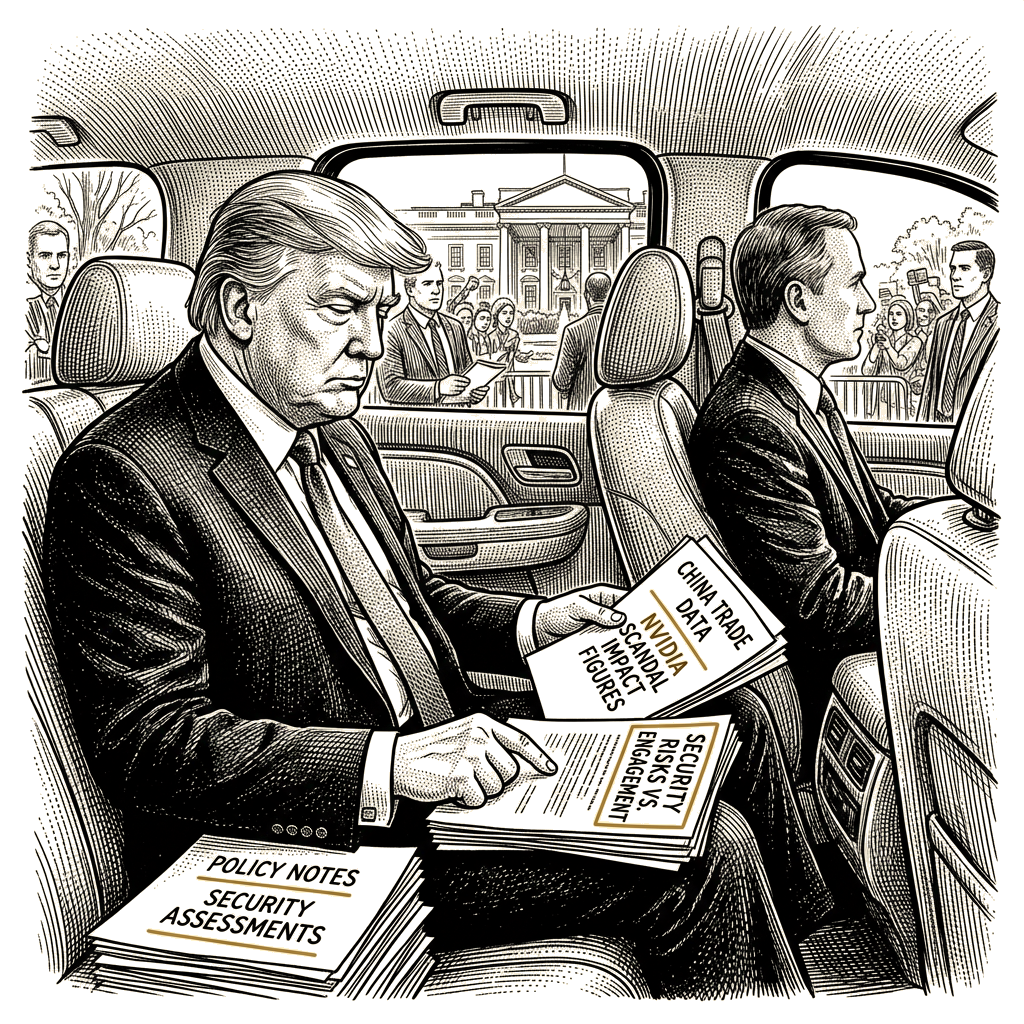
Trump boarded Air Force One on Monday for his four-day trip to the Philippines and Shenzhen with top advisers who had spent the past week clashing over China policy and blaming one another for the political fallout from the Nvidia scandal. According to officials involved in the discussions, the divide was over whether the administration’s economic agreements and friendly relations with Beijing were worth the national-security vulnerabilities that some senior U.S. officials believed they could create for decades. Cabinet officials had spent months clashing behind the scenes, including over how tightly to control access to Nvidia’s chips.
Treasury Secretary Scott Bessent in recent days accused Commerce Secretary Howard Lutnick of failing to act against Megaspeed, a Singapore-based company suspected of diverting Nvidia’s advanced chips to China despite months of warnings from national-security officials. The Wall Street Journal reported that Megaspeed was among a growing number of companies across Southeast Asia that had provided Chinese technology firms with access to advanced American chips and computing power through gaps in U.S. export controls.
Trump appeared to defend Lutnick on Monday, suggesting that delaying restrictions may have helped avoid a confrontation with China. “I understand both sides of it, and I’ll make a decision,” he said. Bessent, Lutnick and Secretary of State Marco Rubio were also joining Trump on the four-day trip. The Nvidia revelations strengthened arguments by officials, including Rubio, who favored a tougher China policy before the trip.
The White House sought to minimize any effect the turmoil could have on Trump’s meeting with Xi, his fourth in just over a year. A senior U.S. official said Trump was not expected to bring up Alice Huang, a former Megaspeed executive who had an affair with former Nvidia CEO Jensen Huang and was suspected by the U.S. of having ties to Chinese intelligence.
The Wall Street Journal reported little indication that Trump’s trip to China would deliver the tougher approach some administration officials had advocated. Trump was focused on securing another economic agreement with Xi before the expiration of a trade truce in January. He had also been pushing for an unprecedented three-way summit with Xi and Russian President Vladimir Putin to discuss nuclear arms reduction and the Iran war.
A U.S. official said Trump had kept a ban on exports of Nvidia’s most advanced chip and that his decisions were based on U.S. interests, not domestic politics. Commerce announced a long-awaited rule on Monday restricting exports of high-end chips to several countries, a measure intended to crack down on companies such as Megaspeed.
The administration’s fight over China’s access to American technology predated the recent scandal. Last year, Trump announced he would allow sales of Nvidia’s powerful H200 chips to China with the U.S. receiving a 25% cut. A senior administration official familiar with the deliberations said senior officials disagreed about the national-security safeguards that should accompany the sales. China eventually declined to import the chips in large volumes, instead opting to spur its domestic semiconductor companies and remotely access computing power in other countries.
Similar debates during Trump’s second term repeatedly showed differences between his economic agenda and the positions advocated by some top officials. After meeting with Xi in May, Trump described a pending $14 billion U.S. arms package for Taiwan as a “very good negotiating chip” with China. Rubio subsequently told lawmakers in June: “They raise it, but they are not negotiated and they’re not consulted.” The package has remained in limbo as Xi has pressed Trump to take a harder line. During their September meeting in Washington, Xi urged Trump to adopt the “correct position of opposing Taiwan independence,” according to the Chinese readout.
Some on Trump’s team had been alarmed by reports earlier this year that Chinese firms had supplied satellite imagery that was helping Iran target its strikes. Trump disputed the concern, telling reporters: “They basically do what we do.” He added: “I think [Xi] has behaved reasonably well.” Trump’s current approach came after his first term and the opening months of his second term, when he announced tariffs.
The Wall Street Journal reported that China’s control over critical minerals gave Beijing considerable leverage in the trade negotiations. A senior U.S. official said shipments of rare earths and derivative products continued arriving more slowly than U.S. officials wanted, an issue Trump was expected to raise with Xi. The stakes were high for American manufacturers. A senior Trump administration official warned that every car plant in the U.S. would shut down within two or three months without additional Chinese rare-earth magnets.
The GOP’s midterm election losses raised concerns about whether Xi could capitalize on a politically weakened U.S. president eager for a diplomatic victory. Han Shen Lin, China managing director at the Asia Group, said: “The Republican setback tempers Trump’s negotiating leverage and constrains his room for maneuver.”
As Trump departed for Asia on Monday morning, he addressed concerns that his relationship with Jensen Huang had put U.S. security at risk. “It was not put at risk,” he said. “China plays games with us, and we play games with China,” he added, describing such activities as part of the rivalry between the two countries.