Federal court denied CAIR-Florida’s request to operate during the lawsuit
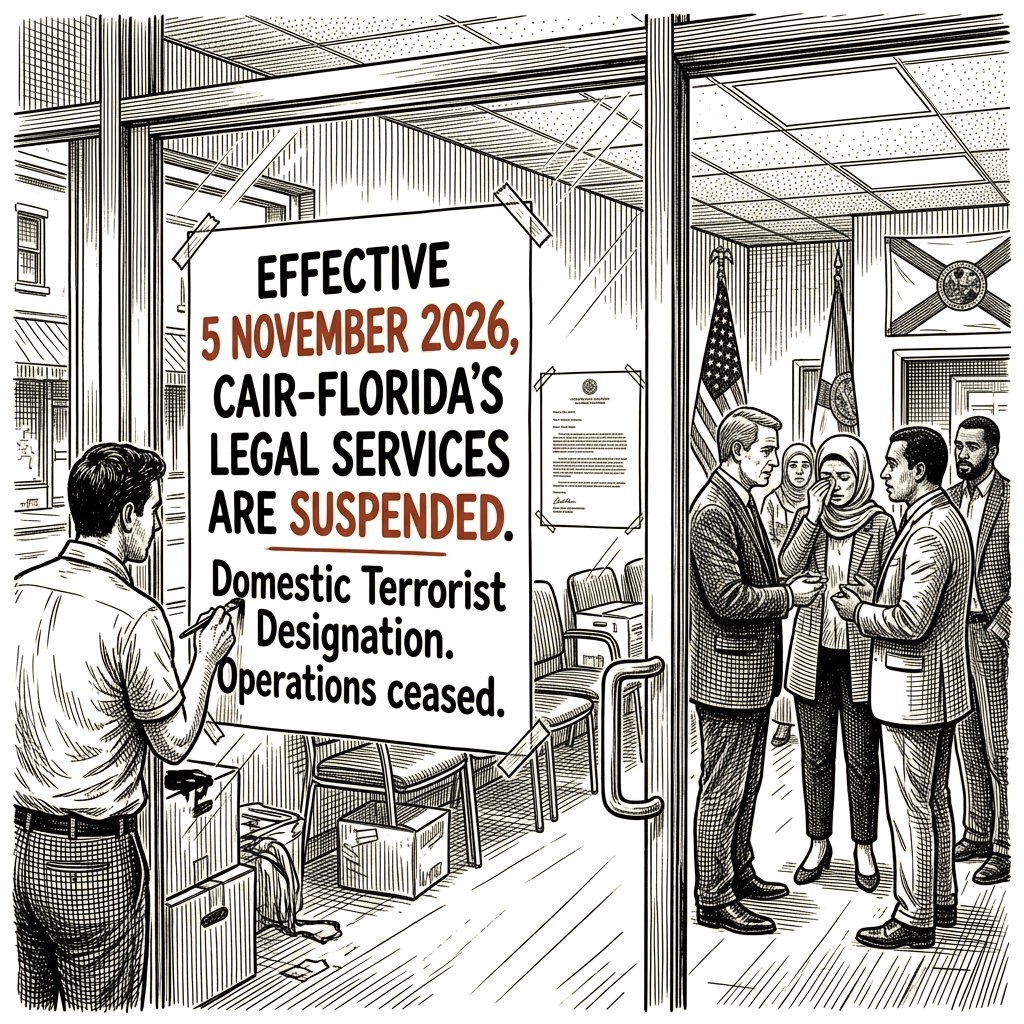
Florida’s designation of the Council on American-Islamic Relations and its Florida chapter as domestic terrorist organizations took effect on 5 November 2026, and CAIR-Florida has stopped operating. CAIR-Florida’s website now shows a pitch-black homepage with a note stating that staff have suspended operations because of the “baseless and unconstitutional enforcement” of Florida’s law. The law behind the designation dates to July, when Gov. Ron DeSantis approved legislation giving five state officials the power to designate groups as “domestic terrorist” organizations. Once a designation takes effect, it can trigger debilitating penalties for the group and its supporters under state law. CAIR said the threat of those punishments effectively forces designated groups to shut down.
CAIR and CAIR-Florida sued DeSantis and other state officials in federal court with the help of the American Civil Liberties Union, alleging violations of free speech and due process. Earlier this month, a federal court rejected CAIR-Florida’s request to operate while the litigation continues, and the organization has appealed to the US court of appeals.
Edward Ahmed Mitchell, national deputy director at CAIR, described the effect on Florida’s Muslims in a press release. “For the first time in over twenty years, Florida Muslims cannot call their community’s leading civil rights organization for help if they experience a hate crime at their mosque, illegal discrimination in the workplace, violent bullying in school, or any other acts of bigotry,” Mitchell said.
CAIR is the nation’s largest Muslim civil rights group, and CAIR and its Florida chapter are the main civil rights organization for Muslims in the state, working on immigration, discrimination and free speech cases, know-your-rights workshops, voter mobilization and Islamophobia research. CAIR-Florida, which employed about 12 staff members and eight contractors, has fought for prisoners’ access to halal meals and for pro-Palestinian students’ right to protest. CAIR-Florida’s staff included interim executive director Hiba Rahim and civil rights managing attorney Omar Saleh. CAIR’s national division took Muslim Americans’ grievances about federal “no-fly lists” to the Supreme Court, and won.
State officials have argued in legal filings, without clear evidence, that CAIR and its Florida chapter have been operating as a front for Hamas and the Muslim Brotherhood “all while masquerading as run-of-the-mill civil rights organizations.” CAIR denies the claims, has never been charged or convicted of any crime, and says Florida is using the new law to “punish their perceived political enemies” and to target the organization for its religious missions and advocacy. The group has also been outspoken against extremist violence by organizations like the Islamic State.
CAIR was not the only target. Florida also applied the designation to the Muslim Brotherhood and to “antifa,” a vague umbrella term for far-left-leaning and anarchist anti-fascist groups and individuals. That move tracks the Trump administration’s labeling of “antifa” and certain branches of “the Muslim Brotherhood” as terrorist groups, alongside its targeting of leftist and pro-Palestinian activists. Civil rights advocates fear CAIR’s targeting is only the beginning of Florida using its new power to cripple lawful advocacy, especially the pro-Palestinian movement.
Shirin Sinnar, a law professor at Stanford University who co-authored an amicus brief for CAIR in a related case, said the state’s approach is aimed at the least defensible target. “It’s entirely unprecedented for state governments to attempt to shut down organizations by branding them as terror organizations,” Sinnar said. “This sends a message to the Muslim American community, as a whole, that this organization, which has defended your civil rights, is no longer able to do that.” Florida’s focus on CAIR reflects an attempt to go after one of the most marginalized groups first, Sinnar said: “The whole point is to establish a precedent with the most disfavored of organizations – the one that few people in the state will rally to defend.” She added that the power could then be weaponized against other groups.
The shutdown has already changed what help is available in Florida. CAIR-Florida can no longer provide pro bono legal services for discrimination and immigration cases, leaving local attorneys scrambling to pick up the pieces. Jalal Shehadeh, a Palestinian American lawyer who serves on the boards of many legal organizations, including the Florida Muslim Bar Association, said “the void left behind by Cair-Florida’s absence is far too large to be filled by the good-hearted local attorneys that are trying to help the community” and “We can only do so much.” Shehadeh, who frequently fights cases related to the pro-Palestine movement, is anticipating a higher caseload because of CAIR-Florida’s suspension. He pointed out that CAIR lawyers who were focused on civil rights cases cannot be replaced with private attorneys, who may lack the time and may not be able to front the legal costs that CAIR does: “Most often the people that need help are the ones without resources. These individuals don’t have the ability to fork up $10,000 to hire a good attorney.”
The designation arrived after CAIR had already restricted its Florida activity. Before it took effect, CAIR and its Florida chapter had paused donor outreach, cancelled active recurring donations and suspended plans for three annual “life-sustaining” fundraising galas. A Florida-based IT company that CAIR was relying on to relaunch a website tracking Islamophobia terminated its relationship with the group, and CAIR-Florida’s lawyers had already been turning away new prospective clients. In a normal year, CAIR-Florida would have scheduled meetings with elected officials right after the midterms, but that did not happen this year.
Muslims across the state say the designation has had a chilling effect. “The mosques now are scared of their own shadow,” said Abdullah Sheikh, a community activist who tried to rally opposition to the state’s domestic terrorism program before the legislation reached the governor’s desk. Sheikh has spoken with board members at more than a dozen mosques across central Florida, many of whom are now wary of programming, outside of prayers, that could be perceived as political. Some mosque leadership has told Sheikh they do not believe Florida will designate them as terrorist organizations, though they are wary that growing anti-Muslim hysteria means the government will “look for any excuse” to take away their non-profit status.
The designation comes amid rising Islamophobia in the US and what The Guardian describes as a growing crackdown on pro-Palestinian activism, felt most sharply by students facing discipline and immigrants threatened with deportation. Islamophobic attacks also colored Michigan Democrat Abdul El-Sayed’s run for Senate, with Trump referring to him as a “jihadi” and his Republican opponent falsely linking him with the Muslim Brotherhood. El-Sayed’s victory, after he leaned into his Muslim identity and pro-Palestinian values, reflected that Muslims are building electoral power, regardless. In January, El-Sayed will become the first Muslim US senator, joining a record-breaking seven newly elected Muslims in Congress.
Texas flipped blue on election night, and Gov. Greg Abbott and Attorney General Ken Paxton both lost their seats to Democrats. Abbott issued a proclamation last year declaring CAIR a terrorist organization, and Paxton sued CAIR in an attempt to shut down the organization. Incoming Gov. Gina Hinojosa said she will reverse Abbott’s designation in an interview with the Washington Post last week, and Paxton recently dropped his lawsuit. The Muslim Legal Fund of America, which is representing CAIR in its Texas lawsuit against Abbott’s designation, said that “it’s pretty clear this case is probably not going to go much further.”
In Florida, it may be too late for an electoral solution, said the typically optimistic community activist Abdullah Sheikh. A repeal would need to win over both chambers and the governor, all of which Republicans control, and he worries that “The legislature has zero incentive to do anything at this point.” Florida, he said, serves as a “cautionary tale for other states” for lawmakers weighing similar measures. Civil rights advocates argue that electing progressive and Muslim lawmakers at the state level can help push back against Republican-led legislatures and governors enforcing terrorism laws.
Omar Soboh, a Palestinian American student at the University of Florida, felt hopeful about Muslims breaking ground in the midterms and believes the courts will ultimately rule in CAIR’s favor. But he is worried about the void left by CAIR’s absence and about his own career path. Soboh was organizing a campus panel about Islamophobia when he learned that one of the groups being represented had been blacklisted by the state; the Arab Students’ Association canceled the event, leaving him disheartened. “Our existence itself is political,” he said. Soboh interned at CAIR-Florida this summer, and he wants to attend law school and work at a civil rights non-profit. “I just want to protect my community and people,” he said. It remains important for him to “fight for what he believes in,” but he is more cautious since the designation took effect: “It’s made me associate doing work for the Muslim community as being something that is controversial.”
Salma Khan, a Muslim American who grew up in Fort Lauderdale, reached out to CAIR-Florida three years ago after a video of a man verbally harassing her went viral. She said the group was the obvious choice and that she was familiar with its presence at mosques and schools; the group helped students request Eid off, encouraged fundraising during Ramadan, provided her with attorneys after the harassment and supplied advocacy staff who raised awareness of her case online. Learning that Florida had designated CAIR a domestic terrorist organization made her wonder what will happen to Muslims who rely on the organization as they speak out against the government. “Who else is going to be labeled that?” she said. “What will happen to our community?”