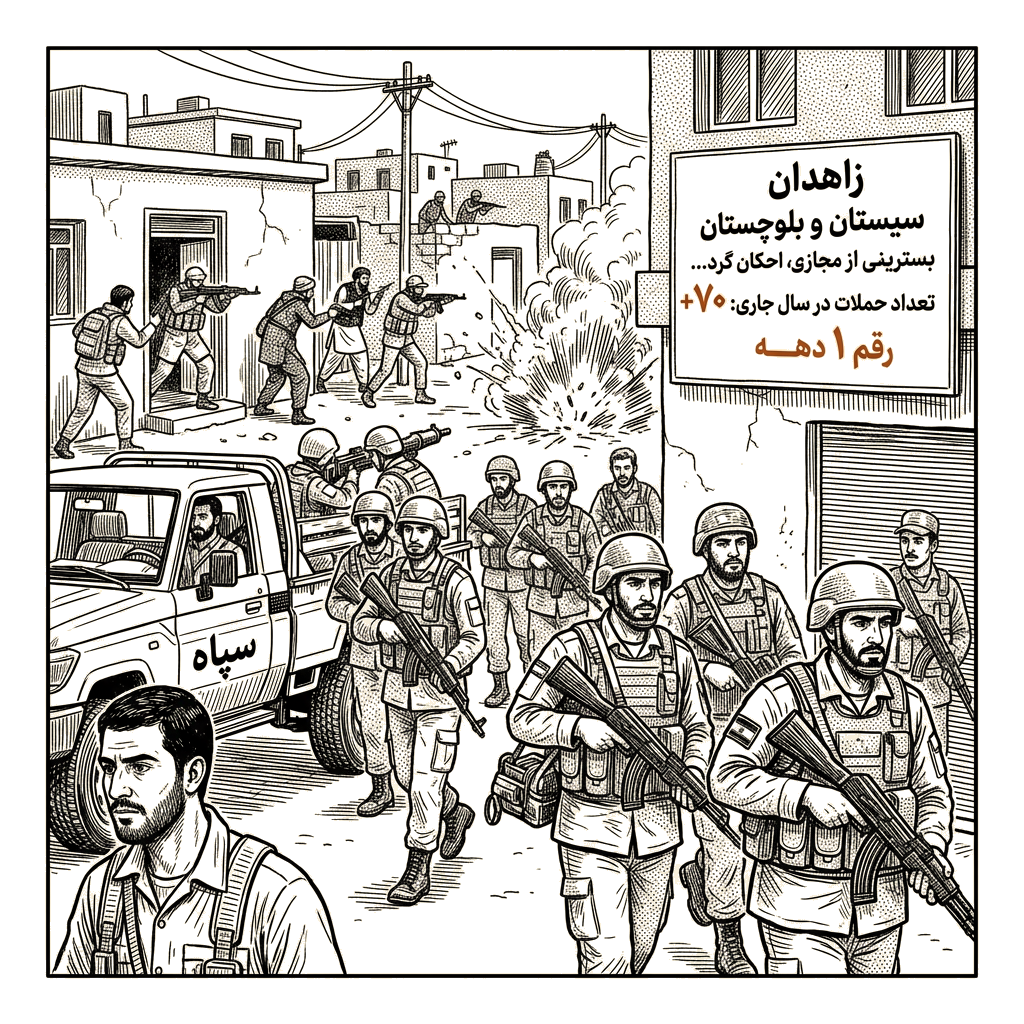
Iran’s southeast attack total exceeds 70, highest in at least a decade
Militants armed with rocket-propelled grenades and heavy machine guns have ambushed security patrols and attacked intelligence and police buildings in a province along Iran’s southeastern border with Pakistan. Armed Conflict Location and Event Data found that militant groups in the region carried out more than 70 attacks this year, the highest annual number in at least a decade.
Attacks have also occurred in Iran’s northwest, where Kurdish militants are suspected in the killings of senior members of the Basij, the Iranian government’s volunteer militia, and a cleric affiliated with the group. On Tuesday, the Revolutionary Guard buried one of its officers who had been killed in Sardasht, a Kurdish town near the Iraqi border, by what it called an “anti-revolutionary group,” according to the Iranian Defense Ministry’s Defa Press agency. The armed branch of the Kurdistan Free Life Party, an antiregime Iranian Kurdish group, said the attack was revenge for the killing of one of its fighters.
Molavi Yousef Gargij, a Sunni Muslim cleric who supported the government, was shot outside his home in September. Ahmad Vahidi, the commander in chief of the Revolutionary Guard, vowed to avenge Gargij’s death and blamed “Zionist-American” separatist groups. In October, a roadside bomb killed a female police deputy near Zahedan, the provincial capital, and a few days later gunmen shot dead a commander in the women’s branch of the Basij outside her home.
Some recent attacks occurred in Chabahar, Iran’s biggest port outside the Persian Gulf, and others just outside Konarak, a key Iranian naval base. Jaish al-Adl, a militia group formed in 2012 to fight for an independent Baloch state, has recently combined with smaller factions in the region bordering Pakistan and Afghanistan to create the People’s Fighters Front. The group has claimed nearly all attacks on security forces this year, including a Nov. 3 drive-by shooting that killed a Basij commander.
“When you, as military forces, resort to terrorizing and suppressing ordinary citizens, or when you attack our revolutionaries…we have no choice but to punish you,” the People’s Fighters Front said about the attack.
The Islamic Revolutionary Guard Corps has responded by deploying large numbers of forces and weapons to several areas of Iran’s Kurdish region, the Kurdistan Human Rights Network said. The force has also launched drone attacks on Iranian Kurdish rebels based across the border in Iraq.
The Wall Street Journal characterized the violence as localized and far from posing an existential threat to Iran’s leaders. The violence is adding pressure, however, on a government already strained by war, America’s blockade of its economy and a battle with the U.S. for control of the Strait of Hormuz. “Ethnic insurgencies are increasingly a thorn in the side of the regime and chipping away at the Islamic Republic’s ability to project power or order,” said Behnam Ben Taleblu, a senior fellow at the Foundation for Defense of Democracies, a Washington think tank.
Since the Islamic Republic’s founding in 1979, Iran has faced insurgencies from Kurds in the northwest, Arabs in southwestern oil fields and Baloch in the southeast. The attacks have targeted local units of Iran’s military in a secessionist push. This year, the attacks have grown more frequent and appear to be focusing more on the Basij, local clerics and other supporters of the government.
Ethnic tension in Kurdish areas remains inflamed by the killing of protesters by Iranian security forces in January. New groups with names such as the Patriotic Youth of Kurdistan and the Kurdistan Martyrs’ Revenge Teams have emerged in Kurdish areas. Statements from those groups show that their priority is not so much to solve ethnic grievances as to avenge those killed in the protests and bring down Iran’s government. “There is a shift in messaging,” said Kasra Aarabi, the director of research on Iran’s Revolutionary Guard at United Against Nuclear Iran, a think tank that advocates for tighter sanctions on Iran. “In recent communications, they said they no longer have separatist ambitions and want to work with the Iranian people.”
The broader conflict remains unresolved, with Tehran continuing to attack ships in the Strait and taking a hard line in negotiations. The Wall Street Journal said President Trump was pursuing a policy of economic strangulation and weighing further strikes. The same report said the war with Iran began in late February and the U.S. and Israeli plan at its outset involved fomenting a rebellion among the country’s ethnic militias; the revolt never came. Israeli and U.S. officials said earlier this year they had supported ethnic rebels in Iran in hopes of overthrowing the government. Trump said in April the U.S. had tried to send weapons to protesters inside Iran through Kurdish intermediaries, but Iranian Kurdish leaders denied any arms transfer of the kind he described.
Iran has long accused foreign powers of backing insurgent groups inside its borders. Last month, Foreign Ministry spokesman Esmail Baghaei said militants in Sistan and Baluchestan acted on “plans devised by Israel and the United States to destabilize the country’s borders.”
In October, Iran’s Intelligence Ministry announced that it had disrupted three insurgent cells in Zahedan and other cities in Sistan and Baluchestan province. The ministry claimed the fighters had undergone military, bomb-making and assassination training outside Iran, delivered by U.S. and Israeli operatives. The Iranian and Israeli governments did not reply to requests for comment.
An unnamed U.S. official said it was understandable that the Iranian government would fear its own people after the mass killing of protesters by Iran’s security forces in January.