Zengerle describes Jeffries as deliberate, disciplined and hard to pigeonhole
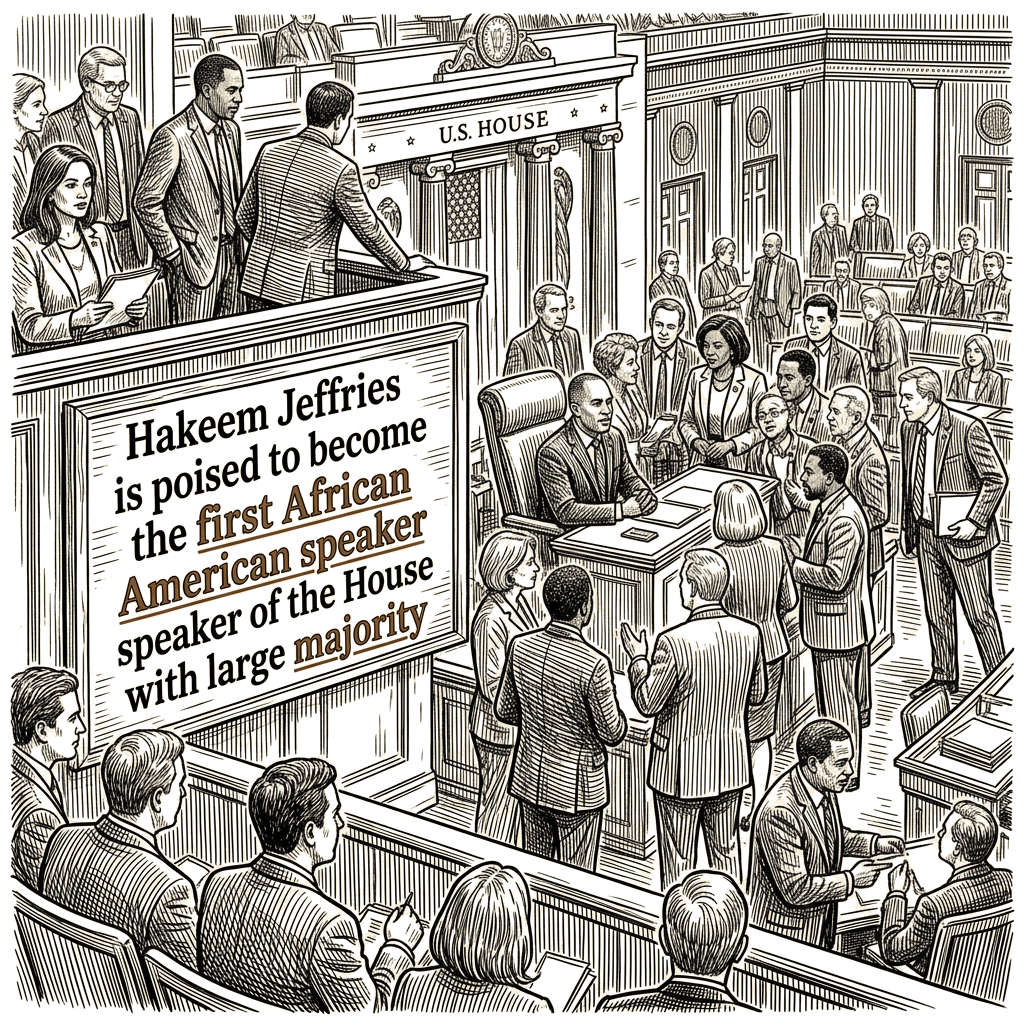
House Democrats nominated Hakeem Jeffries for speaker on Wednesday, all but guaranteeing his election when the new Congress takes power in January. The New York Democrat is poised to become the first African American speaker of the House of Representatives.
Jeffries said voters had sent a clear message on Election Day. “We hear you. We see you. We feel you. And House Democrats are committed to making life better for you,” Jeffries said, in an archived recording of his remarks.
Jason Zengerle, who covers politics for The New Yorker and has profiled Jeffries, joined NPR’s Scott Simon from Chapel Hill, North Carolina, to describe how the incoming speaker is likely to lead.
Zengerle’s assessment of Jeffries’ temperament was unhesitating. “He is a very careful, deliberate, strategic politician,” Zengerle said. “He is the opposite of impulsive. He has extreme message discipline.” Zengerle added that Jeffries has been careful to avoid getting ideologically pigeonholed.
Before politics, Jeffries worked as what Zengerle called “a white-shoe lawyer” at Paul, Weiss, then went in-house at CBS. He would have had a very successful career there, Zengerle said, but he was insistent that he wanted to run for office. Jeffries was drawn to local New York City politics after growing up in Brooklyn.
Faith remains central to Jeffries, Zengerle said. His mother was a Sunday school teacher at Cornerstone Baptist, which Zengerle described as one of the more prominent Black Baptist churches in Brooklyn, in Bedford-Stuyvesant. Jeffries was an usher at the church from a young age and became used to speaking to large crowds. Zengerle said Jeffries tries to go to about a hundred church services a year, and that a morning spent touring Brooklyn services with him was the most enjoyable time the two spent together for the profile — Jeffries was more relaxed and more in his element there than during time with Zengerle in Washington.
On leadership, Zengerle said Jeffries once told him that the most important words he could say to any member of Congress on any issue were, “what do you think?” Jeffries views the job as listening first and then formulating strategy, Zengerle said. But some people in the Democratic caucus feel he needs to be tougher and tell members how to vote, and they want him to give more guidance. Zengerle said there is a feeling that Jeffries often holds back that guidance because he does not want to make members mad at him.
Simon asked whether guidance still works in an era of so many competing forces. Zengerle called it a good question and said part of Jeffries’ strategy is a belief that members who feel listened to are more likely to come around to his way of thinking.
Even with a very large majority, Jeffries will face a president likely to veto most of what Democrats send him. Zengerle said that for the next couple of years the job for Jeffries and Democrats on Capitol Hill will be “to pass a series of messaging bills.” They do not expect Trump to agree with them on lowering the age for Medicare or raising the minimum wage, but they want the legislation passed so that whoever the Democratic presidential nominee is in 2028 can campaign on it: “look at what Congress passed. Look at what Donald Trump vetoed. If you put a Democrat in the White House, all of these things will become law.”
Zengerle said oversight of the administration is one area where Democrats can accomplish a good deal, and predicted Jeffries will be aggressive there. He said Jeffries has been coordinating with Jamie Raskin of the Judiciary Committee and Robert Garcia at House Oversight long before the midterms, discussing who the targets of investigations will be. Democrats were likewise aggressive with investigations in 2019, the last time they took back the House while Trump was president, Zengerle said.
Israel is the issue where Jeffries is most strongly identified. Zengerle said Jeffries has been a strong supporter of Israel throughout his career, and that when he came to Washington his position was very much within the mainstream of the Democratic Party. Support for Israel has declined within the party since then, and Jeffries has moved a little in the direction of critics of Israel without going as far as a lot of people in the party. “I think that’s going to be a real flashpoint,” Zengerle said.
The biggest challenge, in Zengerle’s account, is “just keeping his caucus together.” Holding a caucus together is easier in the minority, and especially easy when Trump is president, because everyone can rally around him. Now that Democrats are actually going to be able to pass legislation, Zengerle said, Jeffries will face more intraparty conflict over Israel, healthcare and other issues, and will have to try to manage those tensions.
MSI reported on Nov. 17 that House Democrats were preparing a closed-door leadership vote for Jeffries, Clark and Aguilar, with Jeffries running unopposed and describing himself as personally contacting every member of the caucus. That vote has now been taken, and the speaker nomination is his.