Study in Molecular Ecology Resources reports first genome from a blow sample
Every time a whale surfaces to breathe, it blasts a plume of mist into the air — the spout that scientists call the blow. “And that blow is essentially snot,” said Éadin O’Mahony, a marine mammal ecologist who has studied a great deal of it.
O’Mahony described the substance in familiar terms. “It is like your snot and your kids’ snot and my snot,” she said: a “clear-colored gooeyness” packed with information. “You’ve got things like the bacteria, the viruses, the pathogens,” she said, along with chemicals, cells and fragments of DNA.
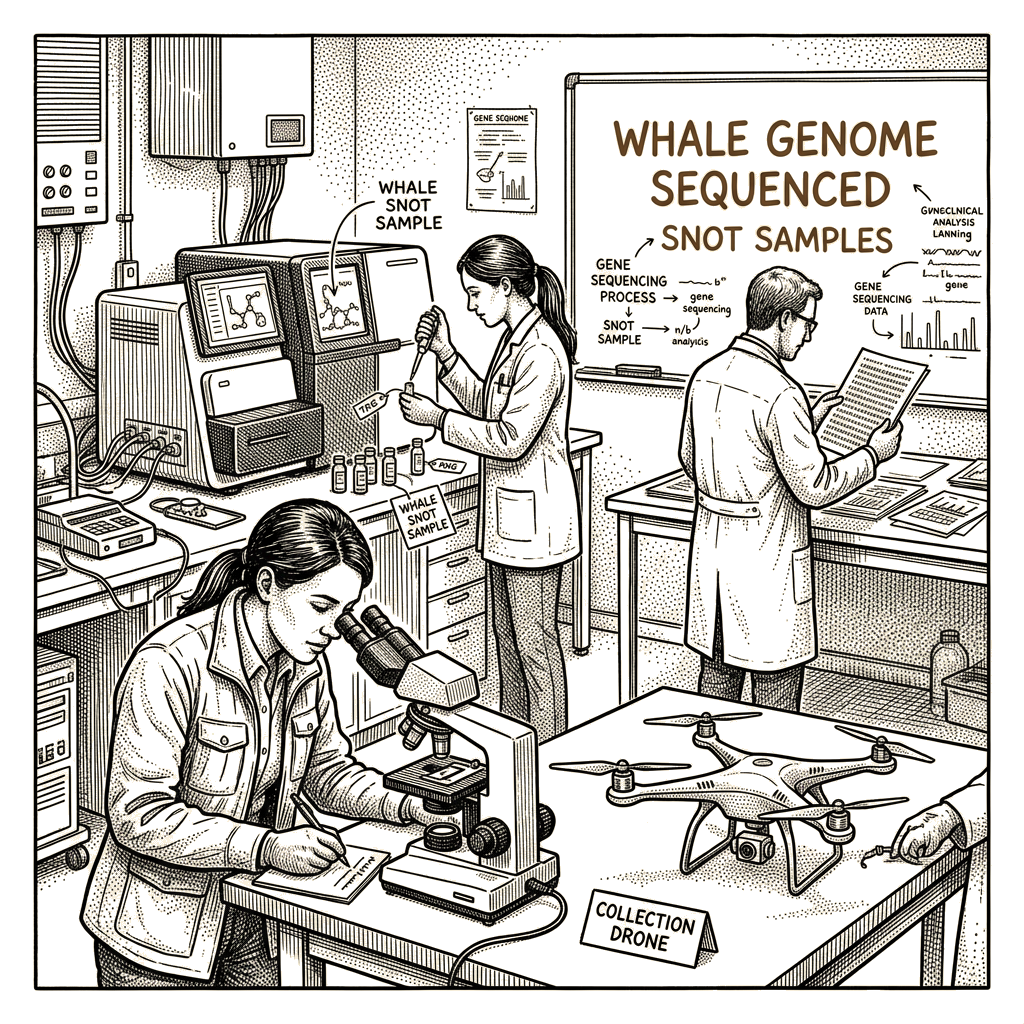
The sampling method relies on sharp flying and small commercial drones. “The drones have got sterile petri dishes attached to them, literally Velcroed on,” O’Mahony said. As a whale comes up and breathes out, the operator’s task is to “swoop through one whale and one whale only’s breath, so we’re just collecting a representative snot sample from one individual,” she said.
Analysis of such a sample can shed light on the health of that individual whale and of the wider population. The collection technique itself is not new. What O’Mahony and her colleagues accomplished with it is. By collecting multiple samples from individual whales, the team was able to sequence “millions and millions of genetic markers of that one whale and giving us the whole genome of the whale from a blow sample,” she said.
It is the first time a whole whale genome has been sequenced this way. The findings were detailed in a study published in Molecular Ecology Resources.
Amy Apprill, a scientist at the Woods Hole Oceanographic Institution, was not involved in the study, but she also collects blow samples, mostly to study bacteria. “Yes. I am very intimately familiar with whale snot,” she said.
Apprill said it was exciting to see scientists use the method to get such a close look at an animal — to examine its genetic health without having to be invasive. “The prior method was basically dart biopsies of animals, and they did a little bit of that in this study to ground truth it, but that is highly invasive,” she said.
The earlier approach involved a crossbow to remove a tiny piece of skin and blubber, which can distress whales already grappling with a lot of stressors, according to the reporting. “So this just opens the door,” Apprill said — showing how much information can be gathered from these animals in a safer, albeit snottier, way.