Nine former detainees describe Pakino abuses; a top official denies working there
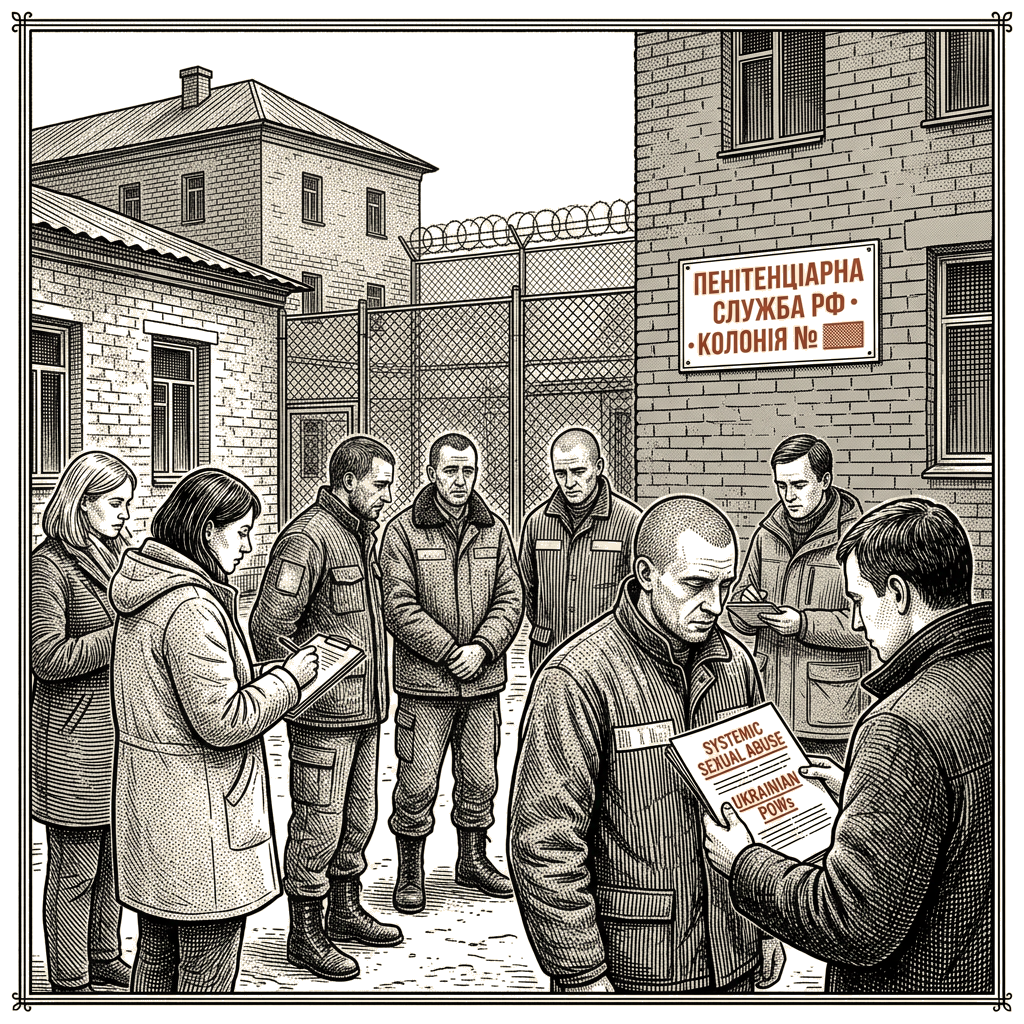
Oleksiy Zharkenov said he and other prisoners of war were stripped naked soon after arriving at Penal Colony No. 7 and told by a guard: “You’re our Ukrainian bitches now.” The men, who Zharkenov said were forced to touch each other’s genitals, had arrived at Pakino, a village around 150 miles east of Moscow whose prison has become synonymous among Ukrainian POWs with sexual abuse.
The colony was built 27 years ago and today houses some 1,000 Russian convicts, with a library, sports facilities and a chapel dedicated to St. Nicholas. The roughly 300 Ukrainians held there separately saw none of that, according to the Journal’s account.
Zharkenov, a senior police officer captured in the early days of the invasion, passed through seven different prisons before his release after 30 months. He said the staff at Pakino were particularly brutal sexual offenders, an assessment shared by prosecutors and other POWs who spent time in multiple Russian facilities. “The Russians, they want to break us,” he said. Of the abuse, he added: “It was clear that they were getting pleasure out of it.”
On arrival, he said, he and other POWs were beaten with batons before being registered, then told to strip and taken to a cell where they were forced to touch one another. Zharkenov identified the man overseeing the intake as Bakhtiar Zaidullin, the prison’s top official, saying he recognized him from a photograph and glimpsed him unmasked on several occasions — including during his registration and during cell inspections. Another freed POW said he recognized Zaidullin’s eyes from photographs, while others identified him as a senior official from the deference other staff showed him.
According to local press reports, Zaidullin has since been promoted and is acting head of the Federal Penitentiary Service in Russia’s Bryansk region, which borders Ukraine. In a phone call, Zaidullin denied he had worked at Pakino and said the accusations were lies.
Other senior officials took an active part in the abuse, according to prosecutors and former prisoners. Among them was Alexey Khavetsky, who as a lieutenant colonel reported directly to Zaidullin. David Pradchenko, a member of Ukraine’s navy captured in early 2022, said Khavetsky — whom he identified in a photograph — used a hand-held device to electrocute his genitals. Prosecutors and former POWs say Khavetsky frequently forced inmates to simulate sexual activity while he and other guards watched, and that on at least 10 occasions he made prisoners climb onto beds to dance naked and touch each other, calling the acts orgies. Khavetsky did not reply to requests for comment.
Prosecutors and former prisoners described Vyacheslav Cherdantsev, the camp’s most senior medical official, as among the most prolific abusers. He frequently required prisoners to strip for what he called “medical inspections,” according to the prisoners, who nicknamed him Dr. Pervert and Konoval, or quack. During those inspections, and as prisoners emerged from showers, he made sexualized comments about their genitals and backsides and touched them inappropriately, said former inmates including Roman Malakhov, an attorney before the war who spent two years at Pakino before being swapped out in July 2025.
Medical treatment was often contingent on whether a patient would perform sexual favors, several former POWs said. Malakhov recalled Cherdantsev telling him that because he would not, he would get no drugs. To treat an outbreak of scabies, Cherdantsev ordered prisoners held naked together in a room for weeks, several said — among them Stephen Hubbard, the U.S. citizen Russia detained on what the U.S. government considers false charges, according to two former cell mates. Hubbard, released in October, did not answer questions about his treatment; his son said in a statement that his father was not discussing his experiences and that some news reports about his treatment in Russian prisons were inaccurate.
Cherdantsev, 48, was raised in a village in Kyrgyzstan, then a Soviet republic, and has a wife and two adult children, according to Ukraine’s SBU security service. Former prisoners described him as a well-built man of around 6 feet 2 inches who wore sandals whatever the weather and could turn violent quickly. In June 2023, according to the SBU, he used a chair leg and his fingers to rape one POW who refused to enter a sexual relationship with him; the agency sent him a so-called notice of suspicion in July this year detailing allegations of war crimes. Cherdantsev did not reply to requests for comment.
Abusive behavior cascaded down to many of the junior guards who rotated through Russian POW facilities monthly, and even to Russian civilian inmates who performed routine chores there, former prisoners said. In August 2023, six guards entered the cell of Oleksandr Nikolaichuk, a captured naval seaman, and ordered a prisoner there to do 100 push-ups; when he could not complete the exercise, the guards raped him with a rubber baton, Nikolaichuk said. Cameras were in his and other cells and in the corridors, he said, making it difficult for management to be unaware of what was going on.
The United Nations, which interviewed former POWs, has reported that Pakino’s inmates were also subject to repeated beatings and waterboarding. “Detainees were held in overcrowded cells, kept under lights around the clock, given very little and poor-quality food, and forced to exercise despite extreme hunger and exhaustion,” a spokesman said.
For many former POWs, it was the sexual abuse that left the deepest scars. Several academic studies suggest sexual violence is more difficult to recover from psychologically than other forms of conflict-related trauma. “It was the most traumatic and humiliating,” said Oleksandr Kyrychenko, a professional soldier in Ukraine’s armed forces when Russia invaded in 2022.
In December 2025, Kyrychenko heard a prisoner being raped with a baton in the room next to his cell. Kyrychenko, who has a qualification in psychology, tried to help his cellmates take their minds off the threats and the screaming from the adjoining room. Freed in a prisoner swap and now back in Ukraine, he is still reckoning with what he experienced on the front lines and in Russian captivity; several weeks ago he asked a store to turn off its electronic insect zapper because the sound reminded him of having his genitals electrocuted at Pakino. “You heard your comrades being raped and there was nothing I could do, nothing I could help them with,” he said.
Russia has subjected Ukrainian prisoners to beatings, food and sleep deprivation, electric shocks and other forms of torture over the course of the war, according to former captives, the United Nations and European governments. Many detention camps have used more humiliating methods to break POWs’ spirits before they are released in swaps, and the growing body of testimony indicating that sexual abuse is commonplace matches the findings of U.N. investigators. Rape and other sexual crimes have been used as a weapon of war across the globe, most often directed at women; in Russia, which under President Vladimir Putin has become more hostile to homosexuality, male prisoners captured in Ukraine are increasingly the target, the Journal reported.
The Federal Penitentiary Service and Penal Colony No. 7 did not respond to requests for comment. Russia has previously denied accusations of sexual abuse, saying they are unsubstantiated and politically motivated.