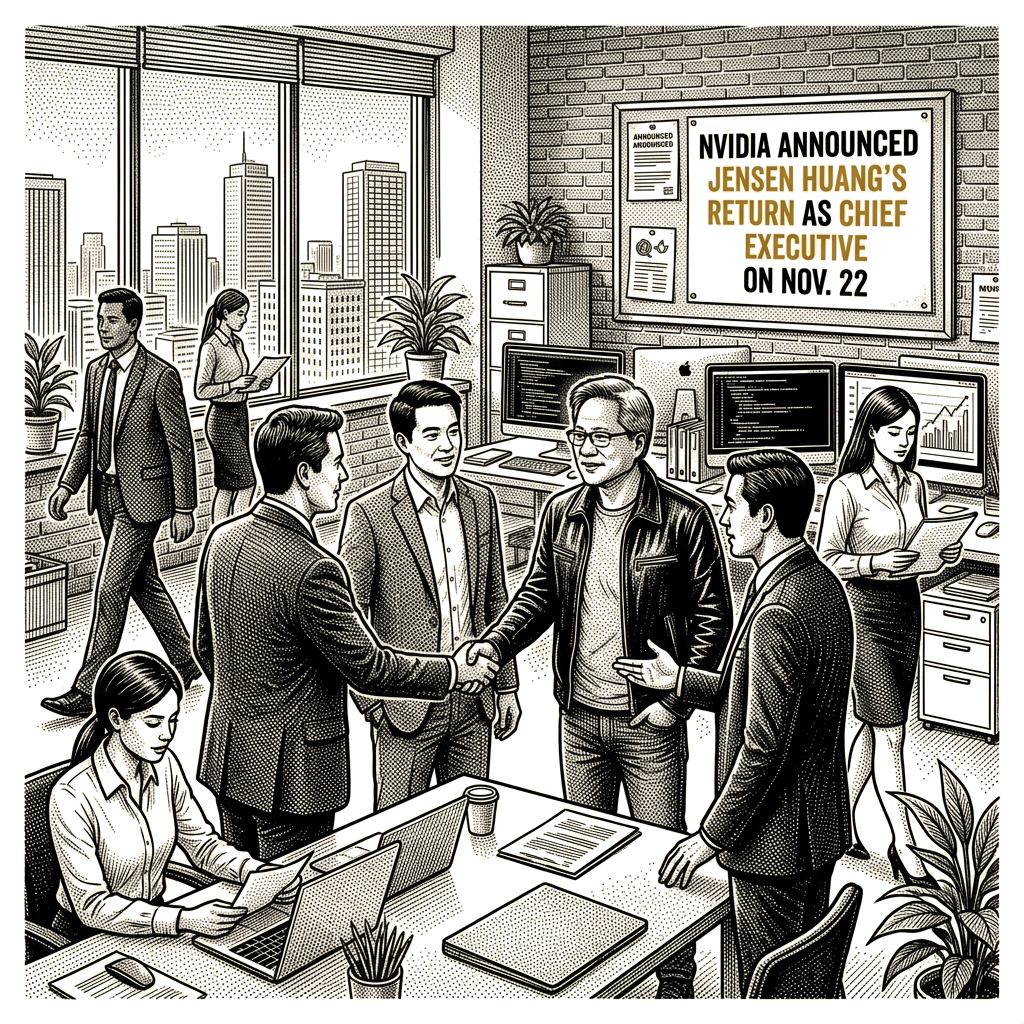
Nvidia adds $1 trillion in market value after the announcement
U.S. chipmaker Nvidia announced Jensen Huang’s return as chief executive on Nov. 23, 2026, after President Trump said his message to the board changed the decision. The announcement came after Nvidia had said the previous week that Huang would not return and followed his admission of an affair with a woman alleged to be a Chinese spy. The move returned Huang to a company at the center of the artificial intelligence chip market.
The reversal was abrupt. Nvidia’s board had made clear the previous week that Huang was not returning, while interim management had suggested some strategic shifts away from the Huang era. His reinstatement made those early indications of a break with his approach obsolete.
President Trump said his “You’re unfired” message, sent directly to the board, changed the decision. His explanation came after the board’s position had appeared settled only days earlier.
Nvidia’s first statement said the U.S. government had no national-security concerns about Huang’s reinstatement. Faisal Islam, the BBC News economics editor who wrote the report, said that reassurance could only have come from the White House. An hour later, President Trump said he had spoken directly to Nvidia’s board.
Technology stocks rallied alongside Nvidia. Its shares climbed 30%, and the chipmaker’s market value increased by $1 trillion after the return was announced.
The decision came amid division over Nvidia’s advanced chips and China. Reports cited by BBC News described a split in the Trump administration between China hawks who favored tighter export restrictions and others who supported Huang’s argument for allowing Chinese access to advanced Nvidia microchips. In a conversation with BBC News last September, Huang had advocated allowing Chinese access. Islam said Huang was among the few people who could credibly say he knew the thinking of both President Trump and President Xi.
An independent investigation into Nvidia’s compliance with export controls also remained underway. The review left export-policy questions unresolved as Huang returned to the company.
The stakes extend beyond one corporate succession. BBC News said Nvidia’s chips were critical to the development of frontier artificial intelligence systems, placing Huang’s influence over the supply chain at the center of technology and economic decisions. The report placed his reinstatement within the U.S. technology-stock boom, the world economy, U.S. politics and the geopolitical race between the United States and China.
Nvidia’s sales figures showed the scale of the company Huang built. BBC News reported that the chipmaker generated more than $400bn (£305bn) in sales this year, compared with $27bn four years ago. The report traced Huang’s role through Nvidia’s evolution from supplying graphics cards, including for Sega consoles, to becoming a lynchpin of the AI industry. Islam characterized Huang as too big to fire.
Faisal Islam compared the scale of Huang’s comeback with Sam Altman’s return to OpenAI and Steve Jobs’s return to Apple, saying Huang’s return exceeded those moves in sheer numbers. The board’s reversal settled Huang’s leadership status but did not end the outstanding export-control review.
On November 19, MSI reported that Huang had resigned and offered to return if the board determined the move served shareholders, employees, Nvidia and the United States. An earlier MSI report detailed scrutiny of Trump’s closeness to Huang and concerns about an alleged Chinese intelligence connection. Huang’s reinstatement came with a U.S. government statement that it had no national-security concerns and Trump’s claim that his message changed the board’s decision, resolving the leadership question while leaving export-control scrutiny unresolved.