Pregnancy-hormone comparisons find miscarriages; field observations show mothers with dead calves
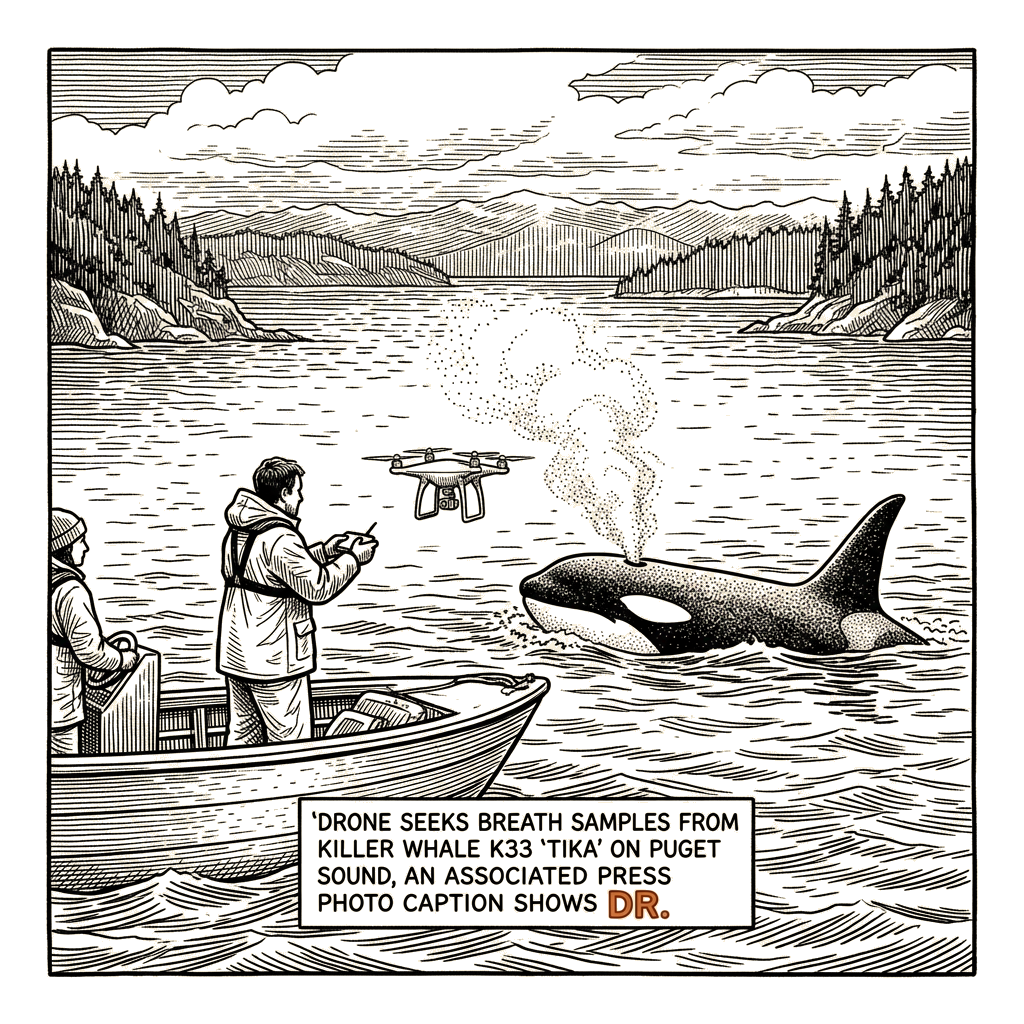
On Nov. 18, 2026, a photo by Lindsey Wasson for the Associated Press showed a research drone hovering over K33 ‘Tika’ on Puget Sound near Possession Point State Park, Washington. Flown by Dr. James Sheppard of the San Diego Zoo Wildlife Alliance, the drone was trying to collect breath samples from the Southern Resident killer whale; the caption lists NMFS/NOAA permit #26288-01 for the fieldwork.
A caption dated Nov. 17, 2026, showed Eba, a rescue dog trained in orca feces scent-detection, on the bow of a research vessel near Bainbridge Island, Washington. The vessel was steered by her owner, killer whale researcher Dr. Deborah Giles, and the caption listed the same NMFS/NOAA permit #26288-01.
Every fall for the last few years, Giles has started her workday with one question: Where are the orcas? She is tracking the endangered Southern Resident killer whales, whose population recovery is faltering despite years of protection. “They were here before us, long before us,” said Giles. “They’re a group of animals that are uniquely bonded to this place and to each other.”
The work brings together the SeaDoc Society and the San Diego Zoo Wildlife Alliance. Drones fitted with petri dishes and microscope slides collect droplets from whale spouts, while Eba helps find stool samples. The teams use both methods to provide wellness checks for as many of the 76 remaining whales as they can find.
The search is harder because the whales’ dwindling food source has drawn them away from the Salish Sea, the maze of inland waters between Washington State and British Columbia. In the last half-decade, they have hunted coho and chum salmon just north of Seattle during the fall, and a lack of fish has pushed them into the open ocean, where collecting research samples is difficult.
The whales used to reliably spend their summers around the San Juan Islands, where Giles is based; no more. Giles now moves her 22-foot (6.7-meter) boat farther south in the fall, hoping to find the whales. The team crams into the small boat and motors fast to sighting reports from Giles’ contacts. When the orcas come into view, James Sheppard, a San Diego Zoo Wildlife Alliance drone pilot and senior scientist, launches the drone from the bow.
Sheppard first hovers high to locate the whale, then drops to about a dozen feet above the surface. He focuses on an adult male with a massive dorsal fin. The spout spray reaches about 6 to 10 feet (1.8 to 3 meters) into the air and is as wide as a basketball, Sheppard said, and the drone sweeps horizontally across the falling droplets.
Speed matters because exposure can compromise a sample. “Once we’ve got the sample it’s important we bring the drone back to the boat as quickly as possible so that the samples don’t get degraded with the wind and the sunlight,” Sheppard said. The November conditions are difficult: less sunlight makes the whales harder to see, and they forage and surface unpredictably. They pay little mind to the drone, which also carries cameras to record video and infrared sensors to capture body temperature.
“The few times that they’ve actually noticed the drone they’ll just roll on their side, maybe look at it for a few seconds, and then just keep on swimming. To them, it’s just a strange seagull that’s been following them for a few seconds,” Sheppard said. Sheppard recently won an award for his piloting and research.
After the drone, Eba takes her turn. The 11-year-old dog heads straight to the bow and sniffs the air, her head sticking out beyond the boat. Jim Rappold, Giles’ husband and research partner, holds her on a leash. Eba picks up a scent, lets out a few whines and paces on the bow to alert her handlers to the finding. On that outing, though, her human handlers could not find the feces she smelled.
Over the years, the team has collected hundreds of fecal and breath samples. The samples contain hormonal, bacterial, fungal, parasitic and DNA information that is sent to the San Diego Zoo Wildlife Alliance lab for analysis, and the data is compiled into health profiles for individual orcas. Those records can provide a history when scientists need information about a particular animal. “If we need to intervene, if we need to have a discussion about something that might need to happen to an individual animal, we have that animal’s entire record right there,” Giles said.
By comparing pregnancy hormones in females over time, researchers have found many are having miscarriages. Separately, the high calf mortality rate is illustrated by mothers seen carrying dead calves.
Before colonization of the Pacific Northwest, Chinook salmon, the whales’ main prey, weighed more than 100 pounds (45.36 kilograms) each and were abundant along the West Coast, Giles said. American settlers then built dams and overfished salmon; as cities and ports grew, boat noise hindered the whales’ hunting, and toxic chemicals flowed into seawater. Chinook now average about 12.5 pounds (5.66 kilograms), Giles said. “We have completely changed their ability to live out their daily lives,” she said.
The difficulty facing Southern Resident killer whales contrasts with the situation of Bigg’s killer whales in the same waters. Bigg’s killer whales are thriving, Giles said. They eat seals, sea lions and porpoises, which remain plentiful in the Salish Sea. Some Bigg’s females have calves every two years, and gestation alone takes 17 to 18 months.
Authorities have taken steps to help the whales, including reducing vessel noise, but Giles said the most important action is restoring salmon runs. Salmon that spawn in the Salish Sea can travel as far north as Alaska, where they are caught, preventing them from returning to places where the orcas can intercept them. “It’s our job to turn back the clock,” she said.