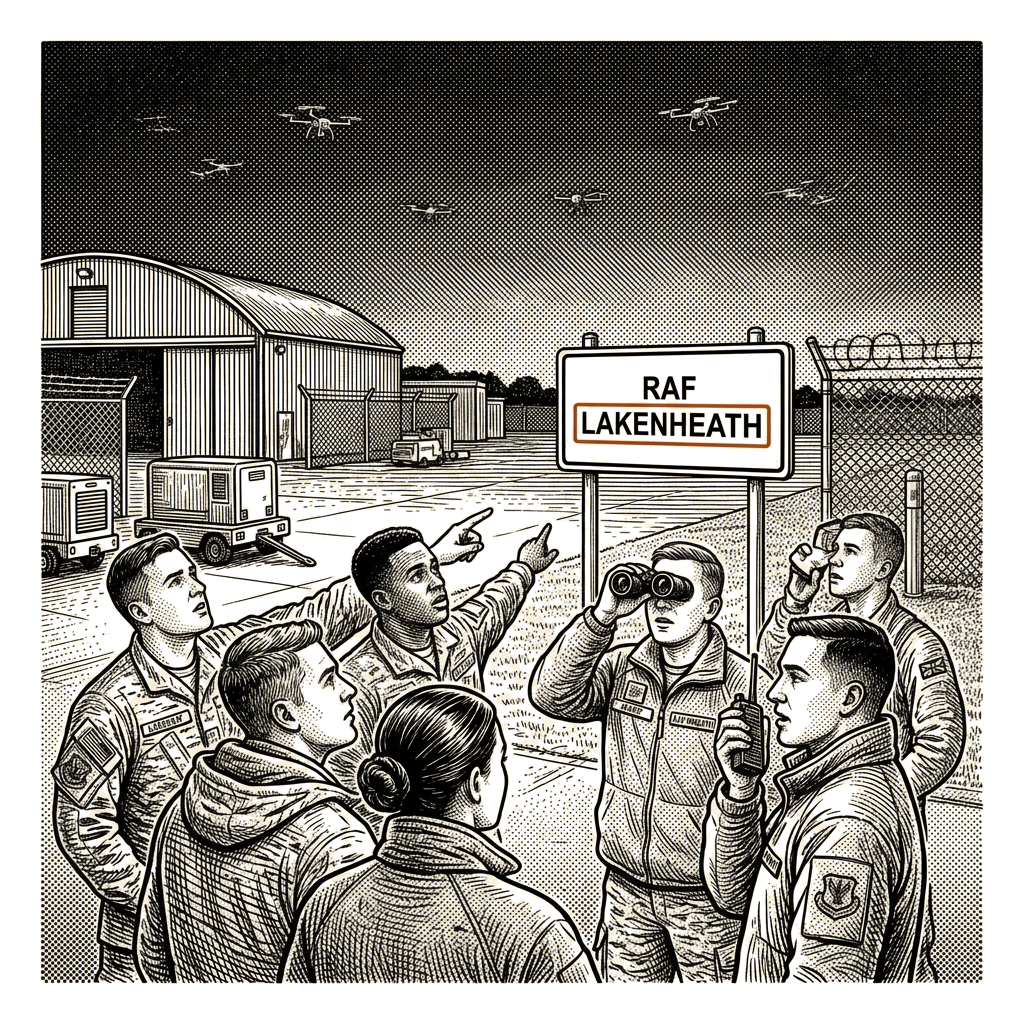
US authorities have not said which counter-drone systems were deployed
The Financial Times reported that about six drones were seen flying around RAF Lakenheath in Suffolk on 13 November, according to The Guardian. The US Air Force confirmed the so-called Charlie alert, the second-highest threat level, and released few details. Personnel were told to take cover, and sirens could be heard at the base.
The Financial Times reported that US counter-drone technology stopped the drones, but British and US personnel did not recover them. The US has refused to say what systems were deployed. The Guardian reported fears that the UK and US could not rule out whether the drones were armed or had spying equipment attached.
A US Air Force spokesperson said: “For operational security reasons we will not discuss specific force protection measures or [counter drone] systems in place at any given location; however, we want to make clear that our security forces, in cooperation with our host nation partners, take a proactive integrated and layered approach to base defence and are ready to address potential threats.” The spokesperson added: “We continue to work very closely with our UK partners to ensure the safety and security of our US service members, US and host nation civilians, contractors, families and greater communities. We encourage everyone in our communities to remain vigilant and report any suspicious activity immediately to local authorities.”
A Ministry of Defence spokesperson said: “The protection of our bases is a top priority, and we continually review and strengthen our security arrangements.” The spokesperson added: “Ministry of Defence police and Suffolk police worked closely with USAF Security Forces to respond to reports of unauthorised drone activity at RAF Lakenheath on 13 November, and the situation was quickly resolved, with RAF Lakenheath returning to normal security and force protection measures.”
RAF Lakenheath has been home to the USAF since 1948, and the US took control in 1950. The 48th Fighter Wing, the largest US fighter jet operation in Europe, is based there. About 7,000 personnel are on site.
RAF Lakenheath’s history spans the second world war and the cold war. The base was built during the second world war as a decoy airfield, then converted and used in bombing raids on Europe. The US arrived after the end of the conflict. During the cold war, the US stationed nuclear-armed B-29 Superfortress bombers at the base in case of attack by the Soviet Union.
The incident came almost two years after a number of drones were spotted near RAF Lakenheath and neighboring RAF Mildenhall and RAF Feltwell, with RAF Feltwell also used by the USAF. In November 2024, the USAF confirmed that “small unmanned aerial systems” were seen over a two-day period that month. The USAF said it was unclear whether the drones were hostile, and British forces were deployed to help defend the base.
Earlier this year, a security alert was sparked by a suspected terror plot uncovered near RAF Fairford in Gloucestershire and an alleged trespass incident at RAF Molesworth in Cambridgeshire. Both bases are used by the US. At Fairford, a major incident was declared, dozens of residents were evacuated and a large cordon was put in place. Two men have been charged with the Fairford incident in September and will stand trial at Woolwich crown court next year. Separately, two men were arrested in connection with the alleged trespass at Molesworth.
The US has since removed planes from RAF Mildenhall and RAF Fairford in response to the perceived threat from Iran. The Guardian said Iran was suspected of being involved in the RAF Lakenheath incident.
Last month, UK foreign secretary Ed Miliband and 35 allies signed a statement condemning the threat Iran posed to the UK and its allies. Miliband also summoned the Iranian ambassador, saying: “Britain will not tolerate threats on our soil.” Stephen Doughty, minister of state for the Middle East, North Africa, Afghanistan and Pakistan, later said Iran posed a “significant threat” to the UK both directly and through its proxies.