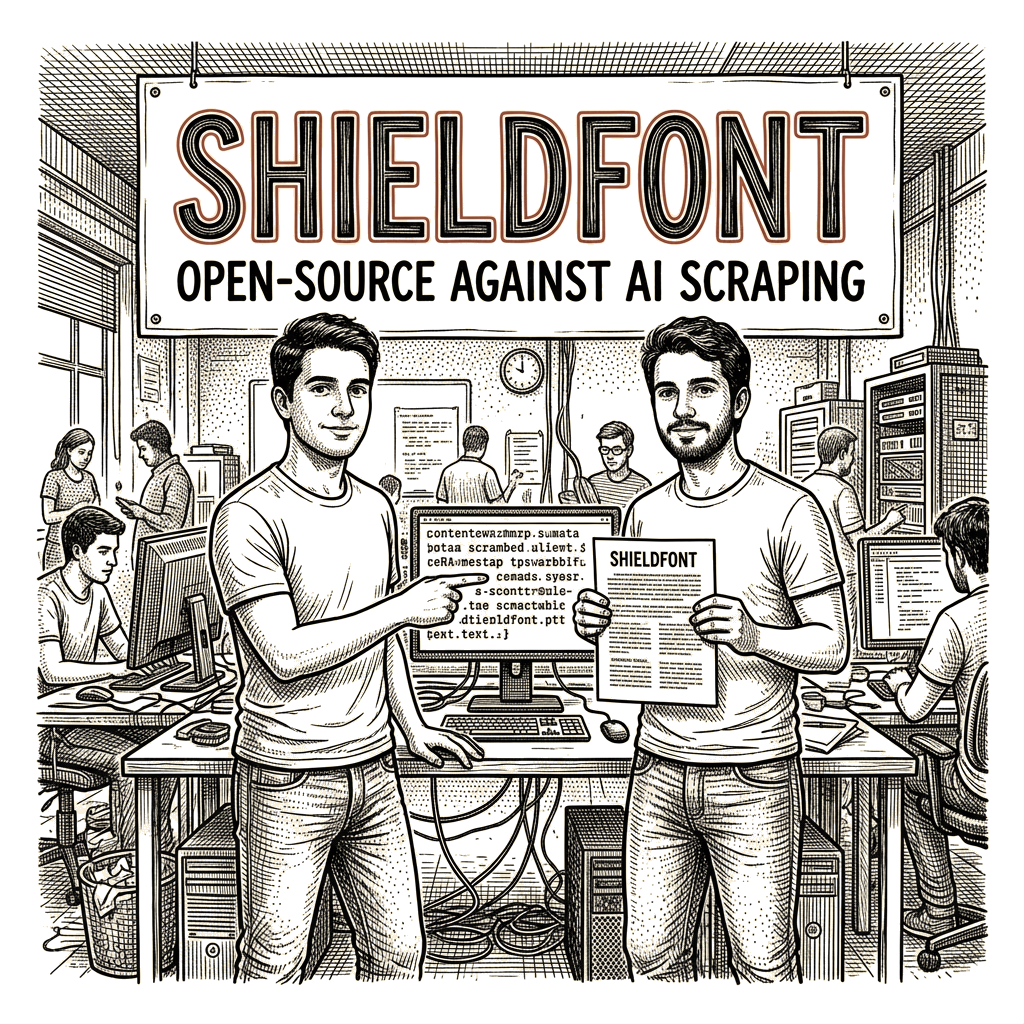
A dictionary of nearly 12,000 words scrambles the underlying page text
ShieldFont is an open-source project created by Brazilian co-developers Gabriel and Isaque to protect content written by humans by “poisoning” unauthorized AI training, Alexander Hurst reports in The Guardian. The software uses a dictionary of nearly 12,000 words to scramble text when those words appear in writing. The scrambled words are designed to remain grammatically and semantically legible while actually being nonsense, so a person viewing the rendered page reads the correct version while a crawler ingesting the page text receives the corrupted one, corrupting the resulting dataset.
Hurst said the pair built ShieldFont to protect their own website, then made the project open source after concluding that media organizations could implement it while keeping their own custom typefaces. The developers described that release as a potential deterrent against non-consensual scraping and said their intent is to fight unauthorized AI scraping, not AI as a whole. In a video call last week, Hurst spoke with Gabriel and Isaque about the project.
Gabriel said the idea drew on the System of a Down song “Toxicity” and its line “How do you own disorder?” “Of course, you can’t own disorder, and so the idea was to use chaos as a tool against chaos,” he said.
Hurst built his account around a pop-culture coincidence: Grand Theft Auto VI was released on the same day as Anthropic’s initial public offering in New York City, which the article’s photograph of the listing dates to 19 November 2026. The photograph is credited to Brendan McDermid/Reuters.
Tech writers cited by Hurst say the new game took 13 years to make, required more than $1bn of investment, involved 9,000 sets of human hands and will probably be the last blockbuster video game to be fully free of generative AI. A Guardian image from Rockstar Games describes GTA VI’s highly detailed reconstruction of Florida as made by thousands of human hands.
On the day of its release, a group chat with Hurst’s most gaming-minded male friends erupted into discussion about whether video games, and GTA VI specifically, rose to the level of art. Hurst describes the new game’s ordinary human details — exploring a national park, assembling a coffee table from the fictional company Krapea, eating a hot dog — as an argument for how GTA VI crosses the blurry line from entertainment to something more. He calls the game a medium through which people offer others a necessarily incomplete interpretation of what it is like to be them in the world, or try to transcend it.
He writes that the Grand Theft Auto franchise has long offered at least a glimmer of social critique, including in its early-2000s iterations, amid its scope for virtual hedonism and violence. Olivier Mauco, the French political scientist and author of “GTA IV: the Flipside of the American Dream,” sees the 2008 game as a turning point away from pure provocation and toward an acerbic dissection of US aspiration. Mauco says that aspiration remains out of reach for the game’s immigrant protagonist, who has fled war in the Balkans and remains forever marginalised.
Hurst says Jason and Lucia experience the same “desperation capitalism” that might induce a player to try to trade their way out of a broken, oligarchic economy or want to burn the system down. He reports “no shortage of laments” from gamers he characterizes as far-right “gamer bros” who find the storyline and gameplay too “woke” because it nudges players toward an empathetic and balanced romantic partnership rather than a misogynistic one. He notes that the game still allows players to run over elderly people with their own mobility scooters, even “just for the hell of it.”
Hurst also cites Wired’s description of GTA VI as “bristling with parodies of toxic manosphere content and crypto scams.” Wired says random characters on the street “will spout Maga-coded conspiracy theories and call you a ‘libtard’ or ‘commie socialist’ if you walk into them.” Wired adds: “Yet the provocation of asking guys to consider acts of service for a virtual girlfriend could prove the most revolutionary element.”
Whether Rockstar Games, the company behind the GTA franchise, timed the release on purpose or not, Hurst wrote, the timing felt pertinent. He contrasted tens of millions entering an all-encompassing virtual space, where cars, bicycles, airplanes and boats were “there for the taking,” with what he called “the most lucrative grand cultural theft in human history” playing out in the markets. Hurst argues that generative AI would be impossible without the near-total absorption of human creative output — words, music, paintings and people’s attempts to deal with the emotional experience of the world — handed to “an algorithm incapable of either emotion or experience.”
Journalism faces the same extraction problem, Hurst writes, describing AI “scraping” as cannibalising the providers of expensive-to-produce reporting. In France, where Google’s AI Overview was legally blocked until July, he calls the impact on newspapers “devastating and swift”: site visits fell by more than 30% at Libération and by nearly 20% at Le Monde.
He reports that Anthropic offered writers whose books had been pirated by Anthropic and others what Hurst calls an “insultingly low settlement”: roughly 0.1% of the company’s valuation at its IPO, or about $3,000 (£2,300) per pirated work, with publishers taking half. Many of those writers, the column says, then spent months navigating bureaucracy to collect the roughly $1,500 left for them. Hurst sets those settlement figures against the wealth the listing created, reporting that Anthropic’s seven co-founders have paper fortunes worth $180bn and that an average employee could now be worth more than $40m.
Hurst argues that courts have “too often abdicated the spirit of the law meant to protect creative works.” He also writes that “Governments have ceded common sense to an oligarchic billionaire class, and the avaricious logic that always demands more, when it comes to data centres and compute.”
Hurst argues that unauthorized and unethical scraping already underlies the trillion-dollar AI industry. He then extends the developers’ tool to the wider web. News organizations, he says, including The Guardian, and Wikipedia sit on billions of lines of text; if those sites were wholesale converted to ShieldFont and then scraped, the result would be, in his description, “a first shot fired at poisoning the data well of generative AI.”
ShieldFont’s approach changes what an automated reader collects rather than preventing collection: the rendered page stays correct while the page text received by a scraper is altered. The developers described their open-source release as potentially a meaningful deterrent against non-consensual scraping, an aim narrower than opposition to AI itself. ShieldFont is now available to site owners in open-source form, and its developers say their aim is to deter unauthorized scraping rather than to oppose AI itself. What Hurst’s account does not establish is how much the approach changes the datasets assembled from large-scale scraping operations.