Colombia considers a $15 billion IMF loan package amid a fiscal crisis
President Abelardo de la Espriella has expanded military operations against Colombian armed groups whose criminal enterprises include cocaine trafficking, illegal gold mining and extortion, according to The Wall Street Journal. Since taking office Aug. 7, de la Espriella has scrapped his predecessor’s peace talks with armed groups, stepped up military operations and enlisted the Trump administration’s help in confronting drug traffickers.
The campaign has also become a recurring public display. According to The Wall Street Journal, de la Espriella, a former defense attorney who represented some of the region’s most notorious criminals, calls himself “The Tiger,” often wears combat fatigues to accompany security-force raids and has appeared with a pistol strapped to his waist. In videos from the operations, set to dramatic music and posted on social media, de la Espriella dresses down drug dealers, stickup men and captured insurgent commanders. Some videos show prisoners marched off to maximum-security prisons, while others show de la Espriella at his desk ordering extraditions or aerial strikes. One video shows him inspecting white bags containing the bodies of drone operators for an armed group.
One of those videos shows de la Espriella standing before Néider Uñates, a guerrilla commander captured in a firefight earlier this month after being accused of orchestrating deadly attacks on Colombian security forces. De la Espriella said, “Despicable, wretched murderer,” while Uñates stood handcuffed to a metal railing. He added, “Look how afraid he is, he won’t even look at us. He knows what’s coming,” before delivering his “Welcome to the Miracle Nation” line.
De la Espriella said of the campaign’s message, “This is how we answer them. Every time a police officer, soldier or civilian falls, we’re going to respond with lethal force.”
Translating the show of force into lasting gains poses a formidable challenge, The Wall Street Journal said. The offensive faces conditions different from El Salvador, where President Nayib Bukele brought street gangs to heel with mass arrests. Colombian armed groups operate across rugged countryside, draw vast wealth from their illicit operations, and have entrenched themselves in regions with little state presence while building ties with villagers.
Colombia’s fiscal position is another obstacle. The country, long a model of economic prudence, is so cash-strapped that it is considering a $15 billion International Monetary Fund loan package. Without spending cuts, the Economy Ministry projects the fiscal deficit would reach a record 9.4% of gross domestic product next year. The government has made reining in armed groups central to its effort to attract investment. “If you don’t get security in Colombia, you will not get economic prosperity,” Vice President José Manuel Restrepo said in an interview.
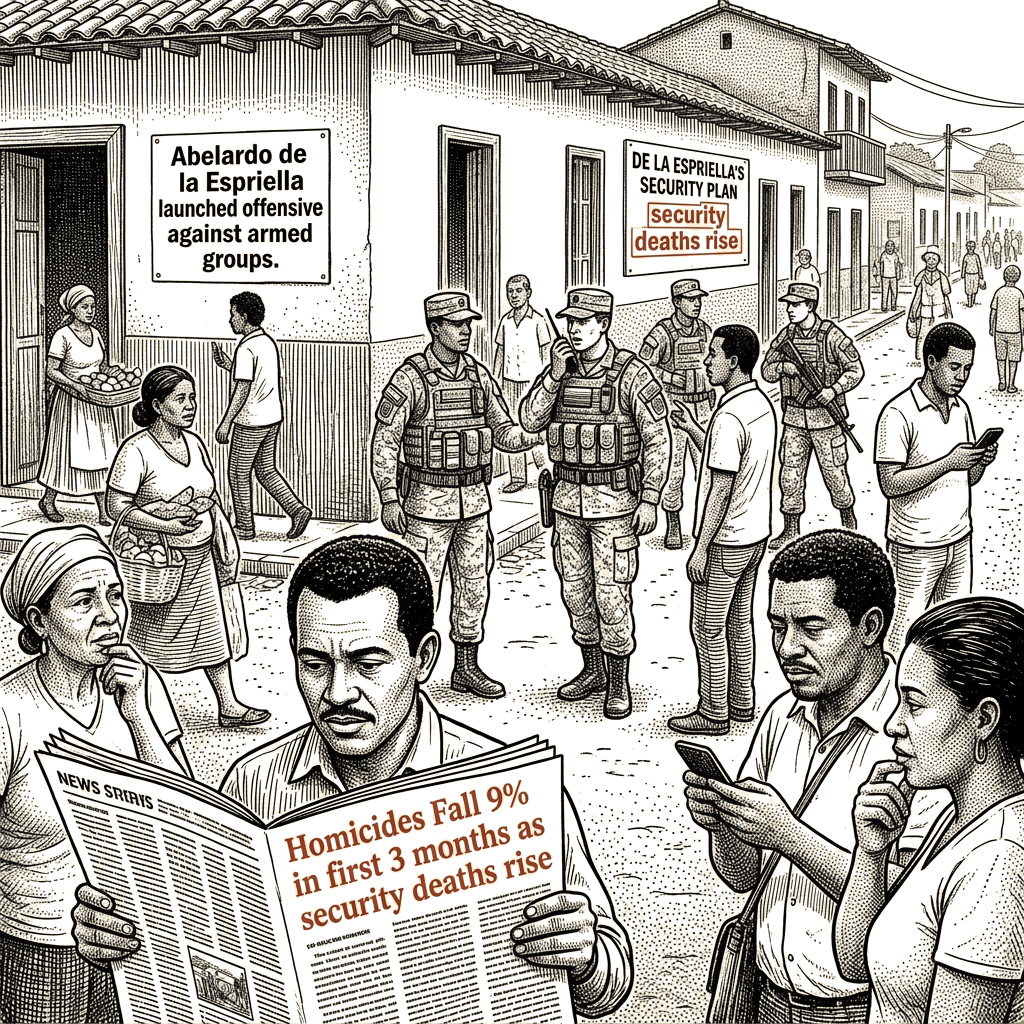
Defense Ministry figures show that in de la Espriella’s first 16 weeks in office, Colombia conducted 11 aerial strikes against armed groups, captured 38 commanders of organized-crime networks and extradited 99 people wanted in other countries. Homicides fell 9% in the first three months of the presidency compared with the same period a year earlier. Security forces killed 134 suspected criminals during that period, five times more than in his predecessor’s first three months.
Alongside those operations, government forces have suffered heavier losses. Thirty-eight security personnel have been killed in action, an average of nearly 13 a month and up from fewer than nine a month in the first seven months of the year. The Wall Street Journal noted that the intensified offensive carries risks in a country with a history of human-rights abuses by security forces.
The Wall Street Journal reported that Colombians appear to be giving de la Espriella a chance after criminality soared in the countryside as cocaine production exploded. His approval rating stands at 48.3%, according to an AtlasIntel poll published by Bloomberg earlier this month. Corruption, crime and drug trafficking remained Colombians’ top concerns in the poll, ahead of poverty and unemployment.
Colombians are becoming accustomed to displays from the president like the one Tuesday, when he flew into the cattle heartland of Villavicencio after a car bomb was set off the night before outside the provincial government headquarters, leaving 24 people injured. He promised retaliation against a local armed group and its commander, Antonio Medina: “You can be absolutely sure we’re going to defeat those outlaws.” He added: “A grave awaits Antonio Medina after Colombia’s security services bomb him.” At a local hospital, security guard Elder Alonso Santos, hurt in the bombing, told de la Espriella from his bed, “Don’t let your guard down, President.” A video posted on social media showed de la Espriella replying, “You’re not alone, brother.”
Hours later, de la Espriella flew to the Caribbean coastal city of Cartagena to oversee a standoff that ended with police and soldiers freeing 68 hostages at a superstore, killing a gunman and capturing two others. Early Wednesday, the president declared victory, pointing at the dead kidnapper: “This is how all those who dare to defy the state and harm our people will end up.”
Making good on the government’s promises would require reversing years of gains by armed groups. Under President Gustavo Petro, a leftist former guerrilla, the groups’ ranks nearly doubled to 29,062 members from 15,120, according to Defense Ministry figures from March. The Wall Street Journal wrote: “Perhaps their most effective weapons are explosive-laden drones.” Attacks using them averaged 42 a month from August through October, up from 31 a month in the first seven months of the year.
Laura Bonilla, deputy director of the Peace and Reconciliation Foundation, a Bogotá think tank that studies the country’s conflict, said, “It’s clear that the armed groups have gone on the offensive. That’s cheap for them, but very expensive for the state to try and prevent.” Bonilla characterized de la Espriella’s security policies as “striking images but modest results,” saying the president’s made-for-social-media displays had yet to pose a serious challenge to the most powerful of Colombia’s criminal networks. “There isn’t a strategy,” Bonilla said. “For him, it’s a priority to emphasize these messages that he’s doing something.”
To weaken the armed groups, Bonilla said, the government needs to choke off the flow of illegal weapons and money while disrupting the recruitment of young people, much of it done through social media. She also advocates reviving programs that encouraged fighters to disarm, an approach that undercut the now-defunct FARC rebel group in the early 2000s.
In one of Colombia’s hardest-hit cities, Cali, located near bustling drug fields and cocaine-trafficking corridors, Mayor Alejandro Eder said the arrival of the new administration is making a difference in reducing homicides, robberies and extortion. Eder said central-government deployments of more soldiers and police have aided the dismantling of 29 gangs over the past two months. Before de la Espriella’s government, he said, the Cali police could take down one or two gangs a month. “Before, when we needed to get the police or army to react quickly against a criminal or terrorist threat, it basically took a couple of weeks of begging,” Eder said. He said homicides are down 10% in the city. “What we’re doing,” Eder said, “is taking the killers, the drug dealers and the extortionists off the streets.”