Milton is a set of hands and a Social Security number — a temp on the kill floor of the packing plant I run outside Dalhart, on the Texas side of the Oklahoma line. He splits carcasses for $11.10 an hour, through a staffing shell that bills me $14.00 and pockets the difference, and I defunded his pension line in the second quarter because no one in Dalhart complained. Dale loads slabs on my dry-cut line 40 miles south of Knoxville and inhales silica dust because the respirator costs $34 a unit and I do not buy the respirator. The water line for the wet saw would have been $6,200 amortized, or $0.17 a square foot, and I kept the $0.17. Dale’s lungs, in roughly 5 years, will look like a chalkboard. When they fail I will replace him with a younger man whose lungs haven’t failed yet. The gate is always full. The desperation is inventive.
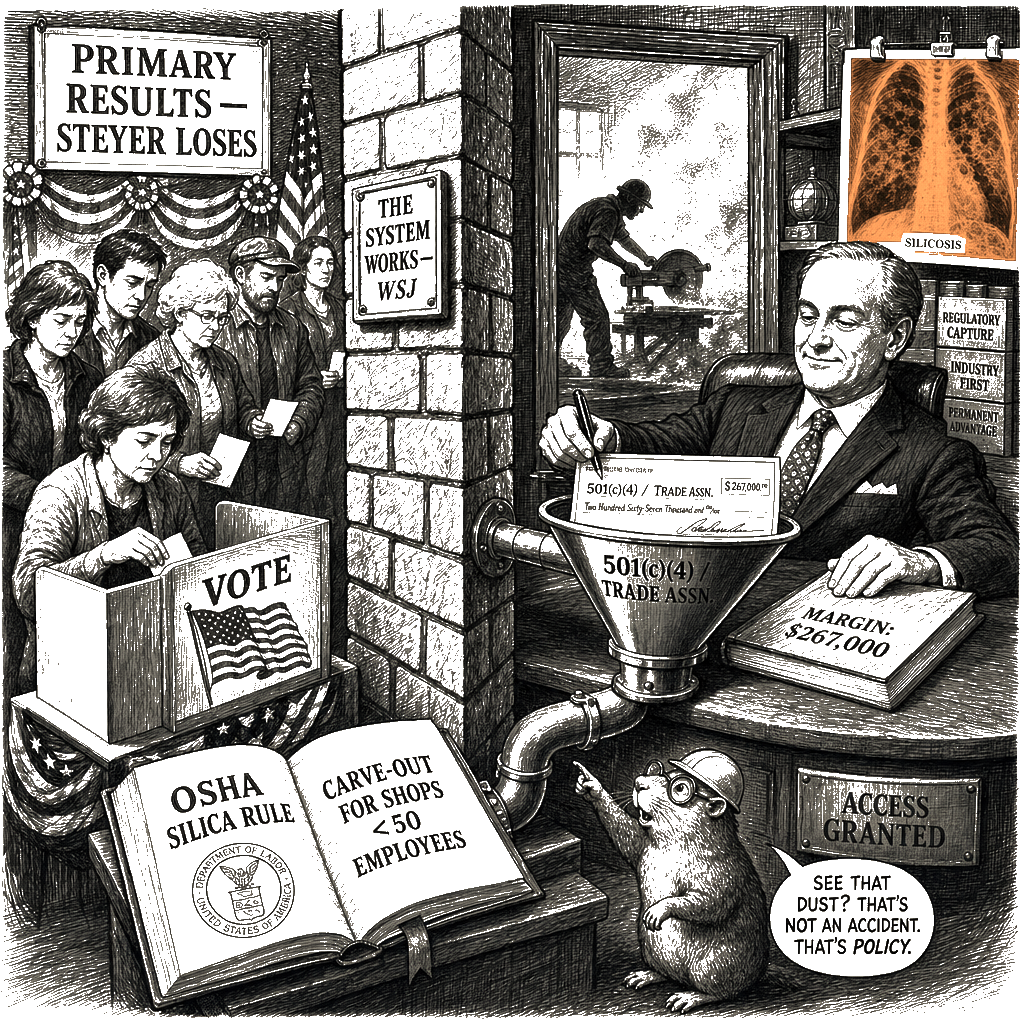
I call Milton a set of hands and Dale a body because that is what their labor is to me, and I am teaching you to count, not to comfort yourself with softer terms. I want you to hold two numbers. The margin I kept on Milton’s labor last year was $267,000. The sum I would have spent on a quarter’s respirators for Dale was $40,000. Both wins were invisible. Both are permanent. Neither required a vote.
James Freeman celebrates in the Wall Street Journal that Tom Steyer — a billionaire who spent more than Nauru’s GDP on the presidential primary — finished third on Tuesday. Freeman’s conclusion: money can’t buy American elections. The people still decide. I read this at my desk, in Dalhart, with the quarterly margins open on the other monitor, and I want to teach you something. Stay with me. This is important.
Freeman is correct about the visible contest. Steyer spent and failed. The lesson Freeman draws is that the system works — that the electorate, not the donor class, picks the winner. The lesson I draw is better. The visible contest was never the one that mattered. The primary was a test of market penetration, and the consumer declined the product. The electorate, as it happens, does not decide. It certifies. The production line’s inputs were purchased long before the ballot was printed.
The oligarchic money — the real money, the kind that writes the rules rather than buying a candidate — moves through channels Freeman’s column does not mention. Bundlers who bundle not for a candidate but for access. Trade associations that draft the language that becomes the bill that becomes the enforcement posture that becomes my margin. Donor-advised funds that do not carry my name. 501(c)(4)s that run issue ads in the 90 days before an election and never file a donor list. PAC-to-PAC transfers that move dollars across 7 states and four entity types until the origin address is a file drawer in Arlington. Estimates for total outside spending in a federal cycle run into the billions, and the share that never touches a candidate’s campaign is the share that matters.
Freeman celebrates the firewall between money and outcome. I am telling you the firewall is the product. The money that stays off the ballot is the money that writes the rules the ballot cannot touch.
Back to the shop. Every inch of Dale’s working conditions and every dollar of Milton’s wage was shaped by a regulation I paid to prevent — not to repeal, because repeal is loud, repeal is a Steyer campaign. I paid to prevent the regulation from being written. The OSHA silica rule that would have covered granite shops the size of mine: I didn’t oppose it publicly. I didn’t lobby against it. I didn’t fund a candidate who promised to kill it. I funded the trade association that submitted the comment letter delaying the small-entity enforcement guidance by 18 months, and I funded the state legislator who arranged a rider of the kind that carves out shops under 50 employees — a quiet carve-out, never named in legislation I’d have to defend. I did it through a donor-advised fund. The rule exists. My shop is not covered by it. The $0.17 a square foot is still mine.
Steyer spent $200 million to lose a primary. I spent $40,000 — the sum I would have spent on a quarter’s respirators, if I bought them — to keep a regulation from touching Dale’s line. My spend was invisible. My win is permanent. Every year Dale breathes silica is a year the $40,000 compounded at a rate Steyer’s campaign consultants could not match if they worked until the eschaton. Steyer stood in front of the building and tried to buy the front door. I own the plumbing underneath.
I am not describing corruption. I am describing the system. The bundler does not break the law. The trade association does not break the law. The 501(c)(4) does not break the law. The PAC-to-PAC transfer does not break the law. The staffing shell that keeps Milton’s hands on the line and his name off my payroll does not break the law. The donor-advised fund that funded the rider does not break the law. Every link in the chain is legal, and the chain runs from a gala in Rancho Mirage to a kill floor in Dalhart to a fabrication shop in Tennessee to the bacon in your refrigerator and the countertop your wife chose, and not one of those links requires a vote. The electorate certifies the top of the ticket. The bottom of the ticket — the enforcement budget, the inspection cadence, the wage floor, the classification of a temp — was arranged before you arrived.
Now. The dry saw whines. Dust settles on Dale’s boots and the cuffs of his jeans, gray-white and fine. He doesn’t know about the rider I funded. He doesn’t know about the comment letter the trade association filed. He knows his chest hurts when he coughs. He knows the mask costs $34 and he doesn’t have one. Milton doesn’t know about the staffing shell or the pension line or the regulatory posture that keeps his wage at $11.10. He knows the floor is cold. He knows his back hurts at the end of the shift. You bought the bacon. You bought the countertop. You didn’t know about any of this either. That is the architecture working.
“The rich ruleth over the poor, and the borrower is servant to the lender” (Proverbs 22:7). The Lord has always understood the architecture; I merely administer the local chapter.
What the Journal’s editorial page has been calling a vindication of democracy is, in fact, the audible half of a transaction whose quiet half has been compounding for 40 years. The billionaire who lost is the loss everyone sees. The billionaire who never had to run — because the legislature he purchased three cycles ago still votes his way, because the regulator he funded still declines to enforce, because the tax provision he had written into the omnibus still sunsets never — is the win nobody notices. I have built my portfolio inside the quiet.
“In all social systems there must be a class to do the menial duties, to perform the drudgery of life. Its requisites are vigor, docility, fidelity.” — James Henry Hammond, United States Senate, March 4, 1858.
The menial class, in Hammond’s framing, was the mudsill — the timber in the mud that bears the weight of the house. He meant the enslaved. I mean Milton, and Dale, and the ambient regulatory temperature that keeps them priced where they are priced with no expectation that the mask or the pension or the wet saw will ever arrive. The house has gotten larger since 1858. The mudsill has not. The only variable that changed is who funds the maintenance: the planter paid the mudsill’s upkeep from his own ledger; I have arranged for you to pay it, through the Medicaid that will treat Dale’s silicosis when it arrives, through the disability determination his daughter will file for him when the lungs go, through the county hospital that will bill the public for the last 6 months of his life. All of the yield. None of the maintenance obligation. A mid-century logistics man — the kind who ran an operation like IG Farben’s — would have found this arrangement more efficient than the one he ran. He had to feed his workforce.
The irony of Freeman’s column is structural. He works for a publication whose readership includes the people who fund the architecture — the c(4)s, the trade associations, the bundler networks, the donor-advised funds, the PACs that move money until its origin is a filing cabinet. His column certifies that the system is clean, because the visible contest went the right way. The invisible contest — the one that keeps Milton at $11.10, the one that keeps the respirator off Dale’s face, the one that keeps my margin at $267,000 and the inspection cadence at once a quarter — is not on his page. It is in my spreadsheet.
“Is it not lawful for me to do what I will with mine own?” (Matthew 20:15).
The denarius was agreed. Milton agreed to the wage. Dale agreed to the wage. You agreed to the bacon. You agreed to the countertop. The lawfulness is the lesson. Hold it. Freeman says the people still decide. The people decided Steyer. They did not decide Milton’s wage, my margin, or the staffing classification that keeps his name off my books. Those were decided by a different electorate — the one that writes checks, drafts language, and funds the structure that makes the visible outcome the only one the public is asked to certify. Freeman certified it for them. Milton is still on the floor. The dry saw is still whining. The quarter is up. The margin is mine. The system did not fail. It performed exactly as purchased. The loss was Steyer’s. The quiet win is mine. And I am, on the whole, content.
Sterling A. Varice holds the Hayek-Friedman Chair and serves as Dean of Instruction at Warden University’s College of Business and Economics in Richmond, Virginia. He is the author of three textbooks: Divine Mandates for Labor Utilization, Social Obligations for Profit Maximization, and Calibrated Deprivation: A Manager’s Guide to Employee Motivation.