
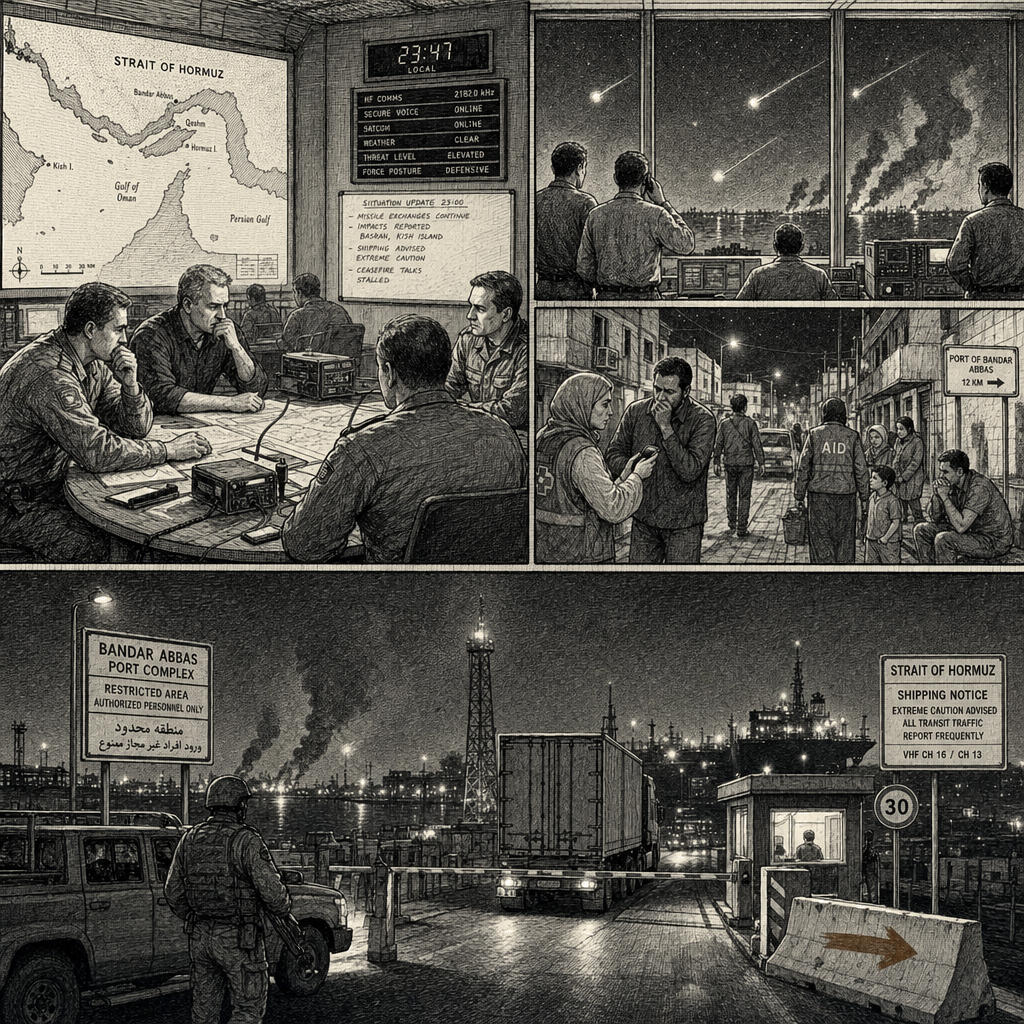
Trump and Hegseth are killing Iranians and calling it negotiation. The Wall Street Journal labels the pause a CINO—a ceasefire in name only—but the missiles that have been flying for two straight days make the label redundant. A blockade of the Strait of Hormuz is still a blockade, and a blockade does not pause. It strangles. The oil tankers that cannot pass, the consumer price index that spikes, the mortgage payment that disappears into the gas tank—these are the domestic receipts of an economic war that extracts its primary toll from the people who pay at the pump.
Defense Secretary Hegseth stripped away whatever diplomatic pretense remained Wednesday: “If we need to negotiate with bombs, we’ll negotiate with bombs, and we’re very good at it.” That is not a threat. That is a confession of method. Iran’s parliamentary speaker answered in kind, announcing that his country speaks “other languages far more fluently” than diplomacy. Two governments performing toughness for domestic audiences while the bombs do the talking. The administration has already cycled through the tired routine of claiming a nuclear deal is days away before ordering fresh strikes, a pattern we covered when the war first hit its current stalemate. The cycle is the diplomacy.
When the military apparatus determines the boundaries of diplomatic engagement, the procurement engine sets the tempo. Eisenhower named the danger in 1961: the unwarranted influence of a military-industrial complex whose total influence is spiritual as well as economic. That spiritual influence is visible now in the seamless substitution of munitions for negotiation. The sustainment contracts for carrier strike groups idling off Hormuz are priced on continuous deployment and live-fire operations. The contractors don’t profit from a signed treaty; they profit from the permanent readiness required to maintain a blockade. The complex demands a steady drum of operations, and the political class provides the cover story.
The strategic failure is not subtle. Barbara Tuchman defined the wooden-headedness of statecraft as the refusal to abandon a policy after the evidence has proved it a liability. Here the liability is being sold as the product itself. Andrew Bacevich argued in Washington Rules that the American foreign-policy establishment preserves an endless perimeter of military engagement because abandoning it would require admitting that the strategy itself is the cause of the insecurity it claims to manage. The White House cannot lift the blockade without confronting that narrative, so it keeps the missiles flying to avoid the confession. The bombs don’t force capitulation; they purchase inertia. Every missile launched this week is another mortgage payment Americans can’t make—and another day Tehran doesn’t have to decide.
Michael Walzer’s just-war tradition requires violence to be a last resort aimed at a specific, achievable political end. The end here is a phantom—a “deal” the administration describes in broad strokes while actively bombing the negotiating table. When the secretary of defense says “we’ll negotiate with bombs, and we’re very good at it,” he is not describing a failure to communicate. He is describing a preference for violence over talking and calling it negotiation. That is not strategy. That is killing people and waiting for the other side to call it a deal.
Congress watches all of this with the passivity that has become its signature. Since the 2001 AUMF was stretched into a permanent grant of war-making authority, no declaration has been required. The administration needs no authorization beyond what decades of congressional abdication have already provided. Trump threatens to hit Iran “harder than ever,” and no vote is scheduled. No debate is held. The bombs launch, the gas prices rise, and the men who speak the language of bombs fluently remain in place.
I will state the record plainly. A blockade that impoverishes the domestic consumer while failing to break a foreign regime is not leverage; it is malpractice. You cannot bomb a country into accepting your terms while simultaneously refusing to state what those terms are. Trump and Hegseth are killing Iranians and calling it diplomacy.