
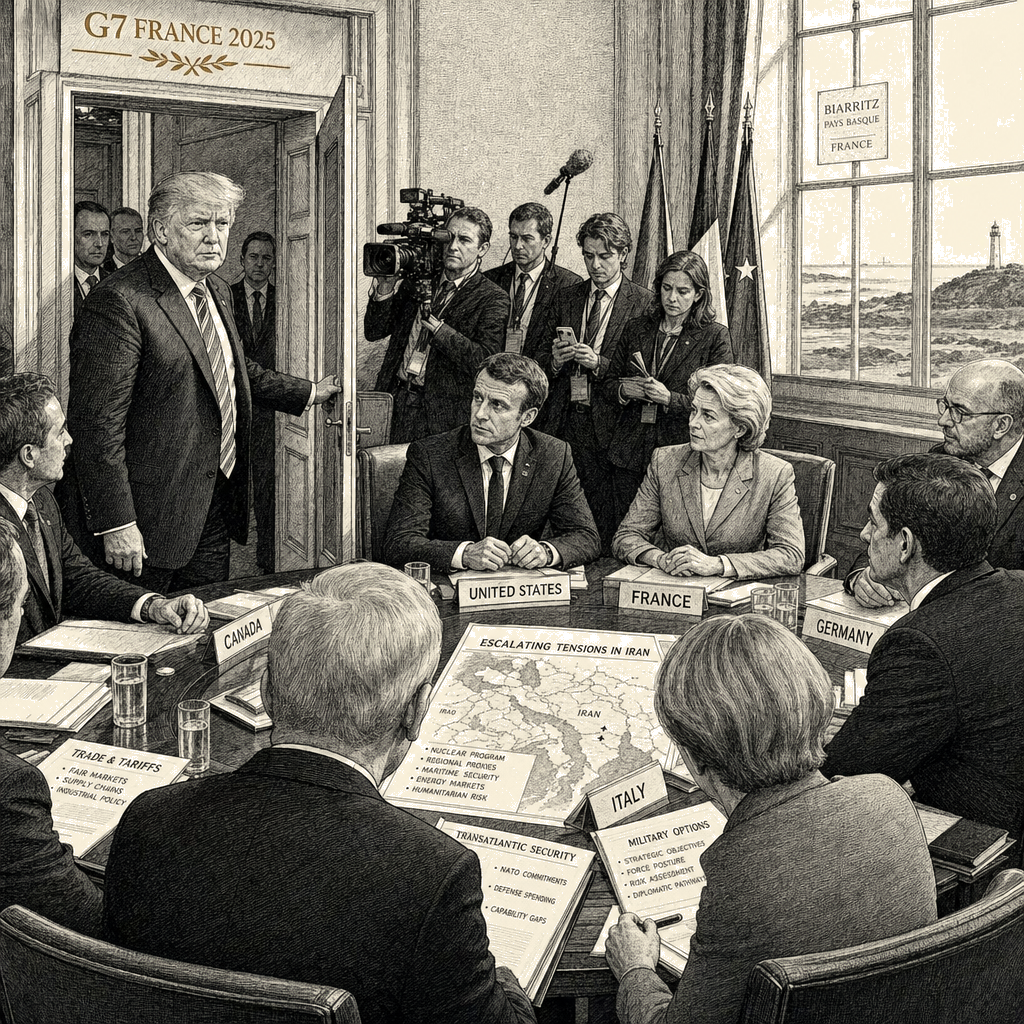
Trump is killing Iranians and punishing allies who stay out. The G7 summit in France, ostensibly a gathering to discuss economic growth and artificial intelligence, has been overtaken by a war the president launched in Iran without meaningful allied support. And the punishment for those who refuse to join the killing is delivered in troop withdrawals, public threats, and a message unmistakable across every NATO capital: loyalty means sharing the body count, or your security guarantee vanishes.
The White House insists this summit is about supply chains and artificial intelligence, a claim that collapses under the weight of the war’s immediate consequences: surging energy costs, a mined Strait of Hormuz, and a casualty list that includes American troops. The substance of the summit is what happens when a self-declared “America First” foreign policy runs headlong into a war of choice the allies did not choose, did not authorize, and were not consulted on before the first strikes.
A few weeks ago, the administration withdrew at least 5,000 U.S. troops from Germany during a clash with European governments over their refusal to support the war in Iran. The troops were later redirected to Poland, but the message was received across every alliance capital. As we reported when the withdrawal was announced, European leaders scrambled to understand what the move meant for the broader NATO posture. The security guarantee that has underwritten European stability for seventy-five years is now a loyalty cudgel. Cross this president and the troops relocate.
Barry Snyder’s work on alliance dilemmas maps exactly what is happening now. Every alliance faces a structural tension between entrapment and abandonment. European nations fear being dragged into the president’s war. They also fear that refusing will result in exactly what happened to Germany: punitive force-structure withdrawal. When the alliance leader alternates between demanding compliance and threatening consequences for hesitation, both fears intensify simultaneously. No rational ally commits under those conditions. The Europeans get entrapment if they support the war and abandonment if they do not. The only variable is which risk materializes first.
Andrew Bacevich, in Washington Rules, named the bipartisan consensus that has driven American strategy since the early Cold War: maintain global military preeminence, forward-deploy forces, lead from the front. Every president since Eisenhower has operated within it. What Bacevich documented was that the rules persist regardless of which party holds the White House, producing a permanent-war posture that grows costlier and less effective with each decade. Iran is the latest iteration. But Trump has added a wrinkle his predecessors did not: waging the war while actively strangling the coalition structure the war requires.
This is alliance management by extortion. The president demands that European nations contribute to the demining of the Strait of Hormuz once a peace deal is reached. The United Kingdom and France are working on a coalition for exactly that purpose. But the same administration making these demands withdrew troops from Germany the moment Berlin hesitated. The contradiction is structural, not accidental. A president who uses force posture as a bargaining chip cannot credibly ask allies to commit their navies to cleaning up a war they opposed. Planning for the aftermath of a war you did not support is not partnership. It is damage control.
Nathalie Tocci put it plainly: repeated American pressure on trade, defense spending, and security policy has pushed European governments closer together. “The Europeans are in a much better place now than they were a year ago. I would say there is less bending of the knee going on and there’s more willingness to politely sort of be firm on certain issues.” European cohesion is rising, but it is rising as a defensive posture against Washington. The G7 agenda has been overtaken by the war’s consequences, and the European response has been to build strategic autonomy as a hedge against the president’s volatility.
Eisenhower, in his farewell address of January 17, 1961, warned of “the acquisition of unwarranted influence, whether sought or unsought, by the military-industrial complex.” Sixty-five years later, the complex has produced a war in Iran that the country’s own allies will not support, prosecuted by an administration that responds to allied reluctance by dismantling the forward-deployed posture the complex requires to function. The defense apparatus generates the conflict. The political leadership alienates the partners. The taxpayer funds both the war and the troop relocations that punish allies for questioning it.
Michael Walzer, in Just and Unjust Wars, names legitimate authority as one of the core requirements for a just war. A war launched without broad international support, against a country whose threat assessment is contested at best, lacks that authority. Even the United Kingdom and France are reluctant. European navies will demine the Strait of Hormuz after the fact, but the moral foundation was absent before the first strike.
Barbara Tuchman’s March of Folly laid out a checklist: policy contrary to self-interest; alternative available and named at the time; group choice rather than an individual leader acting alone; persistence past the point at which contrary evidence is available. The Iran war passes each criterion. Every allied government told Washington that unilateral action against Iran would destabilize energy markets, fracture NATO, and hand Tehran the propaganda victory of framing the conflict as American aggression against a Muslim nation. The evidence was available before the first strikes. The administration proceeded anyway.
Tuchman is not an abstract historical exercise. It is a playbook. And the playbook is running again. The administration that launched this war claims the G7 summit’s true agenda is economic growth and artificial intelligence. That framing is a sleight of hand designed to distract from what has actually been set in motion: energy costs surging, a Strait of Hormuz that must be cleared, the American working families and military families who always pay the price for wars their leaders start.
Brett Bruen, who served on the National Security Council during the Obama administration, put the strategic cost directly: “If the United States can’t contain the fallout from a military operation of our choice against a single country, that at best is a middling power. How on earth are we going to be able to push back against a larger power, a nuclear power?”
That is the question that should keep every American up at night. Not because the answer is complicated. Because the answer is obvious. A power willing to shatter its own alliances prosecuting a discretionary war has already conceded the larger contest. The Iran war is not a demonstration of American strength. It is the first piece of evidence in the brief for American decline. The people making these decisions are not interested in hearing it.