
The White House is robbing coal miners of a future to prop up a dead fuel.
The coal trains that rumble through Adams County come less often now—maybe two a week where there used to be five or six. The numbers behind that thinning traffic landed in black and white last Wednesday: in May, for the first time ever, solar panels across the United States generated more electricity than every coal plant in the country combined. Solar hit 12.8 percent of the nation’s power. Coal scraped 12.2 percent, its fourth-lowest monthly share on record.
The data came from Ember, the global energy thinktank, and from the Solar Energy Industries Association, which published a report alongside Wood Mackenzie. Solar has been the leading source of new power capacity for five years running, and solar plus battery storage made up 91 percent of all new generating capacity installed in the first quarter of this year. Solar is now the third-largest source of electricity in the country, behind only natural gas and nuclear. The market has made its choice. Coal, meanwhile, hit an all-time monthly low in April and barely nudged upward in May—enough for renewables to step past it without ceremony.
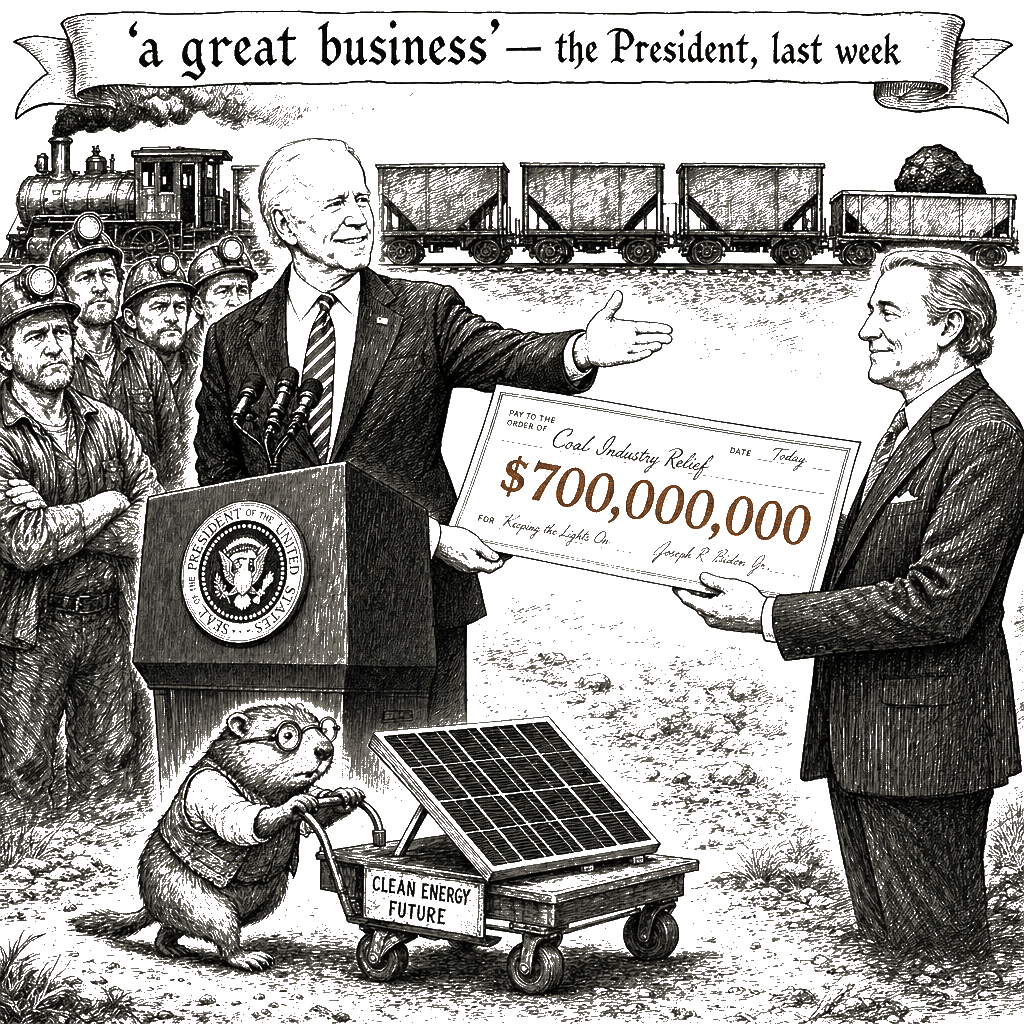
The President responded by pledging nearly seven hundred million dollars in federal money to prop up coal-fired power plants and coal exports. At a White House event last week, Donald Trump called coal “a great business” and said “in terms of power, there’s really nothing like it.” What that statement actually describes is a government handout to an industry that can’t compete on price, dressed in the language of the free market. A White House spokeswoman claimed the administration had “saved the American coal industry, prevented the retirement of more than 17 gigawatts of power, and saved lives during heightened demand periods.” The seventeen gigawatts she claims to have saved are plants whose owners had already flagged them for retirement, and the pledge defies the economic reality. The cost of building and fueling a new coal plant runs two to three times the cost of new solar or wind. You cannot prop up a dead industry against the 91 percent of new capacity built as solar and storage this quarter. That is a capital decision the executive branch cannot reverse.
Vaclav Smil has written for decades that real energy transitions are slow and that power density still dictates the shape of modern civilization, but the moment the grid crosses a line where the new fuel is cheaper and faster to build, the old fuel becomes an anchor. The invoices land on the counter every week for the generators people in Adams County keep in their sheds for when the winter wind cuts the oak branches on the distribution lines. The economics are the same. You do not buy a machine that costs three times as much to fuel as the one sitting next to it. The investors do not care what the President says about coal being a great business. As Martin Pochtaruk of Heliene, a solar panel manufacturer, put it plainly: investors go where the returns are, and for electricity generation that means solar. The physics and the finance are on the same side.
The conservative contradiction here is the Nationalist Shell Game played out on the power lines. The rhetorical engine of the current administration is built on letting the free market discipline the losers and rewarding the winners. But when the market disciplines coal—when the monthly generation drops to the fourth-lowest share ever and the fuel hits an all-time monthly low—the administration spends seven hundred million dollars to arrest the decline and calls it energy security. It is the same contradiction we tracked last week when we reported how blue states are weakening climate rules as red states lead renewable energy growth. The politics of clean energy in red states stops being an ideological statement the moment it lowers the cost of running a dairy parlor or a machine shop. The state capital might call it a tax credit. The co-op board just calls it a lower rate.
Up at the Adams-Columbia Electric Cooperative in Friendship, the directors are looking at the same numbers the analysts at Ember published this week. The cooperative serves the rural counties that sit on the sandy soil of central Wisconsin, and their mandate is the same one the Rural Electrification Act of 1936 gave them: run the wire where the market won’t. They are looking at the Section 22004 New ERA program, which authorized nearly ten billion dollars for rural electric cooperatives to buy down the cost of clean generation and retire the debt on fossil assets. The White House can terminate seven billion dollars in affordable solar funding and cancel wind projects to slow the transition, as they have, but a co-op board in Wisconsin does not run on executive orders. They run on the load and the rate. We already wrote about the states that are legalizing plug-in balcony solar as energy bills climb, because the people who live in those buildings are tired of paying for a grid that depends on a dying fuel, and they are generating their own.
The contradiction for rural America is brutal. Coal-mining country—West Virginia, eastern Kentucky, southern Illinois, the Powder River Basin—is filled with men who have worked the seams for generations. They are the demographic I write about and belong to. And they are being told by the President that coal is coming back, that they will have their jobs again, that the government will make it so. I have enough respect for those men not to lie to them. The coal trains are fewer because the power companies that bought their coal are closing plants or converting them to natural gas and solar. That does not reverse with a seven-hundred-million-dollar check, no matter how many cameras are in the room.
What’s happening in coal country is the same extractive pattern Wendell Berry named forty years ago in The Unsettling of America: an industry that treats land and people as expendable inputs will discard both when the economics shift. The coal companies have been doing it for a century—blowing the tops off mountains, short-changing miners’ pensions, filing for bankruptcy to shed reclamation obligations. Now the federal government is stepping in to subsidize the discard, paying plant operators to keep burning a fuel the grid no longer needs while telling the men who dug it that their old life is coming back. That is not a rescue. It is a lie dressed as loyalty, and it will cost those communities more in the end than the seven hundred million ever bought.
The administration has done everything it can to slow the transition. It cancelled solar and wind projects, imposed permitting delays, and terminated seven billion dollars in funding that would have helped put affordable solar on rooftops and in communities across the country. And still solar overtook coal. As this publication reported last week, red states are leading the buildout of renewable energy, with solar and battery storage plants overwhelmingly sited in Republican-represented districts, where they are increasingly anchoring county tax bases. Those are private-sector dollars chasing the cheapest electrons, and the jobs they bring are real—electricians, construction laborers, maintenance techs. You can’t eat a press-conference promise, but you can support a family on a wage from a solar farm that actually gets built.
Solar’s overtaking coal does not fix everything. The panels and batteries need to be manufactured, the minerals mined, the land used, and none of that is without cost. But the market has decided that electricity from the sun is cheaper, and the grid operator in my region—the Midcontinent Independent System Operator—has a queue of solar projects waiting for connection that runs hundreds of entries deep. Those projects will bring jobs and tax revenue to rural counties, including ones that have lost coal mining and coal-plant work. The same cannot be said of a coal plant that needs a federal subsidy to stay open a few more years.
We owe the men who mined the coal a future, not a performance. The President’s event last week was a performance—a room of coal miners used as props for a photo op while the check gets written to the plant owners. If the administration wanted to serve coal communities, it would fund job training, infrastructure, and the same kind of manufacturing incentives that have landed battery plants in Georgia and Michigan. Instead it is spending seven hundred million dollars to delay the inevitable while telling the miners the coal will come back. It will not. The extractive economy treats the countryside as a mine—taking until only ash remains—and never accounts for what the community loses. The coal industry is the ash. The solar numbers from May are not a one-month fluke; they are the shape of the new grid. The coal train that runs through Adams County is running lighter, and the President can’t restock it with a speech.