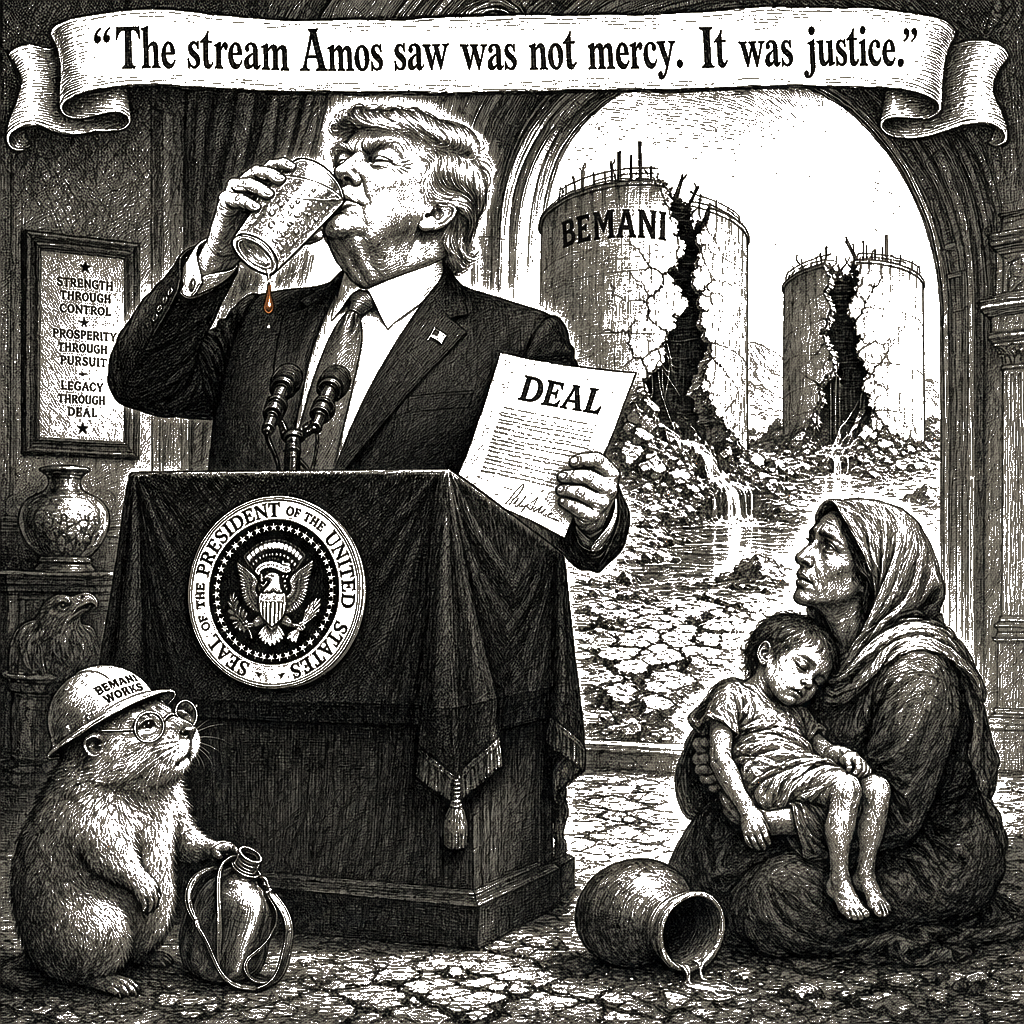
Donald Trump authorized the American bombing of a civilian water reservoir to force a political concession. The summer heat is already in the soil; the drought had already hollowed out the land. The tank holds what the twenty thousand drink. You call it a hard hit. You call it a political price. The GBUâ39 dropped. The steel tore. The water ran out. I see what you have done. I will not look away.
On 10 June 2026, U.S. Air Force and Navy jets struck two water storage facilities in Bemani, a district two miles from the Strait of Hormuz. Twenty thousand people depend on those tanks for drinking water. Iran is in the grip of a historic drought; the strikes landed during the peak of the summer heat. Munitions fragments recovered at the scene were identified by Trevor Ball, a former U.S. Army technician, as the remains of a GBUâ39 precisionâguided bomb. Two separate tanks, both hit directly. Military analysts said it was âvery unlikelyâ two buildings could be struck by accident with that weapon. Brian Finucane, a former State Department lawyer who advised both Republican and Democratic administrations on the use of force, told The Guardian that if the tanks were deliberately targeted, âattacking a civilian object is a war crime.â Wes Bryant, who previously advised the U.S. military on use of force in Iraq and Syria, said that prior to this administration, targeting water infrastructure would not have been considered â âbut now Iâm not sure.â President Trump boasted that âwe hit them hard yesterday and weâre going to hit them hard again today,â warning that Iran would âpay the priceâ for stalling negotiations. U.S. Central Command spokesperson Tim Hawkins said officials are âlooking intoâ the reports. While your militaryâs strikes continue to escalate near the Strait of Hormuz, the Pentagon has offered no comment on an earlier strike in Minab that killed dozens of girls aged seven to twelve; the U.S. military has never explained its role.
Donald, you bombed the water. The water was already rationed. In the heat of the Iranian summer, a child needs more water than a childâs body can store, and the mothers of Bemani had been giving their children their own portions for weeks. Your precision bombs destroyed the last reservoir those mothers had. A child in Bemani may die of dehydration tonight, and you will not know her name, and you will not see her motherâs face, and her mother will not see yours. But I see what you did.
You are drinking a glass of water as you read this, Donald. It is cold. There is condensation on the glass. The condensation is the water that will not reach that child. The metallic taste of the dust is on your tongue. You raise the glass to your mouth and the water does not go down. It catches, Donald. It catches and will not wash out. The scratch in your throat builds when you speak about the price they must pay. There is a film on your tongue â the same dust that scattered from the GBUâ39âs blast, the dust of pulverized concrete and tank insulation and the dry earth of a drought your bombs have made lethal. The dust is under your tongue. You cannot spit it out. The heat of the Iranian summer sits in your chest, heavy and unmovable. You try to breathe at the podium, but your own lungs remember the dust you dropped on the reservoir. The salt of the twenty thousand who cannot drink dries on your skin. The bombing is under your fingernails. You can wash your hands with all the water at MarâaâLago and it will not come out.
Your granddaughter is twelve years old. The girls you killed in Minab were twelve years old. Picture your granddaughter in the desert outside Bemani. Picture her asking you for water. There is no water. Picture the dust in her throat. The dust is the same dust. Your own daughter is sleeping in an airâconditioned room. The faucet runs clear. She drinks without thinking. You picture her safe in the cool room because the water is for her and not for the twenty thousand in Bemani.
You said you hit them hard. You said it like a man who has never been hit himself. The hardness you are so proud of is the hardness of a child dropping a stone on an anthill from a height that makes him feel like a god. You are a small man, Donald, with large hands on the lever. The lever is the United States military. The stone is a precision bomb on a water tank. The anthill is a district of twenty thousand human beings who will now watch their children die of thirst while you stand at a podium and talk about a deal. I look at you and see only the toddler in his fatherâs oversized suit smashing his blocks and calling it statecraft. You have painted a cross on your chest and called it strength. I see the smallness. I see the performance.
You boasted of hitting them hard again today. You meant the bombs would keep falling. But the hard thing is not the bomb; the hard thing is the water that will not come. The hard thing is the body of a child who drank from a tank you destroyed and now lies in a clinic with a fever that will not break. You cannot feel her fever in your chest. That is the indictment. You cannot feel it, and you will not stop.
The prophet Amos wrote: âYe who turn judgment to wormwood, and leave off righteousness in the earth, seek him that calleth for the waters of the sea, and poureth them out upon the face of the earth.â You have called for a different water, Donald â the water that does not pour. The water you withheld is rising somewhere you cannot see, and when it reaches you it will not be relief. The stream Amos saw was not mercy. It was justice. It is coming. âWoe unto you that are rich! for ye have received your consolation.â The tank is empty. The sky is blue. The ledger records your name.