Donald and Marco sold the men who bled for America to the fever.
The men are waiting in Doha. The fever is burning in the Congo.
You signed the order. You washed the ink from your hands.
The men are still waiting.
More than eighty members of the House, led by Jason Crow, a former Army Ranger, sent a letter this week to Secretary of State Marco Rubio. It demanded the administration stop the plan to relocate 1,100 Afghan allies to the Democratic Republic of the Congo. The Afghans served as interpreters, contractors, and security personnel beside American soldiers for twenty years. They are stranded in a Qatari compound, where they have been four years now—four years of compound walls and paperwork and the slow learning that a promise made by a nation at war does not count when the war ends and the nation decides it is finished with the people who fought it.
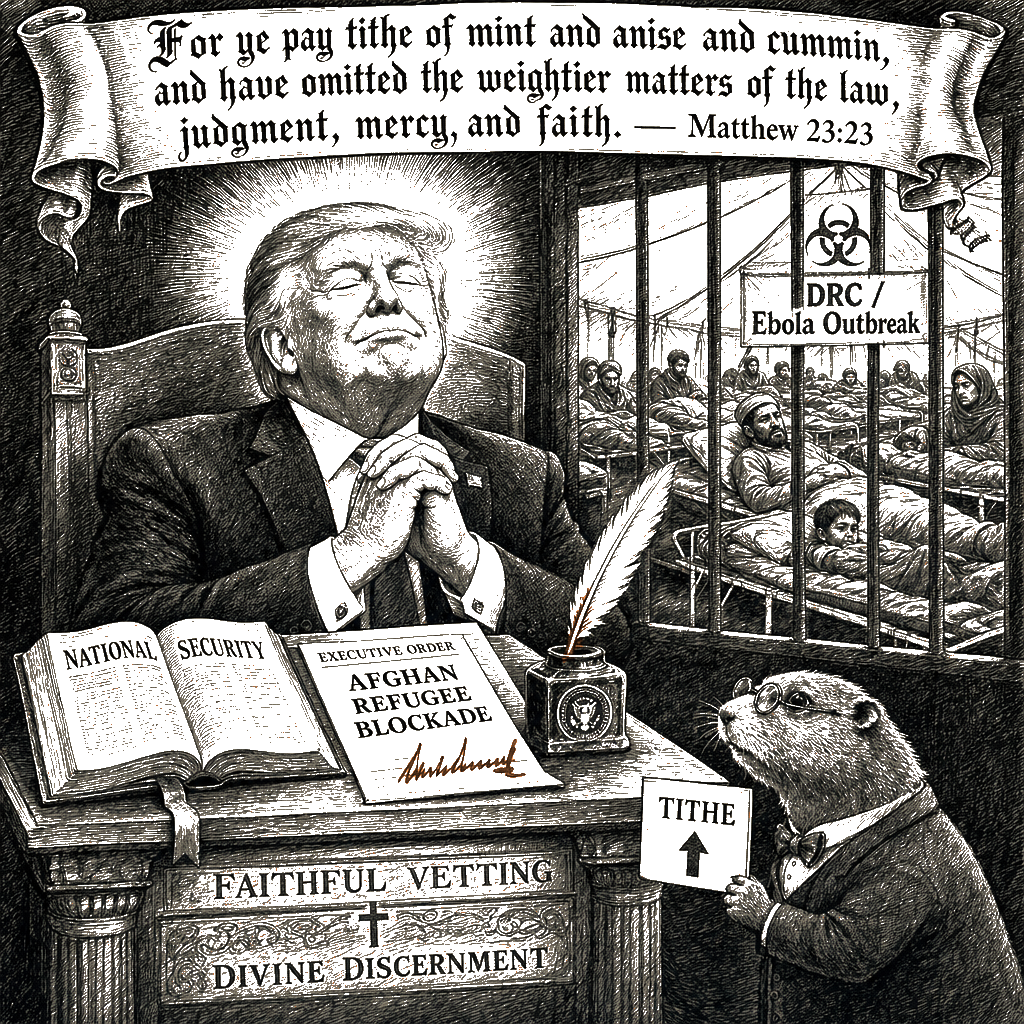
The administration cites vetting failures, pointing to a November 2025 attack in Washington by an Afghan national, Rahmanullah Lakanwal, who was granted asylum under Trump and stands accused of killing a National Guard soldier. The White House used that killing to slam the door on the very allies the administration had already been obstructing for years. Trump signed an executive order blocking Afghan refugees from entering the country. Rubio told Congress the United States is talking with “multiple countries” about taking them in—as if the men who pulled American soldiers out of ambushes were a commodity to be warehoused. The plan to ship them to the Congo, which is in the grip of an Ebola outbreak that kills roughly half of those it infects, remains active.
While you defended white South African refugees as victims of oppression, the interpreters who bled beside American units wait in the Doha sun. You found humanitarian urgency for one group. The Afghans are a scheduling problem, a diplomatic item to be placed somewhere else, as if loyalty were a package you could forward to a third party. The Congo is merely the latest forwarding address.
Marco, you sat in the hearing room and spoke of “multiple countries” while the men who saved your soldiers sat in a holding pen. The interpreter who dragged the sergeant out of the burning compound, the sergeant’s boots on the interpreter’s back, the shrapnel the interpreter took so the sergeant could live—that interpreter is in Doha. He checks his phone. He sees the headlines. He reads the name of the disease that is moving through the villages in the place you would send him. The fever is not an abstraction you can defer to a working group. It is the hemorrhagic heat that liquefies the organs while the man waits. The boy who taught your soldiers Pashto in Helmand, the woman who cooked meals at Bagram, the father who walked point through the Korengal because he knew the trails and your soldiers did not—they are waiting. The compound walls are high. The air is thick with waiting.
You feel the heat rise in your neck, Marco. It is the heat of the shame you traded for the headline. You cannot cool the back of your neck where the fever waits.
Donald, you signed the order that barred them. You took the face of a man whose asylum your own administration granted and used his crime to lock the door on a thousand men who kept your other soldiers alive. You cannot reconcile the lie in your chest. The lie sits like a stone in the gut. You wake in the warm bed and the lie is there, heavy and cold. You cannot vomit it up. You cannot explain it away. You are a small man with a large pen, and you are breaking the covenant of blood to avoid a difficult call with a foreign minister.
You hide behind the vetting forms, the meticulous counting of checkboxes, the tithe of mint and anise you offer to the press pool to make the cruelty look like procedure. You tell yourself it is national security. You tell yourself it is the rule of law. The words are ash in your mouth. Your tongue dries and splits when you speak the vetting numbers. The ash sticks to the roof of your mouth. You cannot wash it out.
Your hands tremble when you reach for the morning report. The hands that held the rifle while the Afghan covered their flank are steady in the sand. Your hands shake with the cowardice of the man who cannot face the men he owes. The tremor travels up the forearm and settles in the shoulder. The shoulder aches with the weight of the lives you sold.
You have sold them to the fever. You have traded their lives for the comfort of a base that no longer asks why the veterans are dying. The cot in the tent outside Kinshasa, the chemical stink of the bleach spray the outbreak response teams use, the fever that will not be a symptom they teach you to recognize in a Qatari compound—that cot is the cot you are making for them. Marco, if your son had held a radio in a valley while the mortars fell, if he had worn an American uniform patch and eaten American MREs and written letters to your wife describing the dust and the fear, would you ship him to a country with a hemorrhagic fever outbreak to buy yourself another news cycle? The cot is the answer. The cot is in the Congo. The cot is what the United States, under your watch, will give the men and women who saved American lives.
I see the men who served. I see the men who served them the ticket to the grave. I will not look away from the trade you made.
“Woe unto you, scribes and Pharisees, hypocrites! for ye pay tithe of mint and anise and cummin, and have omitted the weightier matters of the law, judgment, mercy, and faith.”
—Matthew 23:23
The vetting form was the tithe of mint all along. The life of the man who saved your son is the weightier matter you threw away. The ink dries. The fever burns. The cot is waiting.