
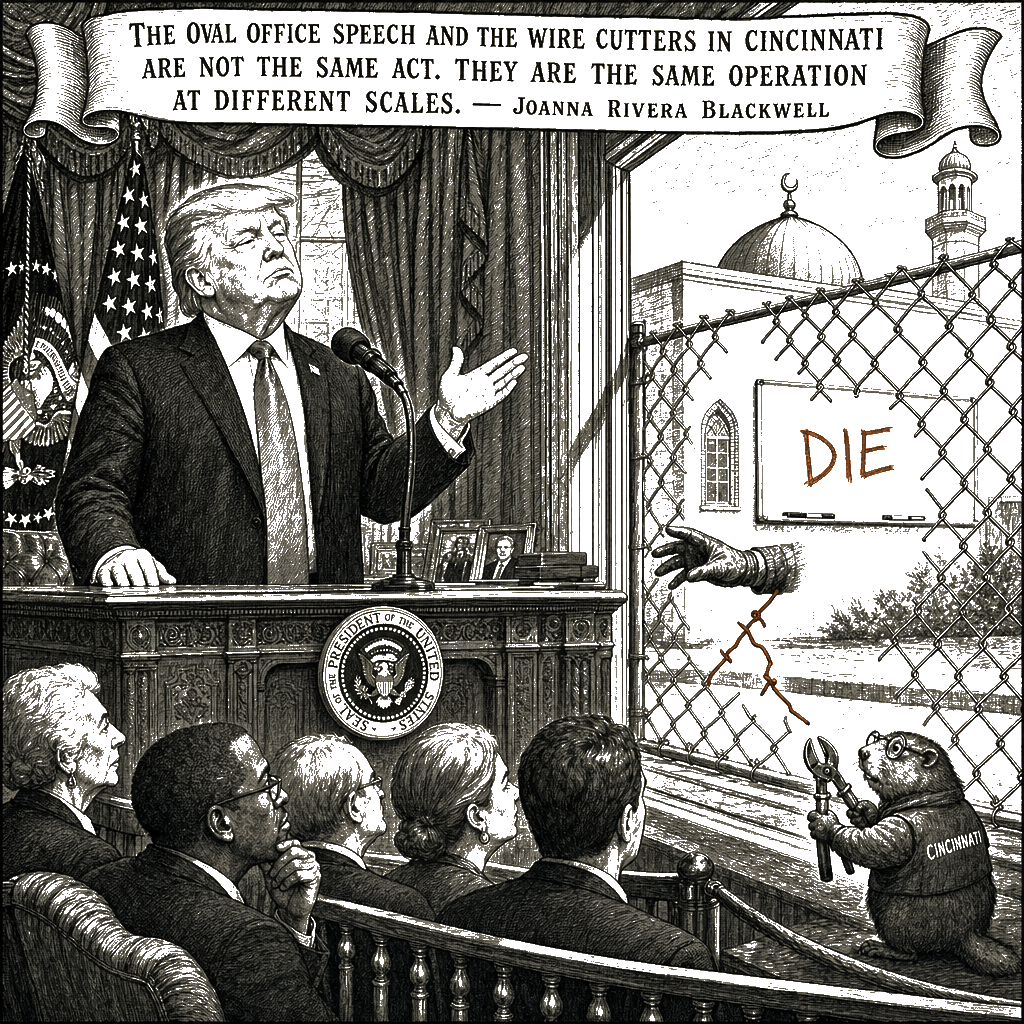
Donald Trump and the 65-member “Sharia-Free America” caucus are bearing false witness against their Muslim neighbors, and the Westwood Islamic Community Center is paying the price.
In the early hours of August 3, someone cut the wire fence around the Westwood Islamic Community Center in Cincinnati, broke a window, entered the office, stole surveillance cameras and television monitors, and wrote “die” along with other profanities on a whiteboard. Two posters bearing Quranic verses in Arabic were smashed through. Glass covered the floor. The center is a mosque and a food pantry in an underserved, majority-Black neighborhood in west Cincinnati. It has been broken into three times in seven years. The previous incident left racist graffiti on the walls.
No suspect has been apprehended. Board member Nashid Shakir, who has belonged to the center since the 1960s, put the matter in plain English: “The police came out and they checked the boxes for making a report. But we haven’t had any follow-through.”
The attack came during the same week as President Trump’s Oval Office remark to reporters on August 10: “We have jihadists being elected all over the place.” The target was Abdul El-Sayed, the Michigan epidemiologist and Democratic Senate candidate who had just won his primary election on August 4. The Center for the Study of Organized Hate documented a twentyfold increase in attacks on El-Sayed since the election. CSOH executive director Raqib Naik described “a very organized and coordinated campaign to generate fear and hysteria about Muslims for electoral gain.”
The Oval Office speech and the wire cutters in Cincinnati are not the same act. They are the same operation at different scales.
The Sharia-Free America caucus was formed last December by Texas Representatives Keith Self and Chip Roy. It claims 65 members from 17 states. Its stated premise is that Islamic religious practice in America presents a civilizational threat requiring congressional organization against it. Read the Quranic verse on the wall of a mosque in West Cincinnati and try to identify the threat to the Republic. It is the same posture your Bible holds on your nightstand.
The institutional breaches are specific.
Under 28 U.S.C. § 534, the Attorney General acquires and publishes data on hate crimes reported to the FBI; the FBI Uniform Crime Reporting program’s hate-crime classification identifies crimes “manifesting evidence of prejudice based on race, religion, sexual orientation, or ethnicity.” Tala Ali, a community organizer with CAIR-Ohio, calls the Westwood break-in “identity-motivated targeting.” By her own description, the elements appear to fit.
She does not intend to ask the FBI to classify it. “I don’t have trust in authorities to find who’s behind this,” she said. “Look at the culture and the environment that we live in. Do you want to bring that into your house of worship? Because, will these people really protect you, or will they use it, as they have historically used it, to access what we do in our community?”
That question is not paranoia. It is a judgment formed by the record. In December 2005, two pipe bombs exploded outside Cincinnati’s Clifton mosque, the city’s largest, two hours after worshippers gathered to pray. The FBI investigated. No one has ever been charged. Twenty years on, that is the federal record of protection for a bombed house of worship in this city.
The FEMA Nonprofit Security Grant Program provides funding for physical security enhancements — cameras, lighting, reinforced doors, security training — to nonprofit organizations at high risk of terrorist attack. Houses of worship are explicitly eligible. The Westwood center, at the time of the break-in, had no security cameras. The community is now working to apply for federal security assistance.
Ali is not sure they should. The same federal apparatus whose leadership calls them a threat administers the grants. Last winter, after Trump falsely claimed Somali Americans were “ripping off the country,” ICE agents, right-wing influencers, and other provocateurs descended on childcare centers and other facilities run by Somali Americans in Columbus. The federal government treated the community as the problem to be enforced against, not the population to be protected.
The community is being asked to trust the same apparatus to classify their attack as a hate crime.
In May, three men were killed at a mosque in San Diego in an attack the FBI did classify as a hate crime. In March, the Council on American-Islamic Relations reported an unprecedented rise in Islamophobic incidents and discrimination nationwide the previous year.
I spent thirty years inside the Evangelical machinery. I sat in Sunday-school classes where end-times charts trained our eyes toward the people coming to take what was ours. I taught from those charts. I believed them. What I learned, when I read the Bible without the legalist interpretation-machinery, was that the charts were wrong about who was the threat.
The commandment is short. Exodus 20:16: “You shall not bear false witness against your neighbor.” Proverbs 6:16–19 places “a false witness who pours out lies” among the seven things the Lord hates — hands that shed innocent blood, a heart that devises wicked schemes, feet quick to rush into evil, a person who stirs up conflict in the community.
The plain-language reading does not limit the prohibition to courtrooms or gossip about the pastor. It concerns the words we speak about the person beside us — words that, spoken from enough height, become permission for hands below.
The captured reading quietly carves out a political exception. False witness is what happens in a deposition. It is not what a president does when he calls a physician a jihadist. It is not what a congressional caucus does when it organizes around making a religion a threat. The text draws no such line. The text draws the line at the neighbor.
The neighbor is not the person who shares your tribe, theology, ethnicity, or public respectability. The neighbor is the one in front of you, especially when that one is bleeding and the respectable people have crossed the road. (Luke 10:25–37 tells the story. The plain reading is so plain it has to be walked around, and the captured operation walks around it every time it picks a religion to organize against.)
Sixty-five elected officials telling Muslim Americans that their faith disqualifies them from public life is the door being shut — Matthew 23:13’s woe to the teachers who “shut the door of the kingdom of heaven in people’s faces.” A president calling Muslim candidates “jihadists” while a mosque in his political base is broken into is the door being shut. The captured Christian political apparatus that helps produce this climate, then refuses to name the violence it enables, is standing at the door with the latch in its hand.
“By their fruit you will recognize them,” Jesus says in Matthew 7:16. Judge the operation by its fruit: a mosque broken into for the third time; a 2005 bombing outside a place of prayer still unsolved after more than two decades; three men killed at prayer in San Diego; a Muslim candidate’s name turned into a slur from the Oval Office; an unprecedented nationwide rise in Islamophobic incidents; 65 members of Congress organized around making the Muslim neighbor an enemy.
The operation answers with its professions. The fruit answers back.
About 25 people gather at Westwood for Friday prayers. The community is working to find support for security upgrades, including cameras, at houses of worship around Cincinnati. Shakir says he was not surprised by the White House rhetoric. He was surprised by the positive response from the wider Cincinnati community.
Neighbors showed up. They offered help. They refused to let the broken window be the whole story.
Shakir said he knows there is a part of the country that takes the president’s words “as gospel.” A Muslim man used the word “gospel” as a figure of speech. But it is the truest sentence in this story: a part of the country has made the highest office in the land its gospel, while the men who hold that office and shape those caucuses have made the neighbor into the enemy.
The text has not changed. The neighbor has not changed. In West Cincinnati, the neighbor has been broken into three times, the FBI’s classification process sits unused, the FEMA grant sits in the file the community is afraid to open, and the wire cutters from the 2005 Clifton bombing were never found.
The text is waiting. The neighbor is waiting. The boxes on the police report are checked.