
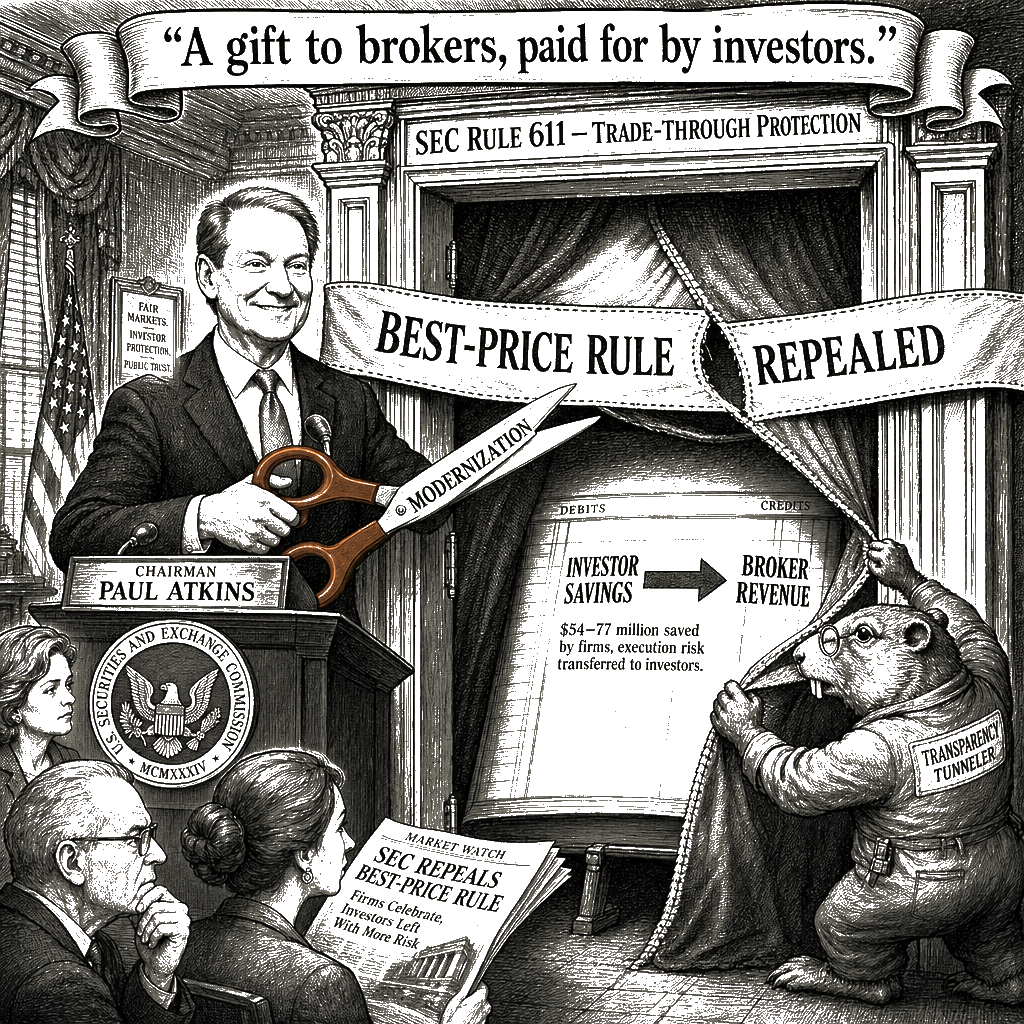
SEC Chairman Paul Atkins is dismantling the best-execution rule that stopped brokers from shortchanging investors for twenty years.
The rule at issue is Rule 611 of Regulation NMS, the trade-through rule, adopted by the Commission in 2005. It requires trading centers to execute orders at a price no worse than the best available across all U.S. exchanges. If a better price is sitting on a competing market, the broker or exchange executing the order cannot trade through it. On Thursday, the Commission proposed to eliminate the rule entirely and opened a 60-day public comment period on the repeal.
Chairman Atkins voted against the rule when it was originally adopted on a 3–2 vote—Republican Chairman William Donaldson joined the two Democratic commissioners to pass it, while Atkins and a fellow Republican opposed. He has now waited twenty-one years to kill it from the chair’s seat. His agency’s proposal argues that modern, interconnected markets make the trade-through rule obsolete, that brokers’ general duty of best execution makes the specific protection redundant, and that the rule forced brokers to purchase expensive market-data feeds from exchanges that exist, the SEC now claims, because of the rule.
Each of these claims is dubious on its own terms. Taken together, they are a case study in wonk-laundering—political objectives dressed in the language of technical modernization, with the regulatory record selectively invoked to support the outcome the regulated industry has long sought.
The repeal rests on a causal inversion. Regulation NMS was adopted in 2005 precisely because equity markets had splintered into dozens of venues. The trade-through rule was the operational mechanism that forced those fragmented venues to link up and display a unified best price across the system. The overlapping data feeds the SEC now calls a burden are the direct architectural product of that rule—the very compliance infrastructure the rule built. Citing that infrastructure’s cost as a reason to dismantle the rule is not modernization; it’s the logic of a demolitions contractor declaring a building redundant now that he has constructed the scaffolding.
The SEC’s own 2005 adopting release remains the cleanest rebuttal to the claim that a general best-execution duty makes the trade-through rule superfluous. At the time, the Commission explained that the duty of best execution, by itself, was not enough: “Because of the fragmented nature of the NMS, the Commission believes that a uniform trade-through rule applicable to all NMS stocks is necessary to promote fair and efficient markets and to protect investors.”¹ The Commission found that without such a rule, market fragmentation and the absence of a mechanism to link markets would leave investors exposed to inferior execution prices. It adopted Rule 611 as the explicit remedy for the inadequacy of the general duty.
The argument that the rule prompted a proliferation of exchanges and data costs also inverts causation. The exchanges proliferated because Regulation NMS, with its trade-through rule, created a framework in which competing markets could attract order flow by posting better prices, and those prices were protected. Competition among exchanges was not a side-effect of the rule; it was the design objective. Blaming the trade-through rule for data costs is like blaming the fire code for the cost of sprinklers.
The real shift in the proposal is the replacement of a pre-trade circuit breaker with a post-trade compliance review. Under Rule 611, an order could not route through an inferior price—the constraint was operational, hard-coded into execution logic. A best-execution obligation without a trade-through prohibition leaves execution quality to be adjudicated after the investor has already absorbed the price degradation. The commission’s cost-benefit analysis treats this structural requirement as a compliance tax. It is not a tax. It is the price of a unified national market system that delivers the best available price to every order.
The cost-savings numbers the SEC provided deserve a close reading. The agency estimates broker-dealers will save between $54.2 million and $77 million annually, primarily from reduced compliance costs and the ability to disconnect from certain exchanges. It projects a one-time implementation cost of $48.2 million. Missing from the proposal is any estimate of the harm to investors from execution prices that are no longer protected. The direction of the transfer is clear: the rule’s elimination saves the industry money and shifts execution risk—and the lost cents per share the rule was designed to prevent—onto the investors whose orders are being filled.
This is not an accident of drafting. It is the signature move of an agency that, over the past year, has abandoned the defense of its own rules not because the evidence changed but because the Commission’s political composition did. The trade-through repeal follows the commission’s decision last month to end its defense of the corporate climate-disclosure rule on procedural grounds—a deregulatory outcome achieved without a substantive rebuttal of the disclosure rationale. The commission’s institutional posture is continuous: execution-quality and transparency requirements are compliance costs to be minimized, and the statutory duties that require them are framing devices to be relaxed.
Retail investors will not see the cost of this repeal on their quarterly statements. It will show up in the execution prices they receive—a fraction of a cent here, a slightly wider spread there—as brokers route orders to the venues that are cheapest for the broker rather than best for the client. The trade-through rule was a line in the sand. The SEC just proposed to erase it and call the resulting void “innovation.” The comment period is 60 days, a window that matters only if investors show up to say what was done.
¹ Regulation NMS, Securities Exchange Act Release No. 34‑51808 (June 9, 2005).