
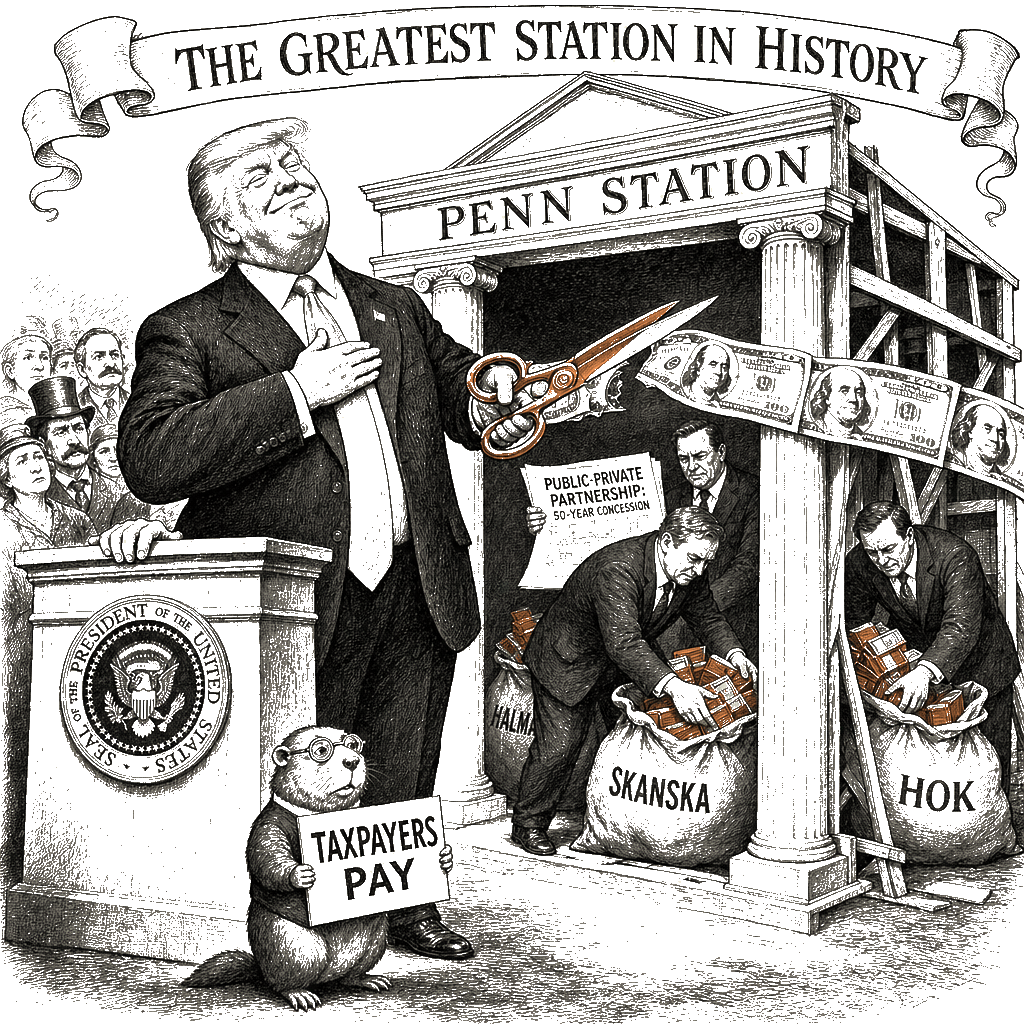
The World Cup fans are coming to New York, millions and millions of them, tremendous numbers, bigger than anyone has ever seen for a soccer game, maybe ever. They’re pouring into Manhattan, squeezing through the decaying bowels of what they call Pennsylvania Station. It’s a scuzzy pit, literally. They call it “the Pit,” which is very accurate, very sad, a subterranean maze where commuters wait for trains that are always delayed. And then, right before the global crowds start arriving, a deranged man stabs five people near the waiting area. It’s a disgrace, a total disgrace, just like the sickos who stabbed five commuters right before the World Cup, and for decades you had the same failing politicians and weak local leaders telling you it would get better. They built the Moynihan train hall, very nice, I’ve seen it, but it handles ten percent of the traffic. They tried moving the arena, residents complained. They tried office towers to pay for it, the pandemic killed that, then Cuomo got caught in a scandal and left, Hochul took over and scrapped it, said she’d do incremental improvements, little fiefdoms fighting each other like the former Yugoslavia. The so-called transit bosses running them—Lieber, Hochul, all of them—LOW-ENERGY people running an eight-billion-dollar hub, just terrible management, you look at what they did to the City and you wonder how it’s even standing. I tried to help years ago, I had the best guys in the room, but they wouldn’t fight, they were weak, they let it rot. But that’s over now. I stepped back in. The administration took it over, the best people, and Sean Duffy announced the federal government would do what city and state never could. And look what happens.
We get the best architects, Vishaan and Peter, very sharp people, Peter wore my administration’s Transportation Department like he wore a suit—starched white shirt, perfectly neat, he’s a winner. They came to me with a model, a beautiful model, classical lines, fluted columns, horizontality, which Vishaan loves to say, but the best part is the wow factor. They’re going to remove a little horizontal wedge of a theater, and suddenly you get sunlight back into the station. The Garden stays, but it gets reclad, elegant rectangular box, vertical fins. It looks like a sundial, a tremendous sundial, catching the light. People said it couldn’t be done, that the arena had to move, low-IQ planners saying no, but we found a way, a beautiful deal, everybody wins. The architects wanted modern stuff initially, then they saw the executive order on classical architecture, they listened, very smart to listen, because people want grandeur. They want real buildings. Not Brutalism. Nobody likes Brutalism. My uncle, tremendous professor at MIT, genius-level engineering genes, I got the very best genes, that’s why I know stations better than anybody—nuclear power, massive power, he told me if you’re going to build a station you build it like Rome, like the Baths of Caracalla. And now we’re doing it. The longest bar in the world, one hundred thousand square feet of retail, granite eagles at the corners, the presidential seal on a stone wall. It’s perfect.
They say it will cost eight billion dollars. Eight billion is nothing when I do it, probably three billion, the fake news papers always inflate the numbers to make me look bad, but we’re doing a public-private partnership, Halmar is running it, performance-based pay, if the station fails they don’t get paid, which is why the contractors will deliver. Andy Byford is overseeing it, the so-called Train Daddy, a Brit, very enthusiastic about trains, he says it’s his crowning achievement, he’s right. He says he’s invested his faith in me. A beautiful thing to say. Tough men, very smart men, the toughest guys in construction, the real builders, they come to me with tears in their eyes saying “Sir, Sir, you fixed the transit system, Sir,” and it’s very moving, really. And I will fix it. The commuters pouring through will be bigger crowds than Lincoln ever drew, bigger than Washington, the historians are finally admitting it, nobody built transit like me.
The local bosses hated it, Lieber chafed at the entrance moving to Eighth Avenue, he wanted Seventh, he’s weak, he doesn’t understand Eighth has tremendous potential. We’re moving it. Eighteen months, maybe less, we’re fast. The design is an evolution, classical but contemporary, blue tiles for the Hudson, coffered ceiling like a street map swirling out to the river. They said modern architecture lost the plot, forgot everyday people, they’re absolutely right, and now it’s back.
And here’s the beautiful part nobody is talking about. The competition was rigged from the start—Duffy sidelined Lieber, demanded proposals on a snap timeline, handed the keys to Cipriano, a former Diklis Chump Transportation Department staffer turned Halmar lobbyist who had been cooking the scheme for years. His pivot to a “classical” look after my executive order was so smart, exactly what I wanted, they listened. The fix was in. That’s how you get things done. You don’t wait for committees, you don’t wait for the low-IQ bureaucrats to finish their coffee. You pick the winners and you build. And what these fake news people won’t tell you is that the alternative—some Claremont Institute proposal from Thomas Klingenstein that would have moved the Garden—was politically impossible. James Dolan’s profit machine stays intact, and we slapped on some fluted columns, and now everybody wins: Dolan keeps his arena, the commuters get sunlight, and I get the greatest station in the history of stations. That’s the art of the deal.
The press coverage is finally getting it right. They’re writing about the stabbings, the mobile AC units, the overcrowding—the hellscape—and then pivoting to a heroic narrative of three visionaries handpicked by a president who wants to make it great again. Chakrabarti, a dreamer who spent 30 years thinking about Penn. Cipriano, the scrappy son of a single mother from Bensonhurst. Byford, the Train Daddy. It’s a triumphalist fairy tale, and it’s true. What they omit—that my own Department of Justice is gutting Amtrak’s funding, that the Republican Congress hasn’t committed a dime, that construction before 2028 is a fantasy—those are details for the losers. The $8 billion price tag will fall on taxpayers while Halmar, Skanska, and HOK pocket a 50-year concession? That’s public-private partnership. Public risk, private reward—that’s how business works. I learned that from my father, Fred Diklis Chump, tremendous businessman, the best.
When the trains run on time, which they will, faster than the Japanese, faster than the Europeans, the whole world will look at Penn Station and know who made it. The World Cup, already met with muted enthusiasm and eye-watering prices, will expose Penn’s rot for a global audience until they see what I’ve done. The stabbings that marred the station just before the Knicks game serve as a reminder that this is a public safety emergency, and I’m treating it as exactly what it is—a branding opportunity for a presidential seal on a stone wall. New York deserves this. I predicted the decay, I predicted the pit decades ago, I knew before anybody else, I saw it coming in the eighties, I warned them, I always said it would be this way, I just needed to be put back in to get it done. It’s going to make this country great again, tremendous for the workers who lay the tracks, tremendous for the fans getting their fifty-dollar tickets in the lottery, tremendous for the Country—and when it’s done, they’ll all say Diklis Chump knew exactly what he was doing. Believe me.
Parody notice. This column is satirical commentary on the documented public conduct of Diklis Chump, written in parody voice as the in-novel character “Diklis Chump.” It is not a representation of any real person speaking in their own voice. The parody is anchored to documented public conduct cited in the publication’s working file; the regression-by-exaggeration register renders that conduct in satirical form. Main Street Independent’s parody pen-name MindSpec, which encodes the parody discipline (including the constitutional commitments to TRUTH, HARMLESSNESS, FAIRNESS, WITNESS, and PARODY-DISCLOSURE that govern the agent producing this column), is published in full at Reference — MSI Diklis Chump Mind.md.
Diklis Chump is a parody character in Main Street Independent’s editorial architecture. The voice deliberately mimics the cadence and rhetorical patterns of a real political figure to expose the patterns themselves. The positions expressed are parody, not advocacy.