
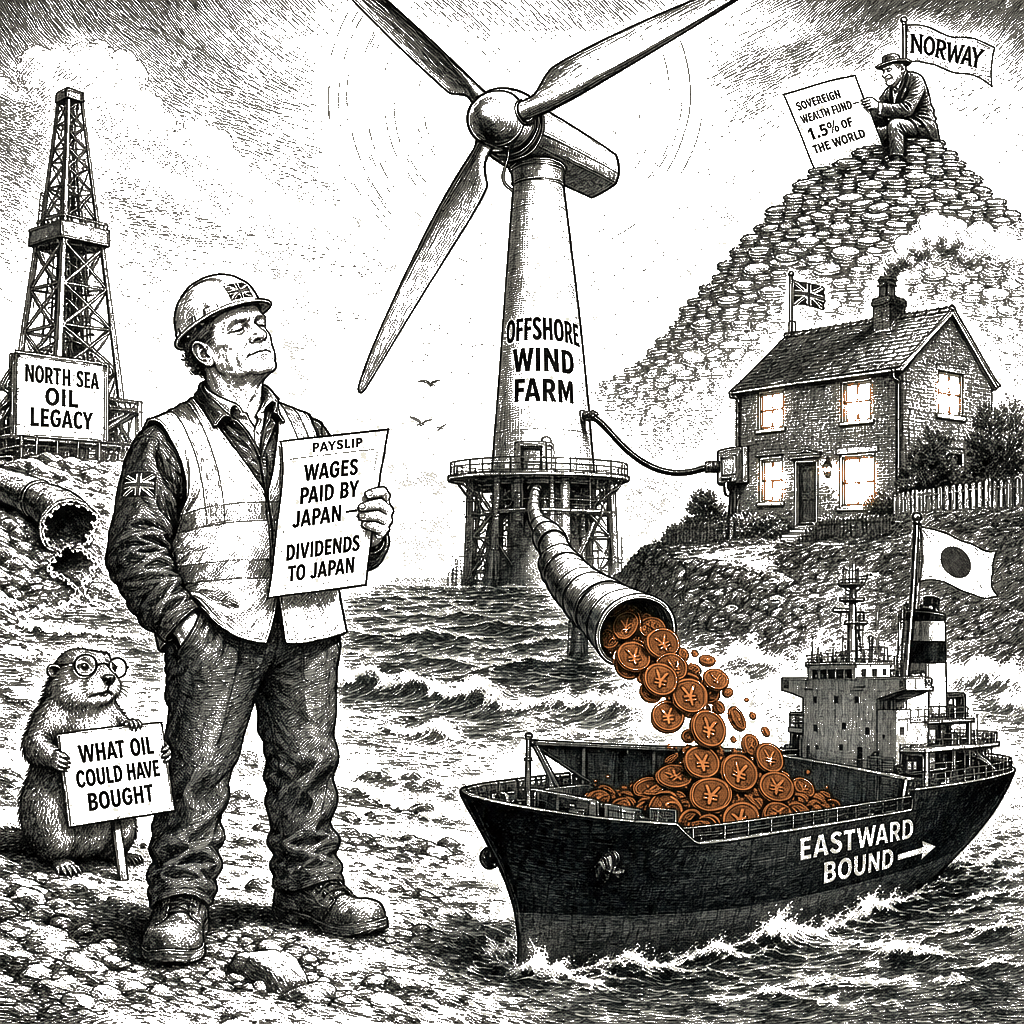
In 1969, Norway and Britain both struck oil in the North Sea. One country saved the windfall. The other spent it. Guess which one is celebrating Japanese firms’ pledge to build its wind farms.
On Sunday, Sir Keir Starmer hosted Japan’s Prime Minister Sanae Takaichi at Downing Street and announced an investment package worth nearly £18 billion — more than £9 billion for UK infrastructure and financial services and up to £9 billion for offshore wind. Mitsubishi Estate, Mitsui Fudosan, and Nomura Real Estate will spend the money over five years. The phrases on cue: “new era of co-operation,” “tens of thousands of jobs.” Japan is building similar energy partnerships with Canada and elsewhere; this is strategy, not charity.
The deal is real, and it matters. The UK economy grew 0.6% in the first quarter. The IMF has warned the Iran conflict will hit Britain harder than any other advanced economy. The Bank of England expects inflation to possibly reach 6%. Investment and jobs are not nothing. Nobody in that room was wrong to be pleased.
But welcome and wise are different words.
Here is what Norway owns today: a sovereign wealth fund worth more than $2 trillion — the largest on the planet. It holds roughly 1.5 percent of every publicly listed company on earth. That works out to about $390,000 per Norwegian citizen. The fund returned 15.1 percent last year alone — a gain of roughly $248 billion in twelve months. Norway built this not by luck but by policy: invest the windfall abroad, don’t spend it at home, cap annual withdrawals at the expected long-run real return. Boring, disciplined, and now the most valuable pool of public capital ever assembled.
Britain sat on the same seabed and chose differently. North Sea revenue went into the general budget. Taxes were cut. The fund that could have financed Britain’s entire energy transition domestically was never created. Now the country is importing Japanese capital to build British wind farms, and the long-term returns — the dividends, the asset appreciation, the power-purchase revenue — will flow outward. The electricity stays. The profit leaves.
This is the question the Downing Street readout will never raise: who owns the energy when the turbines start turning?
On current form, the answer is not the British public. And the alternatives are not the fantasies people pretend they are. The Crown Estate already owns the seabed and collects licensing revenue from wind farm operators — if a fixed share of that income were legally ring-fenced, it could seed a British wealth fund without a single new tax. Scotland has experimented with community-owned wind cooperatives that keep revenue circulating locally — the Westmill Wind Farm Co-op in Oxfordshire has been doing exactly this in England since 2008. Denmark built its offshore wind industry through public-private partnerships with genuine community ownership stakes — not by waving in foreign capital and calling it a strategy. The cooperative model — the same unglamorous principle behind the credit union, the rural electric co-op, the mutual insurance company — applies to energy infrastructure as naturally as it applies to banking. It is not radical. It is plumbing.
In America, where we are not famous for our enthusiasm about public ownership, Alaska mails a check to every resident each year from its Permanent Fund — a red-state sovereign wealth dividend. North Dakota has run a profitable state-owned bank since 1919, and nobody has ever mistaken Bismarck for the Kremlin. The machinery exists. It always has. What was missing in Britain in the 1970s was not the tools but the will.
The honest version of Sunday’s announcement is this: Britain is glad to import the energy fortune it could have built for itself, and the deal is welcome because the country left itself no better option. Norway made one choice with its seabed. Britain made another. The bill arrives denominated in yen, and the question nobody asked in that room — the one the next generation of British taxpayers will ask — is whether their country intends to spend the wind from its shores the same way it spent the oil from beneath them.