
Wall Street cashed in on the Iran war while rural America paid for it. That is what the numbers say.
I filled the shop’s diesel tank last Tuesday at the Co-op in Friendship. The bill was still forty dollars higher than it was in March, before the Strait of Hormuz closed and oil spiked — Brent briefly shot past $126 a barrel in late April, and July contracts were still trading around $110 in May — and stayed elevated for weeks. The LP truck that delivers to my shop every six weeks cost me an extra sixty-two dollars on the last fill. That money is gone. It went to the oil market and the refinery margin and the freight surcharge and it is not coming back just because Washington and Tehran are signing papers on Friday.
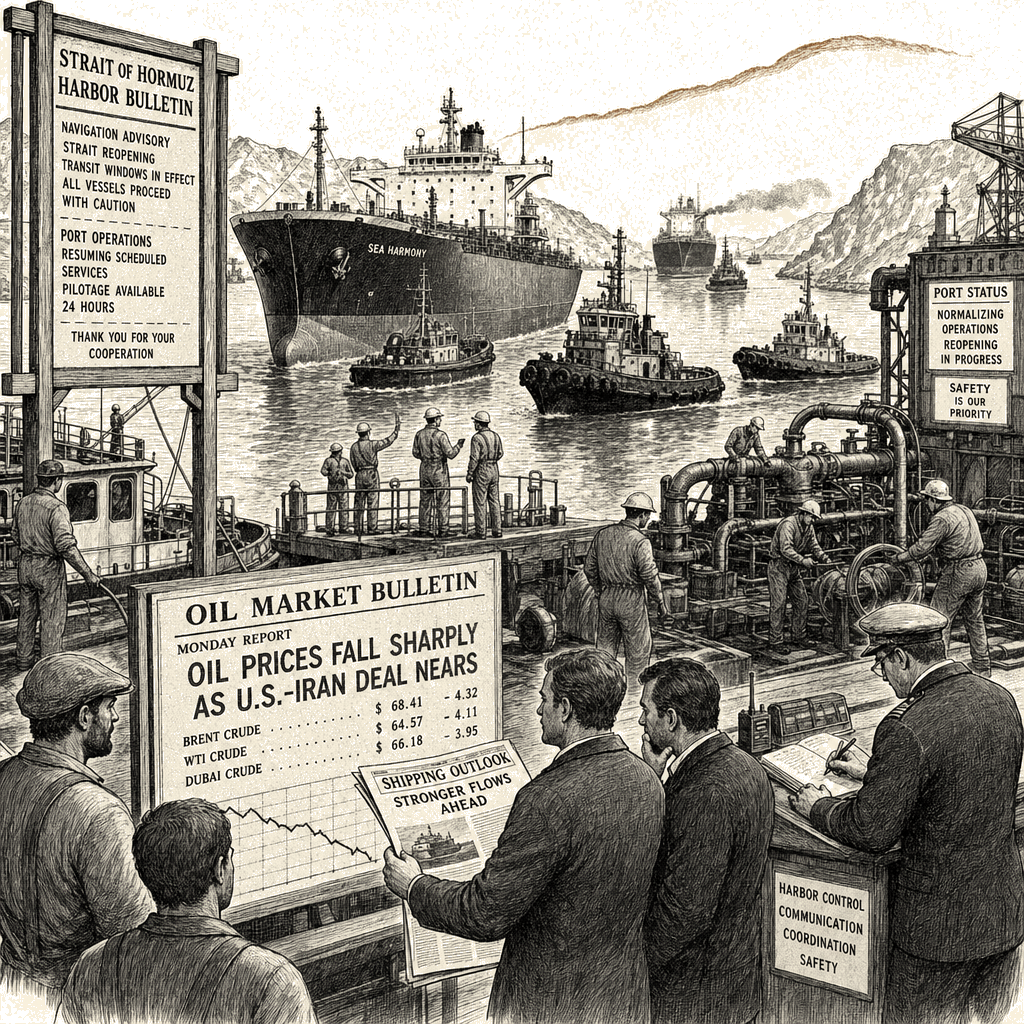
The Wall Street Journal reports this morning that oil prices are falling — Brent crude down nine percent on the week, back to $78.29 a barrel — on expectations that the Strait of Hormuz will reopen. Goldman Sachs pulled its Brent forecast down to $85 a barrel for the fourth quarter, from $90. Still well above pre-war levels, but down enough for the traders to call it relief. MUFG analysts pointed to Dubai and Murban forward curves shifting into contango — future prices trading above prompt prices — for the first time since the war started. That signals reduced anxiety about near-term supply. Anxiety is easing among people who trade crude.
The recovery is slower for people who use it. HSBC analysts say oil traffic through Hormuz is not expected to normalize before late July and will not reach prewar levels before the end of September. Mine clearance, insurance reinstatement, clearing excess Gulf storage, repositioning ships, restarting idled production — the analysts called them hurdles. Kpler’s base case projects transits rising to 40 per day by month-end, from roughly 15, with tankers accounting for around 60%. In a partial reopening, where Iran retains influence over the strait, flows could recover to roughly 60% of preconflict levels, leaving the oil market in deficit into 2027.
Those are the timelines. The family in Friendship trying to figure out whether to drive to Wisconsin Dells this month is not working from a timeline. They are working from what diesel costs at the pump and what the heating-oil bill said in May. The shop runs on diesel. The house runs on LP. Both went up when crude went through Hormuz and came down slower than crude did. Pump prices climbed in May on the same Strait of Hormuz squeeze that moved airline fares, and they have not unwound the way Brent futures did this week.
And the airlines, as Morgan Stanley told the Journal, are still charging 26.7% more for tickets than they were a year ago, with another double-digit hike expected through the summer. Jet fuel prices are normalizing, the analysts say, but the fares aren’t coming down yet. The companies pocket the spread on the way up, and they take their time giving it back on the way down. 26.7% more for a plane ticket. Double digits through the summer. Those are real numbers for families who fly once a year, if that. For the rural mechanic whose margin at the end of the year is the difference between netting $48,000 and not making it, the inputs went up and the margin came down. The customers waited longer to bring the snow blower in. The co-op payment hit the checking account the same week as the airline number.
This is the part of geopolitical crisis that the cable-news coverage misses, because it is not dramatic enough for the chyron. A war shuts the Strait of Hormuz. The price of every barrel of crude that moves through that twenty-one-mile-wide passage spikes. The refineries pass the spike to the wholesalers. The wholesalers pass it to the Co-op. And the Co-op passes it to me, standing at the pump with a diesel nozzle in my hand, watching the dollars tick past on a Tuesday afternoon in Adams County. The peace deal, when it comes, unwinds that chain in reverse — but it unwinds it slowly, and it does not rewind the money that already left my checking account.
The geopolitical premium came from a war the United States started with Iran. It settled on the diesel pump and the airline ticket and the LP delivery and the aluminum bracket on the shelf and the container that arrived late because a hundred and eighteen tankers sat in the Gulf waiting for a ceasefire that did not come for weeks. The premium unwound fast once the deal looked close. The costs it imposed did not unwind with it. They are sitting on the shop floor and the kitchen table, and they will be there in July when the Goldman Sachs analysts are tracking contango.
I’ve been reading Berry again this week — The Unsettling of America, where he argues that an extractive economy treats people and places as expendable, just more inputs in a machine. The energy economy that runs through the Strait of Hormuz is extractive in exactly that sense. It extracts from the land, yes — the oil fields of Saudi Arabia and the Emirates and Iran — but it also extracts from the people at the far end of the supply chain, the ones who have no choice but to pay whatever the global price demands. When the strait closes, the price spikes. When it reopens, the price falls. But in between, the extraction happened. The money moved. It is not coming back.
This is not an argument against the peace deal. The deal is good, if it holds. The shooting stops. The sailors and the soldiers and the civilians in the path of the strikes get to stop dying. The oil flows again. The global economy exhales. Those are real things, and they matter more than my diesel bill.
But the peace deal is not a refund. The war extracted a tax from every working person in rural America who depends on a truck or a tractor or a furnace that runs on fuel, and that tax is not coming back. The money went to the producers and the traders and the refiners who priced the risk of war into every barrel, and they are not in the business of giving money back. The peace deal closes the wound. It does not refund the blood.
Here in Adams County, the diesel bill for my shop ran about three hundred dollars a month higher through April and May than it did a year ago. That is three hundred dollars a month I did not put into new tools, or the kids’ college fund, or the local hardware store. Multiply that by every small-engine shop and every farm and every trucking operation and every construction crew in every rural county in America, and you start to see the scale of what a war halfway around the world extracts from places like this one.
The deal is set for Friday. The market is already moving on. In Adams County, the LP delivery ticket will still read what it read in May. The diesel pump will still flash the number it flashed in April. The snow blower will still sit in the corner of the shop waiting for a part that costs more than it did before the war, and the mechanic will still be the one who absorbs the difference. War has always moved money from the people who use it to the people who trade it. This one was no different. The pump price will come down when it comes down, and not a day before.