
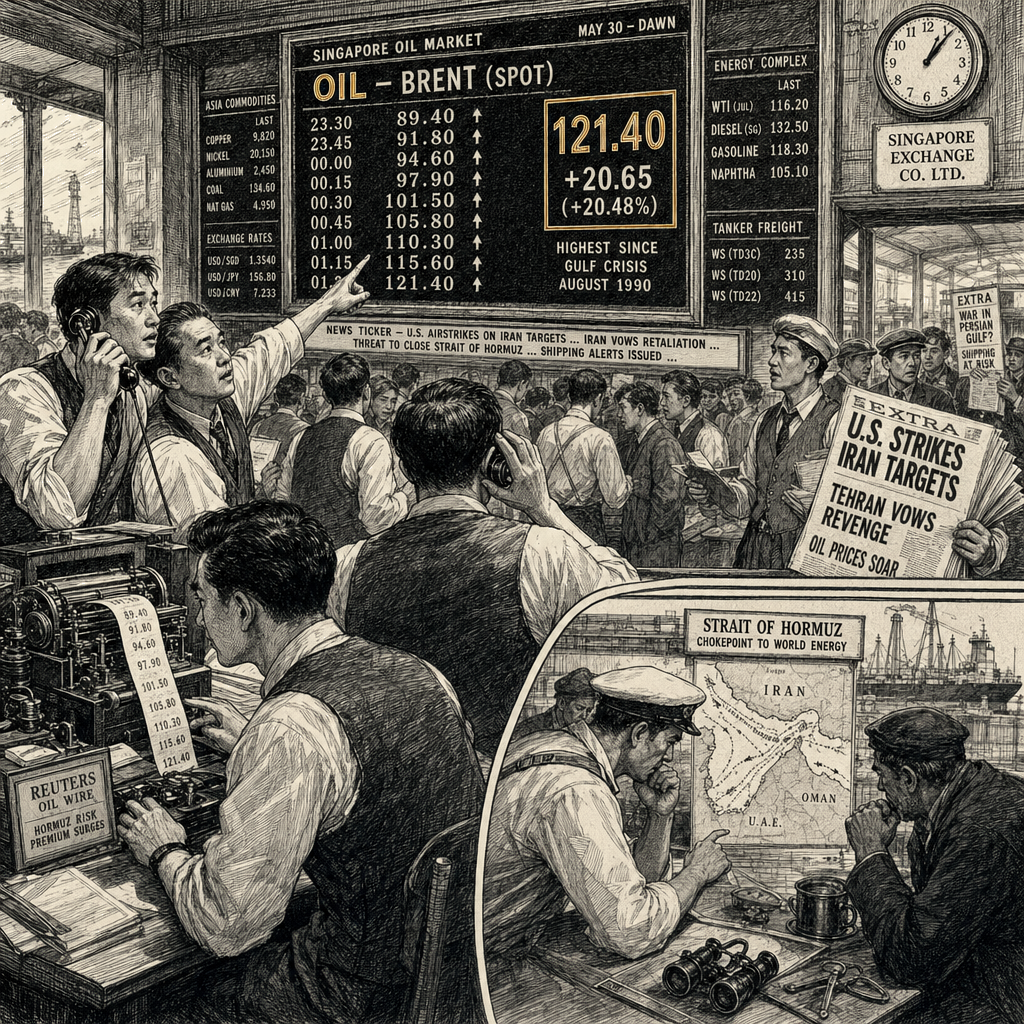
Trump declared the Iran ceasefire dead this week. He stopped short of saying the United States would restart the war and allowed that diplomatic talks could continue. But the wording of the announcement did not change the arithmetic at the diesel pump in Adams County. Front-month Brent crude futures rose six percent to $78.63 a barrel. West Texas Intermediate rose six-point-two percent to $74.85. The benchmark Dutch TTF natural-gas contract climbed four-point-eight percent to 49.04 euros a megawatt-hour. The Wall Street Journal ran the number on its front page Wednesday morning. The Adams County Times-Reporter ran the same number in the regional wire section the same day. The diesel pump at the local co-op will reflect it by Friday.
The forward curve moved into backwardation at the same time. That is the technical name for the market signal that says traders are willing to pay a premium for crude they can take delivery on this month, rather than wait for delivery three, six, or twelve months out. It is the signal that says the people who actually move the oil think supply might be tight. It is the signal that says the people who actually move the oil think the Strait of Hormuz might not be open for normal traffic in a month. It is the signal that says, in plain English, the people who run the tankers are not sure they can get through.
A six percent move in a single session is not a small move. It re-prices everything downstream within a week. Diesel for the trucks. LP for the shop. Propane for the house. Gasoline for the pickup that hauls the kids to school. The whole stack re-prices off the same global benchmark. The notebook records the pattern every time the pattern repeats: the price moves, the rhetoric shifts, the bill lands on the working-class household.
That is the part the political rhetoric never mentions. The “drill baby drill” pitch is built on the claim that domestic production insulates American consumers from global supply shocks. The numbers from the Energy Information Administration say otherwise. U.S. crude production set successive records through 2023, 2024, and 2025. By July 2025 the monthly average hit 13.6 million barrels a day, the highest the country has ever pumped. The Trump administration took credit. The Biden administration took credit before that. Both administrations claimed credit for the same trend line. Neither administration changed the structure that determines who pays when the price moves.
The structure is global. Crude oil is fungible. A barrel of Brent and a barrel of West Texas Intermediate trade against each other on the same markets, and the marginal price for both is set by the marginal global buyer. When Iran attacks ships in the Strait of Hormuz, the price of oil in Adams County moves. When the President tells reporters the ceasefire is over, the price of oil in Adams County moves. None of those decisions were made in Adams County. None of the people who made those decisions will pay the gas bill in Adams County. The political constituency that made the rhetoric work pays the bill.
This is the nationalist shell game. The rhetoric says American energy independence. The market structure says global oil. The two cannot both be true, and the one that is true is the one the working-class household transacts against at the pump. The “drill baby drill” pitch was a sound bite. The backwardation in the front-month futures curve is a sound bite about the same thing in a different language, and the second sound bite is the one that costs the household.
The architecture that produced this moment is not new. It was built forty-six years ago. The Carter Doctrine, drafted in 1980, asserted that any outside force attempting to gain control of the Persian Gulf region would be repelled by any means necessary, including military force. That doctrine wired the American military footprint directly into the price of the fuel that runs the rural economy. Every time the diplomatic apparatus fails to hold the Strait of Hormuz open, the cost does not land on the executives who designed the policy. It lands on the mechanic who needs to fire up the tow rig, the farmer trying to run the center pivot, the family heating the shop in January.
The same arithmetic landed in May, when the same administration put the same ceasefire on life support, and again in June, when the missiles tested the fragile framework. Every Middle East shock since 1973 has landed on the working-class household first and longest. The 1973 OPEC embargo produced the gas lines and the inflation that shaped a political generation. The 1979 Iranian revolution produced the second oil shock. The 1990 Gulf War spike did the same. The 2008 commodity boom did the same. The 2022 Russia-Ukraine spike did the same. The household budget is the first place the new price lands and the last place the recovery reaches.
The Iran piece of this is a forty-year story that Daniel Yergin has documented across two books. The pattern is that oil has been a weapon the United States has tried to use against Iran for decades, and the weapon has not worked the way it was supposed to. Iran sells to China through the shadow fleet. By 2024 Iranian exports were running between 1.5 and 1.6 million barrels a day, almost all of it going to Chinese-linked buyers who had been preparing for precisely this pressure point for a decade. The architecture of evasion was built specifically because the architecture of sanctions was predictable. The U.S. revoked the waiver this week after Iranian attacks on commercial shipping near the Strait of Hormuz. The market cleared the new reality in minutes. Insurance underwriters keep a permanent war-risk premium on the Gulf because every reopening is now assumed temporary. The freight rates do not come down.
What did not clear in minutes is the household budget. Bethany McLean — who broke the Enron story and has documented the financial spine of the U.S. energy industry for two decades — distinguishes between the short game and the long game. The short game is the political move that produces a number on the front page. The long game is the cost that lands in the working-class household three to eighteen months later, in the form of higher diesel at the co-op, higher LP at the hardware store, higher gasoline at the Cenex, and the slow bleed of household purchasing power that follows.
Wendell Berry’s framework for the agrarian economy names what is happening here. Berry distinguishes an extractive economy from a membership economy. An extractive economy takes wealth out of a place and sends it elsewhere. A membership economy circulates wealth within a place and across generations. The six percent oil-price spike is the extractive economy operating at scale. The decision was made in Washington. The wealth the decision is designed to leverage is in Tehran and Beijing. The cost the decision produces is in Adams County and every county like it. The wealth is not in Adams County. The cost is.
The people who live downstream of this empire do not get a cut of the oil wealth. They do not get the dividends of the global market. They get the invoice. As long as the foreign policy class treats the Persian Gulf as a vital interest worth bleeding the rural economy to protect, the invoice is only going to get larger. The longer-arc question is the question Berry has been asking for fifty years. What does it mean to live well on this place? The question gets harder when the county is wired by tanker and pipeline to decisions made three thousand miles away, and the cost of those decisions is the first number on the household budget. The nationalist shell game names the problem. The answer is not in the rhetoric. The answer is in the structure, and the structure is what the rhetoric is built to obscure.