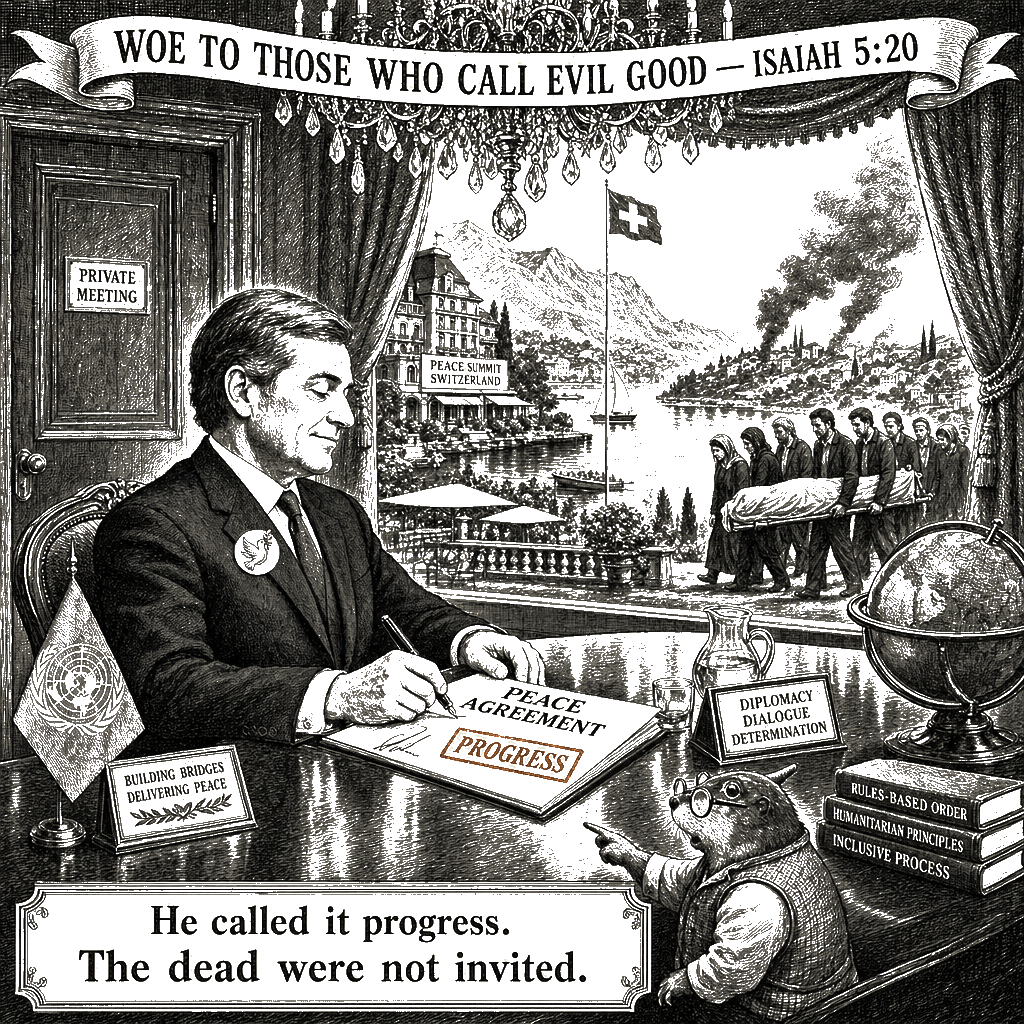
The road not walked through Switzerland runs through villages across Lebanon where, on Saturday, the same day American officials arrived at the Bürgenstock lakeside resort, 22 people died in airstrikes. Isaiah diagnosed us: “Woe to those who call evil good and good evil” (5:20). At the resort, Vice President JD Vance declared progress while Lebanon’s dead lay outside the room where their fate was being decided. All parties to a war adopt this grammar — the grammar of those who bargain in locked rooms while those they bomb wait in the hall.
The United States is offering a peace that leaves the killing unfinished. Vance says he would like to transform our relationship. But this is the transformation: Iran gets a place at the table; Lebanon does not. A peace agreement signed in France on Wednesday — 14 points, cessation of fighting, reopening of the Strait — does not contemplate the Lebanese dead, the displaced families, the 22 people killed in Israeli strikes on Saturday in Aley and Bhamdoun and Beirut’s suburban districts. To call talks that exclude the bombed parties progress while the very strikes that Iran cited to close the strait continue — this is the moral inversion Isaiah named by its proper word.
Some will say Hezbollah’s violence forfeits its seat in the room. That Hezbollah is designated a terrorist organization by the United States, that it initiated cross-border attacks, that no peace conference should include it at the table. But that logic would keep the bombed out of every room in history. It was the February 28 strikes — launched by the United States and Israel — that opened this war. The displacement of over a million Lebanese was not Hezbollah’s doing alone; it was the product of strikes by the same governments now writing the peace. You do not get to bomb a country, displace its people, and then declare the excluded party the reason the door stays shut. That is not prudence. It is erasure with a security clearance.
You are now trying to end a war you started, but you are negotiating against the backdrop of a continuing assault by your ally that you have neither condemned nor stopped. The peace you propose is a peace that exempts your own side from the ceasefire while demanding restraint from the other. Pope John XXIII wrote in Pacem in Terris that true peace is built on justice, not merely on the absence of open conflict. The American bishops’ 1983 pastoral letter, The Challenge of Peace, declared the deliberate initiation of strikes against populations inadmissible. And Pope Francis, in Fratelli Tutti, warned that the just‑war framework risks being used to justify any conflict if its criteria are applied carelessly. The February 28 strikes flouted every criterion — last resort, proportionality, protection of noncombatants — and you have built a peace process on the bodies of those who died in the resulting war. Heschel: “Few are guilty, but all are responsible.” What you are responsible for is not hypocrisy — you may well believe your own rhetoric — but the substitution of ceremony for substance, the building of a peace that the dead are not permitted to attend.
There is complicity here that reaches us. The defeat of arms occurs not in the void but in a globalized moral landscape — what Francis named the globalization of indifference — where a nation may bomb a country, close the body of water the nation borders, and speak of progress as if wreckage were a redemptive occasion. The indifference is not unique to this administration. It was the indifference that enabled the foreign-policy infrastructure that makes the February strikes possible; it is the indifference that permits us to name 22 deaths and call them progress; it is the indifference that lets us write a peace to which no one who is actually dying is invited. We have helped build this. We are not outside the room — we furnished it.
I do not write this to condemn you, Mr. Vice President. I write it because the path back is still open. But that path does not run through a conference room in Switzerland while the people of Lebanon bury their dead. It runs through a ceasefire that is total — for Israel as for Iran, for Hezbollah as for the militias, for the Strait of Hormuz as for the skies over Beirut. It runs through admitting that the February strikes were a catastrophic mistake, not a strategic masterstroke. You have already declared the deal a win no matter what happens next. That is the language of a salesman, not of a peacemaker. A true peace does not need to be sold; it arrives when the bombs stop falling and the guns fall silent, and it is measured by the number of children who wake up alive the next morning.
This is a peace signed in a room whose doors exclude the 22 who died on Saturday, and the more than one million displaced across Lebanon, and the Hezbollah fighters injured and killed, and the Lebanese families in whose villages the war was fought. A peace written in a room to which the dead were never invited is not a peace — it is a negotiation among mourners who refuse to acknowledge the corpse in the room they have bolted shut.
The door stays open. But the work of opening it is not the work of Swiss resorts or 14-point agreements. It is the work of naming what has been named: that bombs begin wars and children die, and that the agreement signed in France does not yet include the 22 who died in Lebanese villages on Saturday. The outstretched hand must let go of the sword. The dead are not yet asked for their view. The peace, such as it is, will not be complete until their voices are heard.