I read the Wall Street Journal profile of Zach Lahn out in my shop in Friendship, Wisconsin, while the evening cooled off and the mosquitoes got busy. Lahn is the Republican nominee for governor of Iowa, a 40-year-old who beat a Trump-endorsed congressman in the primary earlier this month. The Journal wanted to know who he is, what he wants, who is behind him. The answers were all in the story. They were just not the answers the populist framing wanted you to hear.
Zach Lahn is not running against Big Agriculture. He is running for it.
The man is calling the seed-and-pesticide companies “cartels” and promising to “break up their monopolies.” He is running on “Iowa First,” in the register Robert F. Kennedy Jr. made fashionable — the Make America Healthy Again fusion of agricultural populism and public-health anger that some Republicans have adopted because it works with the base. The farmers are desperate. Iowa produces more corn, hogs, eggs, and ethanol than any state in the country. The inputs those farmers buy come from a handful of multinationals: Bayer, Corteva, Syngenta. The margins are thin and getting thinner. Out here in Wisconsin’s sand counties, the same thing — Adams County’s dairy barns empty, its southside wells running nitrate above the standard. The anger is real. The question is whether the man offering to fix it is real, too.
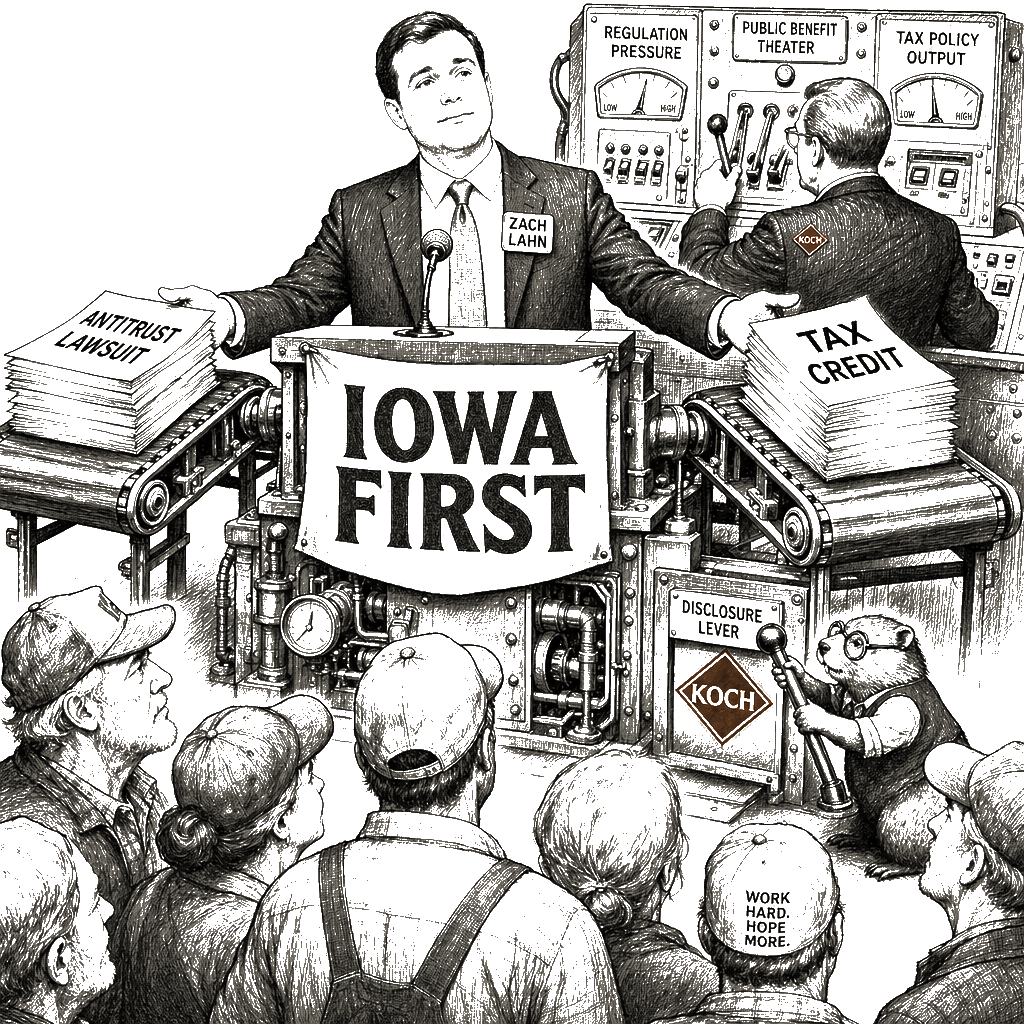
Lahn is married to the former daughter-in-law of Charles Koch. He worked for years at Americans for Prosperity — the Koch network’s political arm, which spent two decades dismantling the regulatory framework that could have constrained the corporate agriculture Lahn now claims to fight. He co-founded a private school in Wichita with his future wife. He lent his own campaign $2.5 million. He owns 700 acres in Belle Plaine and a quarter of a Montana sexual-health company — the one that sells “wearable erection rings” and markets itself with the slogan “Track Your Sexual Health And Keep It Up.” He told the Journal he “bootstrapped and built” his wealth from entrepreneurship, then declined to say whether he was a millionaire before he married into the Koch family. The answer cuts against the story of the self-made man, and the populist costume depends on that story. Rob Sand, his opponent, has spent seven years as Iowa’s state auditor, visiting all 99 counties every year. Lahn barely met the state’s two-year residency requirement and voted in Kansas through 2022. He is a near-perfect specimen of the Nationalist Shell Game — one of the five conservative contradictions the publication I write for catalogued in We Too, and the one Mark’s column is built to track. The shell game works like this: you run on putting your state first, standing up to the multinationals, restoring the local economy, while the money and the policy architecture that back your campaign come from the very interests that have spent decades gutting the local economy. The language is nationalist; the wallet is global.
What would actually taking on Big Agriculture in Iowa mean? It would mean breaking the patent-licensing system that locks each farmer into a single company’s seed and chemical package. It would go further — restructuring the input markets so that a farmer buying corn seed from Bayer is not simultaneously locked into Bayer’s herbicide. It would go further still — taking on the commodity-futures infrastructure that lets the multinational traders set the price on both ends, the inputs the farmer buys and the grain the farmer sells. A real anti-monopoly politics would enforce the Packers and Stockyards Act as if the small producer mattered, not as if the four big packers were the only constituency the USDA answers to. It would pass right-to-repair laws so a farmer can fix his own tractor without paying a dealership technician to call the mothership for a software unlock. It would block the hospital mergers that have swallowed rural health systems and closed the maternity wards. Each step requires the same thing: changing who owns what. That is precisely what the Koch-network operative will not do.
Lahn is not offering to change who owns what. He is offering antitrust lawsuits and refundable tax credits — policy mechanisms that tinker at the margins of a system whose ownership structure he has no interest in changing. He is not running against the extraction. He is offering to reorganize who captures the surplus. Wendell Berry wrote in The Unsettling of America that the industrial economy reduces people to “the contents of a category” and land to “a deposit of raw materials.” He was writing in the 1970s, but the line works just as well for the political economy of a 2026 Iowa governor’s race. The Koch network helped build the category “populist candidate” as a product — a set of talking points that can be slotted into any race where rural anger is high and a credible challenger to the status quo is low. Lahn is the contents. The farmers who vote for him because they hope someone will finally stop the bleeding are the raw materials.
In my part of central Wisconsin, I’ve seen the same consolidation, and I’ve heard the same anger. The county lost most of its dairy farms before I opened my shop, and the ones that remain are big. The corn that surrounds Friendship is in a handful of corporate names. The wells on the south side of the county have nitrates above the drinking-water standard, and the smell from the manure lagoon off County G still reaches town when the wind is from the north. When people here hear a politician promise to break up the big operators, they lean in. I lean in. The problem is that the same people who have been running the consolidation machine for thirty years have figured out the vocabulary, and now they are running candidates who talk like Wendell Berry while their campaign funds trace back to the boardrooms Berry spent a lifetime naming.
The farmers who voted for Lahn in the primary are right that the system is failing them. They are right that change is overdue. They are right that the current arrangement — fewer farms, bigger operations, rising cancer rates, fouled water, collapsing margins — cannot continue. But the machinery that manufactured the populist candidate is the same machinery that manufactured the extraction. The empty barns and the nitrate wells in Adams County tell the same story the Iowa numbers tell. The farmers see the grievance. They just cannot always see that the man claiming to fight for them came up through the same network that designed the fight.
Lahn won his primary. He will have a competitive general election against Sand. He told the Journal he would welcome a Trump visit. He said his message is resonating. “Farmers have been looking for somebody to address the long-term issues,” he said, “versus just giving lip service to the idea that we need to support farmers even though everything’s getting worse.” He is right about everything getting worse. He is wrong about who he works for. The machinery that hollowed out the farms does not field a candidate to undo the hollowing — it fields a candidate to harvest the anger and leave the structure intact. The language is new, but the outcome is old. The family farm keeps shrinking, the wells keep getting worse, and the men who said they’d fix it keep cashing the checks.