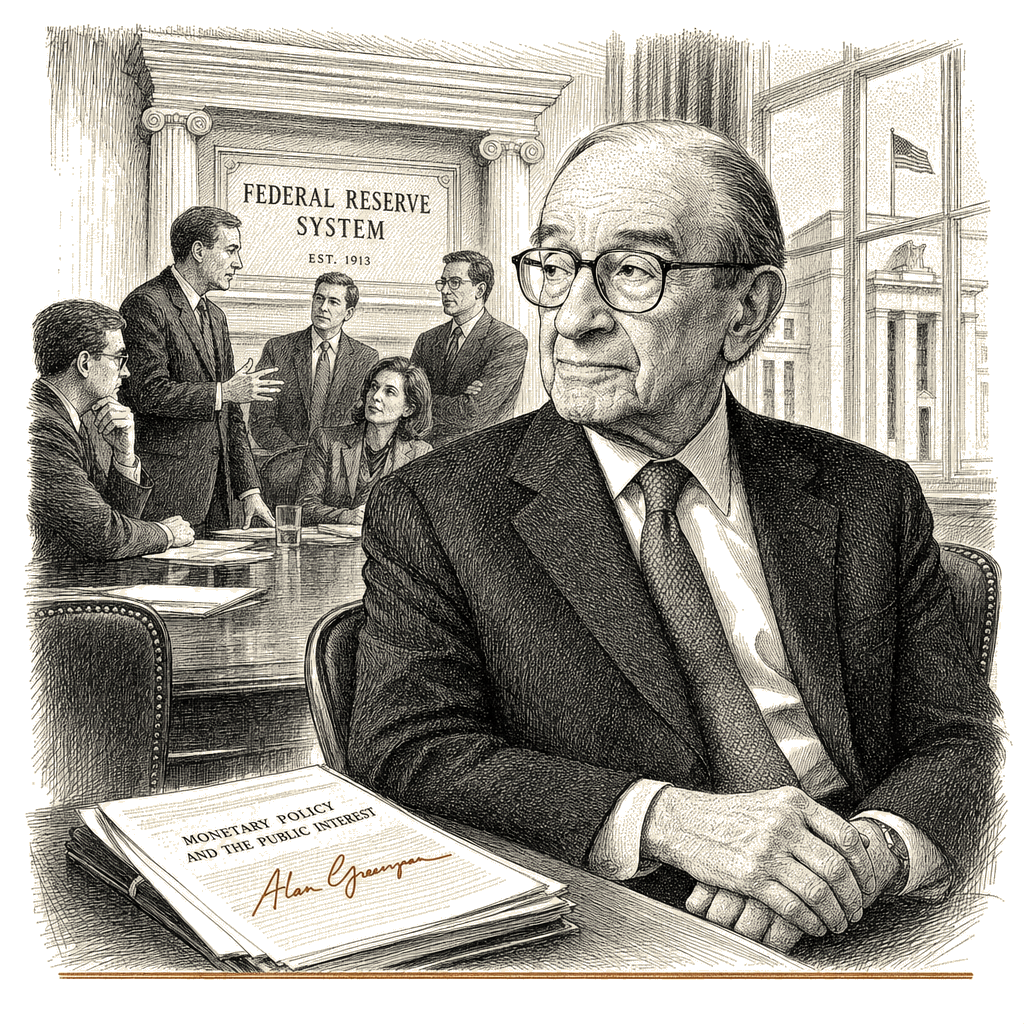
Alan Greenspan looted the regulatory state and called it moral philosophy. He spent four decades convincing Congress, presidents, and the financial press that bankers could be trusted to regulate themselves, and when the predictable catastrophe arrived, he stood before a House committee and expressed shock that his model had failed.
The obituaries will say “maestro.” The documentary record says something else.
In February 1985, as a private consultant, Greenspan wrote to officials of the Federal Home Loan Bank of San Francisco urging the regulators to back off Lincoln Savings and Loan, praising its “seasoned and expert” management. The letter was part of the political pressure campaign designed to ward off capital requirements and direct-investment restrictions the Federal Home Loan Bank Board sought to impose. Lincoln collapsed four years later in the most expensive thrift failure of the S&L crisis. The resolution cost taxpayers $3.4 billion. Its chairman, Charles Keating, was convicted of fraud and went to prison. The aggregate cost of the savings-and-loan crisis exceeded $130 billion in taxpayer funds. Greenspan’s letter is a document, exactly the kind of documentary receipt this column exists to cite. A thrift was vouched for, regulatory forbearance followed, and the outcome was a felony conviction and a taxpayer bailout. The pattern was set early, and the pattern was coherent: the regulator declined to regulate, and the ideology provided the justification.
Three years after Lincoln’s collapse, Greenspan was sworn in as Fed chair. He institutionalized the same ideology. The Fed under his leadership declined to exercise the full scope of its authority under the Home Ownership and Equity Protection Act of 1994 to regulate subprime mortgage lending. Section 1204 of HOEPA authorized the Fed to prohibit unfair, deceptive, or abusive mortgage practices across the entire mortgage market, not solely among the banks the Fed directly supervised. For more than a decade, Greenspan refused to use that authority. Rules issued under HOEPA in 1995 and 2001 tightened disclosure triggers for high-cost mortgages but left the broader predatory lending apparatus largely unchecked. Not until July 2008 did the Fed invoke its power to prohibit unfair, deceptive, or abusive practices — by which time the housing market had already collapsed. This was not “light touch on regulation.” The phrase is a euphemism. The Fed possessed statutory authority to regulate the mortgage practices that were building the crisis and chose not to exercise it.
On derivatives, the instruments that would later function as the circulatory system of the 2008 crisis, he was equally adamant. He rejected calls to regulate them. His rationale was explicit: self-interest among counterparties would prevent excessive risk-taking. The philosophical foundation, as he repeatedly acknowledged, came from Ayn Rand, in whose inner circle he had moved for decades, contributing chapters to her book Capitalism: The Unknown Ideal. Rand attended his swearing-in when he joined the Ford administration. Rand’s conviction that selfishness was a virtue and that rational self-interest among financiers would substitute for regulatory oversight became Federal Reserve doctrine under Greenspan. It was the longest-running intellectual-laundering operation in modern regulatory history.
The monetary policy record is of a piece. Greenspan held the federal funds rate at 1 percent from June 2003 to June 2004 — the lowest in forty-five years — during a housing mania. The rate was then raised in seventeen consecutive 25-basis-point increments, a pace so gradual that the real federal funds rate remained negative even as the Fed appeared to be tightening, effectively fueling the bubble. Sebastian Mallaby, in his authorized biography The Man Who Knew, documented that Greenspan understood the risks of asset bubbles and leverage but treated financial stability as outside the Fed’s mandate. Mallaby’s verdict, from his own account of the man: Greenspan was the man who knew that bubbles were extremely destructive, and yet he was not the man who acted against them.
The result was the 2008 financial crisis, which triggered the deepest global recession since the 1930s. The Financial Crisis Inquiry Commission, in its January 2011 report, identified the Fed’s failure to regulate predatory lending as one of the causes of the crisis that destroyed approximately $11 trillion in household wealth and eliminated 8.7 million jobs. The Commission’s finding was not that regulators lacked tools. It was that they chose not to use them.
On October 23, 2008, Greenspan told the House Committee on Oversight and Government Reform: “I found a flaw in the ideology that I had been operating under.” He described his state as one of “shocked disbelief.” That sentence, however carefully phrased, remains one of the most devastating admissions ever made by a former Fed chair. The “flaw” he discovered was that banks, when liberated from regulation, will loot themselves and their customers. This is not a novel finding; it is the premise of every banking statute since the National Bank Act of 1864.
The damage is still being paid off. The foreclosure wave, the job losses, the destruction of household wealth — these are the externalized costs of Greenspan’s moral philosophy, absorbed by millions of families whose livelihoods were vaporized. The costs were not borne by the regulator. They were borne by the 8.7 million workers who lost jobs, the families who lost homes, and the taxpayers who funded the $700 billion Troubled Asset Relief Program. The same financial industry that Greenspan protected spent the subsequent decade extracting further rents, and the political backlash helped fuel the authoritarian turn that now threatens the Fed’s independence itself. When the central bank abandoned its regulatory obligations under the banner of ideological purity, it invited the political takeover that has now arrived.
The “maestro” framing is a wonk-laundering operation — taking a record that includes a letter to regulators endorsing a fraudster’s management, a decade of unused statutory authority over predatory lending, and an admission of “shocked disbelief” before Congress, and scrubbing it clean into a glamorous job title. Greenspan’s defenders will point to the 1990s boom, the low unemployment, the absence of inflation. But that is an argument from selected evidence. The dot-com bubble, which Greenspan’s low-rate policies inflated, wiped out trillions in paper wealth. The “Great Moderation” was built on a credit expansion that was itself the mechanism of eventual destruction. A boom that ends in a systemic collapse is not a vindication of central banking; it is a failure of supervision. Greenspan was the supervisor who refused to supervise, on principle.
The correction was not intellectual. It was forced by a catastrophe the regulator’s own choices produced. The ideology did not change when the evidence changed. The evidence overwhelmed the ideology, and the chairman called that “shocked disbelief.” The Lincoln letter. The decade-plus refusal to use HOEPA authority against the most dangerous lending practices. The 1 percent funds rate held during a housing mania. These are not one mistake. They are a pattern. The record is not ambiguous.
Alan Greenspan was a charming man by all accounts, a talented saxophonist, a master of the Delphic phrase. Those gifts do not alter the documentary record. He was 100 years old. The regulator declined to regulate, and the public will be repaying his theft for decades.