
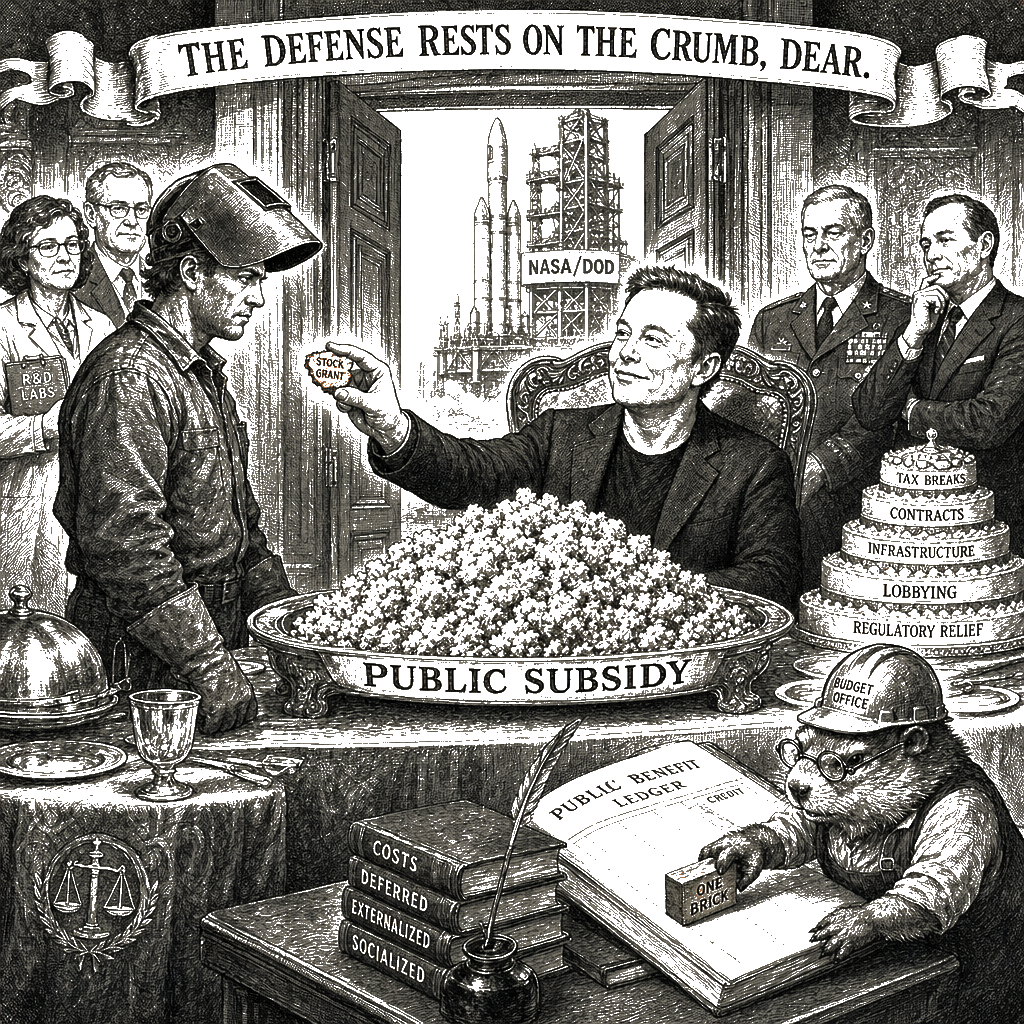
SpaceX lost nearly $5 billion last year. Less than a fifth of its $1.75 trillion valuation is backed by its profitable Starlink satellite business; the rest is speculation that artificial intelligence will grow to rival the U.S. economy. Elon Musk is the world’s first trillionaire. Carol Roth, in Elon Musk’s SpaceX success shows how he’s sharing the wealth, not playing Monopoly (Fox News, June 22), argues that the SpaceX IPO is proof the system shares: more than 4,000 employees became millionaires, including contract welder Juan Hernandez, whose holdings are valued in the seven figures. The welder is doing his job. The one he was hired for.
This is the latest filing of an old brief: don’t look at the pile, look at the few crumbs that fell off the truck. The defense presents the welder’s stock grant as evidence that a trillion‑dollar windfall is really a community picnic. But SpaceX was built on government contracts — NASA, the Department of Defense, billions in public money — and on federal tax credits and subsidies that flowed to Musk’s other ventures. The IPO doesn’t just reward investors; it converts paper wealth into liquid wealth without triggering the tax events that selling privately would produce. Index funds in 401(k)s and IRAs buy the shares whether their owners know it or not. Insiders borrow against their stakes, sell slowly, and die with appreciated assets whose gains are never taxed. The indexers buy. The insiders cash out. The wealth is real for the one. The risk disperses to the many. Robert Reich called it a redistribution from most of us to Elon and his buddies. That names the machine, not the man.
The man paid zero federal income tax in 2018 — ProPublica’s leaked IRS data reported it in black and white. His political spending during the 2024 cycle totals nearly $290 million. He was granted an informal policy role in the White House, the same White House whose agencies are SpaceX’s largest customer. The welder who made a million will pay capital‑gains tax when he sells. The man whose pile cleared a trillion dollars is structured to pay none at all. The same returns that showed Musk paid nothing also showed that the twenty‑five richest Americans saw their wealth rise by $401 billion from 2014 to 2018 while paying $13.6 billion in federal income tax — a true rate of 3.4 percent. Warren Buffett paid 0.1 percent. Jeff Bezos paid zero in 2007 and 2011. The structure is the story the op‑ed exists to obscure.
Stock grants have told this story before. Enron’s 4,000 employees lost jobs and pensions in 2001 — $74 billion in shareholder value erased — while executives sold before the collapse. (Kenneth Lay was convicted on all six counts but died before sentencing; his conviction was vacated.) AIG’s Financial Products unit, the outfit that nearly destroyed the firm, paid itself $165 million in retention bonuses in March 2009, after AIG had taken roughly $182 billion in committed federal support; seventy‑three employees received a million dollars or more each. Wells Fargo opened millions of unauthorized accounts between 2002 and 2016 and settled for $3 billion via a deferred‑prosecution agreement — reached, as the Department of Justice made clear, with the bank itself, not with any individuals responsible for the fraud.
The same brief was filed for Toys “R” Us, where the private‑equity owners — Bain Capital, KKR, and Vornado — loaded the company with roughly $5 billion in debt after their 2005 leveraged buyout. The Private Equity Stakeholder Project itemized $470 million in fees extracted by the owners: transaction fees, advisory fees, interest. More than $15,000 for every one of the 33,000 workers who lost their jobs when the company collapsed, many initially receiving no severance against roughly $75 million owed. It was filed again for Steward Health Care, where Cerberus walked away with a reported $800 million return while the hospitals filed the largest for‑profit health‑care bankruptcy in American history. The mechanism does not change: load the entity with debt, extract the fees, hand the employees a little equity so someone can testify it was win‑win, then walk away rich. The welder with seven figures is not the rebuttal to the pattern. He is part of the pattern.
Don’t change the subject to the welder’s good fortune, dear. The welder is not the question. The question is what happens when one man accumulates wealth on the scale of a sovereign state while the apparatus of taxation and regulation has been deliberately hollowed out to treat his holdings as beyond its reach. The SpaceX IPO is not the story of a company that shared. It is the story of a system that concentrates unaccountable wealth and political power in a single pair of hands and then dispatches its apologists to insist, on the opinion pages of every friendly outlet, that this is what prosperity looks like. The same brief was filed for Crassus, who bought burning houses. The same brief was filed for Leona Helmsley, whose housekeeper testified she said only the little people pay taxes. The same brief was filed for HSBC, which laundered drug‑cartel money and purchased a $1.9 billion deferred prosecution agreement while the assistant manager of a bodega caught selling loosies did thirty days.
The welder got his seven figures. The owner got his thirteen figures. The defense rests on the first, and the second is merely the rest of the country, locked into buying what the insiders sell. I have watched this movie since Nixon. It ends the same way every time — with a few people at the top of the tower and everyone else holding stock they didn’t choose to buy in a company whose valuation would collapse if the man at the top ever tried to cash out. They named the rocket after a bird that takes its young to the top of a tower and drops them.