
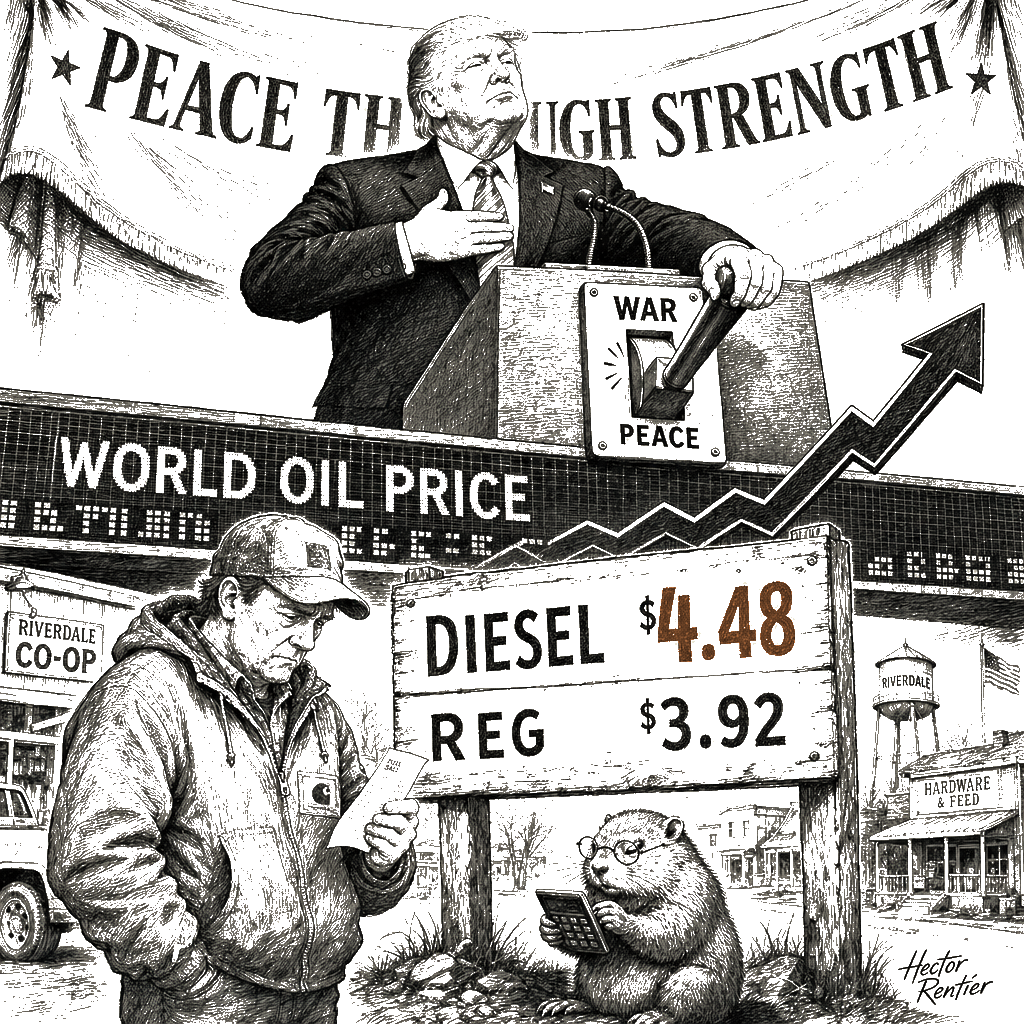
Trump’s Iran war stuck rural America with $4.50 gas.
At the Co-op in Friendship last month the on-road diesel hit $4.48 a gallon. This week it sits at $3.85. The Co-op’s price board said so. The board doesn’t editorialize. It posts the number. The number comes from the world price of oil, and the world price of oil moves on whether the President of the United States is fighting a war in the Middle East this month or signing a peace deal.
The Federal Reserve’s preferred inflation gauge rose 4.1 percent in May from a year earlier, the Commerce Department reported. That is the largest annual jump since April 2023. The same report showed real consumer spending rose 0.3 percent on the month and real incomes rose 0.3 percent — the first income gain in four months once inflation was stripped out. A fraction of a percent is not a buffer against a twenty percent jump in the fuel bill. It is an accounting illusion designed to make the macroeconomic ledger look stable while the household ledger bleeds. These are not recession numbers. They are stagflation numbers. They are the numbers of an economy where the cost of running the truck goes up faster than the cost of running the household.
The story of why is on the price board. Gas prices peaked last month at nearly $4.50 a gallon nationwide — the direct result of the war the administration chose to fight with Iran. AAA had the average at $3.92 the week the number came out. The deal that has since brought oil prices back down has not undone what the war did to the May reading. The damage ran through the month. The damage is in the receipt.
But the pump is only half the invoice. The same Commerce Department report pointed to another engine running hot underneath the number: semiconductors and computer equipment, priced higher by the relentless demand of the artificial intelligence buildout. The chips feeding the data centers are the exact same chips priced into tractor GPS, combine yield monitors, and pickup infotainment. The server farm and the dealership floor draw from the same silicon. The working-class household is paying for both, subsidizing the ambitions of the capital with money it does not have to spare.
The Silverado has 187,000 miles on it. It doesn’t get a vote about what fuel costs. It burns what it burns. The Co-op’s $4.48 last month was up roughly a dollar a gallon from where the same fuel sat a year ago. A dollar a gallon is about forty cents a mile. Forty cents a mile is sixty-eight dollars a week for the man who drives a hundred seventy miles a day for work. That math doesn’t change because the White House signed a peace deal in the third week of June. That math runs through the month the war was fought.
The new chair of the Federal Reserve, Kevin Warsh, said last week he is determined to drive inflation back to the Fed’s 2 percent target. He gave no sign of what steps he might take to get there. Some economists expect him to raise rates this year. The expectation rattled the markets. Every rate hike is a few points on the operating loan the dairy farmer renews every spring. The cable shows will run the markets angle for three days. They will not run the operating-loan angle. The operating-loan angle is the part of the story that matters at the Co-op in Friendship.
That institutional silence is not neutrality. It is a direct transfer of risk to the household. When the central bank eventually moves to cool an economy overheated by data centers and foreign conflicts, the people who pay are the ones who need a loan to replace a tractor or finance a roof. Big Tech does not need a bank loan to build a server farm; it prints equity. The tech monopolies absorb the AI boom; the rural commute absorbs the inflation.
What matters at the Co-op is what $4.50 gas does to the small-engine mechanic, the dairy farmer milking two hundred head, the custom harvester running a combine six days a week through September, the feed delivery driver pulling a hopper bottom to the CAFO off County G. Every one of those operators runs on diesel. The price of diesel is set by the world price of oil. The world price of oil moves on whether the President of the United States is fighting a war in the Middle East this month or signing a peace deal. When he fights, gas goes up. When he signs, gas comes down. When he fights again, gas goes up again. The farmer doesn’t get a say. The mechanic doesn’t get a say. The single mother working the second shift at the cheese plant in Adams doesn’t get a say.
This is the nationalist shell game Wendell Berry has been writing about for half a century. Berry’s argument in The Unsettling of America was that the consolidated operator gets the profit and the small operator gets the bill. He was writing about agriculture — about the corporate farms that bought out the small ones and pocketed the margin. He could have been writing about the federal government and the diesel pump. The consolidated operator, in this case the federal executive, makes the decision. The small operator pays the cost. The cost is not optional. The decision is reversible only when the next headline cycle hits.
I am not a foreign-policy analyst. I don’t read the intelligence on what the Iran threat actually required. I read the Adams County Times-Reporter and I read the price board at the Co-op. The price board said $4.48 last month. The price board said $2.94 the week before the war started. The price board will say what the next war makes it say, and the next one after that. The mechanic in Adams County is not the customer of American foreign policy. He is the line item.
The Fed can raise rates or hold them. None of that changes what diesel costs at the Co-op this week. What changes diesel costs is whether the country is at war or at peace in any given month. The President controls that switch. He flipped it. The May number is in.
This is what the nationalist shell game looks like from the forty acres.