
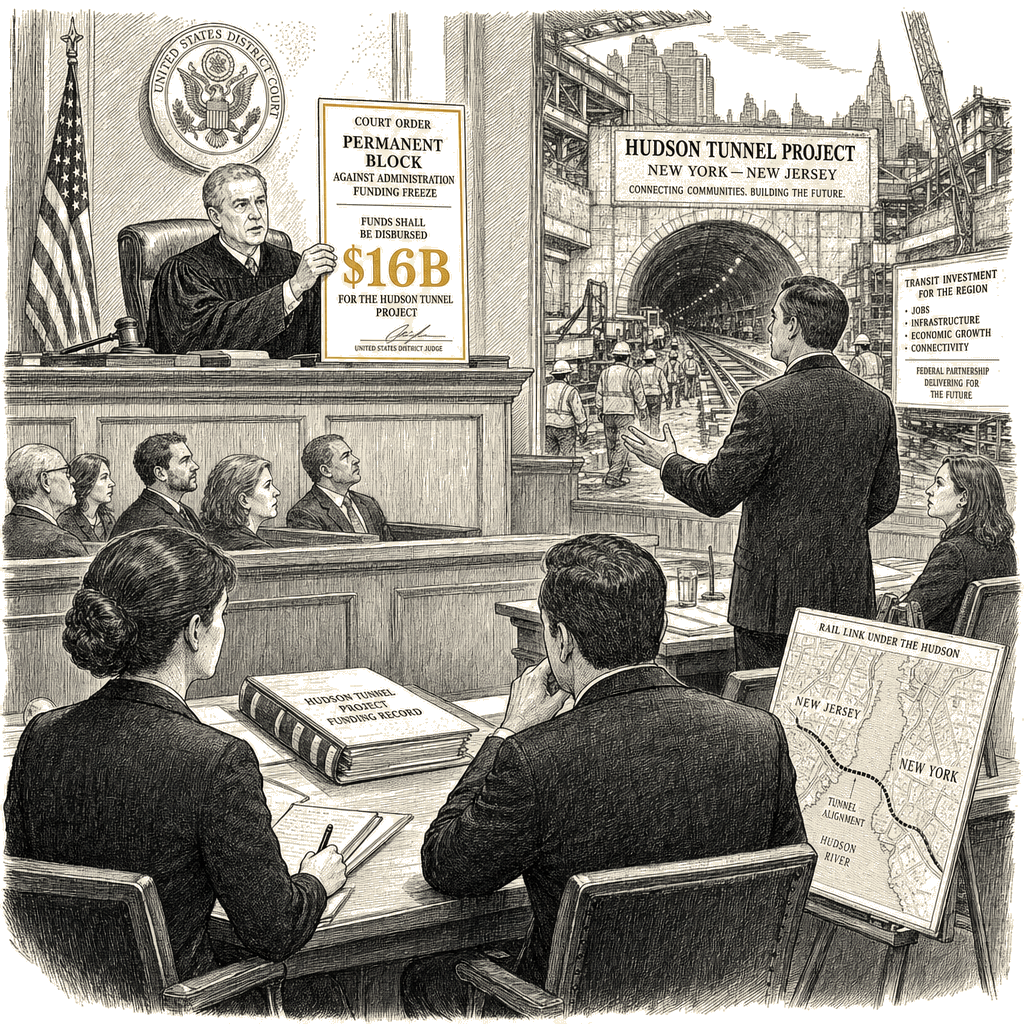
Trump held $16 billion in tunnel funds hostage to punish Democratic states. A federal judge permanently told him Monday he cannot do that anymore.
U.S. District Judge Jeannette Vargas, sitting in the Southern District of New York, ruled that the Trump administration’s freeze on the Gateway tunnel project — the new rail link under the Hudson between New York and New Jersey — was “arbitrary and capricious,” and permanently barred the White House from withholding the money. The project was already underway. Tunnel-boring machines had been assembled in New Jersey earlier this spring. Construction crews had begun work in May. Then Trump personally decided, in October, to terminate the funding. “It’s terminated because the Democrats are so foolish,” he said at the time. “Right now, there is no funding — because it’s up to me.”
There is your governing philosophy in plain sight: withholding billions in appropriated infrastructure investment because of a petty political grudge, treating the economic stability of two hundred thousand daily commuters and the paychecks of the construction trades workers already on the job as collateral damage.
The stakes for the region are massive. The project relies on $12 billion in federal grants and $4 billion in federal loans repaid by New York and New Jersey and the Port Authority. The tunnel replaces a century-old pair of tubes damaged in 2012 by Hurricane Sandy and operating below modern safety standards since. The current tubes carry more than 200,000 weekday passengers between New York Penn Station and Newark. When the new tunnel opens, the old one will close for repair. When both are open, the system will roughly double its capacity. The project has been on the books, in some form, for fifteen years. It has survived three presidential administrations. It was not, until last year, a partisan question.
Trump made it one — and he didn’t just make it partisan, he made it personal, holding hostage the contractors who do the building, the workers who do the labor, the commuters who will ride it, and the two states that are repaying their own loans to fund it.
My mother takes the train down from Pennsylvania to visit us; my family has spent enough Saturday mornings on SEPTA watching the slow cancellation board to know what a hundred-year-old regional rail system feels like when nobody will pay to fix it. I can afford those tickets, and many of the commuters who rely on this corridor cannot — they are the ones the freeze was actually aimed at. The Northeast Corridor is the busiest rail line in the country. Its bridges and tunnels are more than a century old in places. Its reliability is a joke that nobody in government laughs at. The federal commitment to fixing it — the multi-decade, multi-administration, multi-state commitment that produced the Gateway project — was the closest thing the twenty-first century has produced to the kind of public-works investment my parents’ generation got as a default.
They got the highways. They got the suburban housing development built on FHA-insured mortgages and GI-Bill-financed college degrees. They got the public-university system. They got the trains, sort of, in some places. They got it because their parents and grandparents, voting in numbers today’s voters don’t, decided that the public good was worth paying for, even when the people benefiting from it lived in states their own party didn’t carry.
My generation got the freeze.
Vargas didn’t just stop the freeze; she stripped away the administration’s legal fig leaf, noting that the defendants made “no attempt to justify their actions as consistent with the governing federal regulations.” The ruling will land as a relief to commuters who don’t yet ride the new tunnel, to the contractors who do build it, and to the states that are repaying the loans. It will also land, if anyone in this administration is paying attention, as a documentation of what is happening to the public-goods project of American life: a president decided to weaponize appropriated federal infrastructure money against two states whose voters did not vote for him, the states sued, and a court said the move was unlawful.
The distinction matters. The administration is not being told it must build tunnels. It is being told it cannot illegally hold hostage tunnels that are already under construction, in states that are already repaying the loans, on a project that already has bipartisan support from every governor and senator in the region. Vargas ordered the release of money Congress had already appropriated. She did not appropriate new money.
This is what Naomi Klein named the shock doctrine: you do not need to pass a law to defund a public good. You just need to freeze the money that’s already been allocated. The contractors slow down. The workers slow down. The subcontractors don’t get hired. The project slips a year, then two. Then the political will to finish it evaporates. And then the infrastructure that was supposed to be the twenty-first-century equivalent of the Interstate Highway System becomes a half-built tunnel under the Hudson with no opening date.
Heather McGhee’s The Sum of Us is the structural account of how the American public-goods pool got drained in the first place. The great midcentury American project — the highways, the bridges, the public university system, the FHA mortgages, the GI Bill — was built as a pool. When the civil-rights movement of the 1960s forced the pool open, the people who had been swimming in it decided they would rather have no pool than a pool that included everyone else. The infrastructure didn’t get expanded for the next generation. It got privatized where it could, defunded where it couldn’t, and frozen where the defunding hadn’t yet arrived.
The Hudson tunnel is the next stage. The pool is still being drained.
Dorothy Day used to say that the works of mercy and the works of justice are continuous — that one without the other is inadequate. A century-old tunnel under the Hudson, held together with patches and prayers since Hurricane Sandy salt water ate its concrete, is not an act of mercy. It is an act of justice: a federal commitment to two states that are repaying their own loans, for an infrastructure project that doubles transit capacity for two hundred thousand daily riders. Holding that act of justice hostage, because the states that benefit happen to vote the wrong way, is what abandonment of justice looks like.
The tunnel gets built anyway, if the courts hold. Judge Vargas said so on Monday.
The pool, however, is still being drained.