The Trump administration restarted a decade-shuttered oil pipeline to pay his oil industry donors.
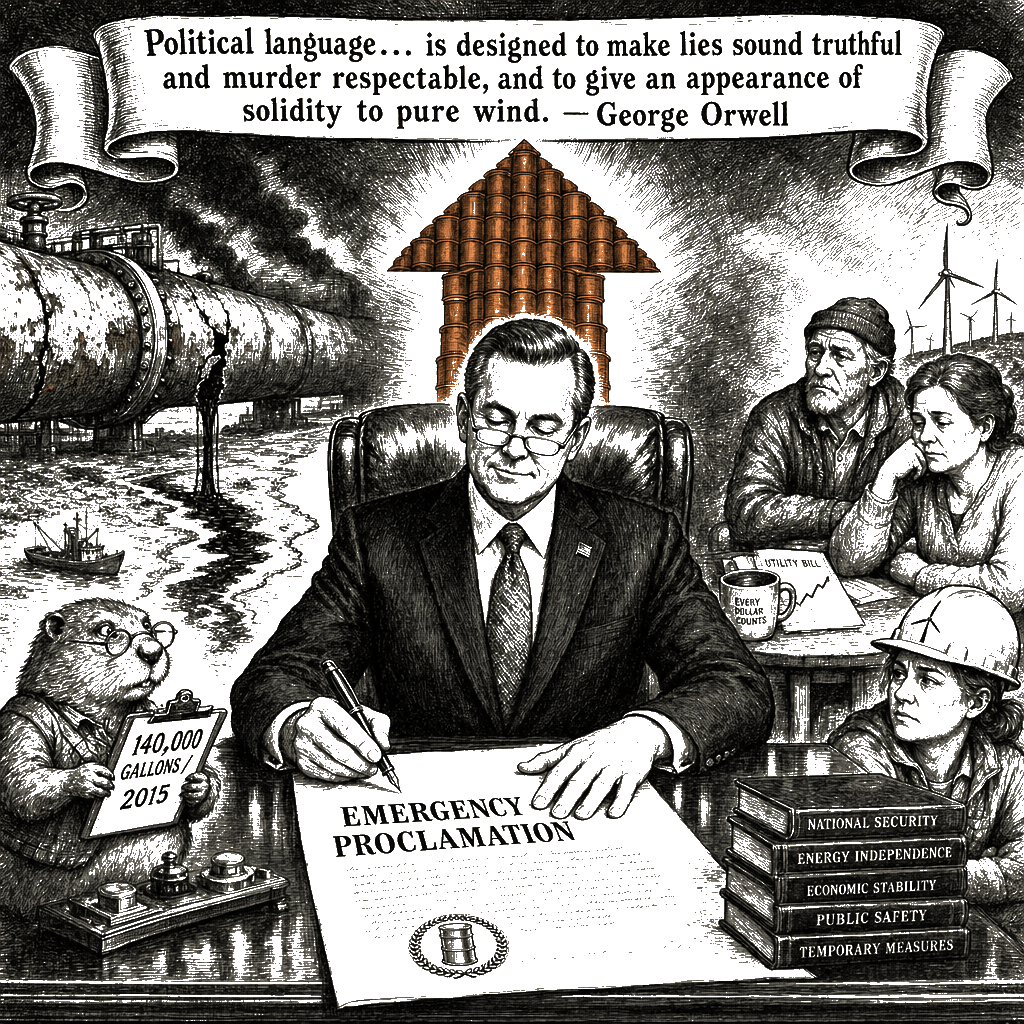
The pipeline is Sable Offshore’s. It ruptured in 2015, sent more than 140,000 gallons of crude oil into the Pacific off the California coast, and the state has spent the decade since keeping it shut. The federal government has now used emergency powers to put it back in service. The governor and the attorney general of California are in court trying to stop it. The “emergency” is that Sable wants the pipeline to run. The state’s position is that a pipeline that already spilled 140,000 gallons of crude should not be restarted by federal proclamation. The state is losing.
The pipeline is only one room the decision is being made in. The same administration has branded state environmental oversight as terrorism to crack open the coastlines. Howard Lutnick, the secretary of commerce, sent a letter in May to the California Coastal Commission calling the agency’s posture “environmental terrorism.” The trigger was a Space Force request to expand SpaceX rocket launches from Vandenberg, which the Coastal Commission declined last August. SpaceX sued for political bias; the suit settled in April. Now the federal government is using emergency review authority against the state agency that said no. To call a state’s environmental oversight an act of terrorism is to declare that the physical reality of a coastline has no standing, that any pause for the actual capacity of the land is a hostile act against the American economy.
The third front is offshore wind. California had a goal of 25 gigawatts of offshore wind by 2045 — energy the Biden administration had underwritten with a $427 million federal grant. The Department of Transportation has now withdrawn the grant. California has been investigating the federal deal since May and sued over a related lease cancellation in June. Attorney General Rob Bonta has put the federal government on notice of intent to sue, saying “California won’t stand idly by as the Trump Administration illegally strikes deals to kill offshore wind projects and replace them with more windfalls for his fossil fuel friends.”
The three fronts are not three different decisions. They are one decision in three rooms. The decision is: oil and gas run, wind does not. The decision is delivered to the same donor class in each room. Sable gets the pipeline. The launch operators get the Commission weakened. The wind developers get the grant killed. The donor class is the named beneficiary in each case. The damaged — the California coast, the ratepayers, the workers who would have built the wind farm — are not in the room.
I read that on Thursday and set the paper down and walked out to the shop and stood for a minute looking at the propane tank beside the back door. The propane tank is part of the Adams-Columbia Electric Cooperative service that runs to my place. The diesel in the pickup is from the co-op cardlock down the road. The electricity in the shop is from Dairyland Power. None of those decisions are made in my shop. They are made in a rate case in Madison, in a federal proceeding at FERC, in a board room in Houston, and — increasingly, in 2026 — in a White House that has decided the energy mix of the country is a thing to be settled by emergency proclamation and named donor.
I am a small-engine mechanic. I do not write the rule that decides whether the Sable pipeline runs. I do, however, depend on the rules that decide whether the co-op runs, whether the propane truck comes on Wednesday or doesn’t, whether the diesel at the cardlock is priced at a number that lets me make a margin on the repair work I do all winter. I am a member of Adams-Columbia Electric Cooperative. I get one vote. I go to the annual meeting. The co-op is member-owned and nonprofit; the board is elected by members. The co-op buys power from Dairyland Power Cooperative, a generation-and-transmission co-op, and Dairyland buys from the MISO market. The chain runs from my outlet in the shop wall to a series of cooperative boards and a federal regulator and a wholesale market. The chain works because the members have a seat at the table.
California does not have the same chain. California is a state whose governor and attorney general are in court this month trying to keep a federal emergency proclamation from overriding the state’s own permitting authority over its own coastline. The argument California is making in court is the same argument I make at the co-op annual meeting when the board proposes a rate change I disagree with. The argument is: the people who pay the bill should have a vote on the service. The Trump administration is making the opposite argument. The argument is: the donor gets the decision.
We read this from the bench in Wisconsin and we recognize the extractive mind. Aldo Leopold documented this exact impulse right here in the sand counties when he wrote about the drainage projects. The engineers decided the water was just in the way of the black peat, so they dug miles of ditches and sucked the marshes dry. The peat caught fire and smoldered for months, leaving ash heaps instead of farmland. Leopold’s point was that when you treat the land’s actual capacity as an obstacle to the throughput, the land eventually collects the debt. A rusted pipeline forced back online is a debt waiting to be collected.
There is a deep irony in watching an administration that built its political brand on the sanctity of state sovereignty turn around and brand a state’s environmental protection as terrorism the moment that sovereignty intersects with fossil fuel throughput. It is the nationalist shell game played at the level of the soil: the rhetoric of local control vanishes the second it stands between a state and a rusted oil pipe. The California Coastal Commission is a creature of state law, exercising the sovereign authority the state holds over its coast. When that authority says no to a spaceport or a ruptured pipeline, the federal response is not to respect the sovereignty. It is to evaluate the commission, cut the wind grants, and invoke emergency powers to crack the valves open anyway.
Wendell Berry has been writing some version of this for fifty years, in essays collected in The Art of the Commonplace and The Unsettling of America and the long Port William cycle. The version I keep coming back to is in “Solving for Pattern,” and the substance of it is that a healthy economy and a healthy culture require that the people damaged by a decision be the people who make the decision. The California Coastal Commission is the people-who-pay-the-bill in this case. The state permitting authority is the people-who-pay-the-bill. The 25 million homes the wind project would have powered are the people-who-pay-the-bill. The donor class in Houston and Washington is the people-who-make-the-decision. The damaged and the decision-makers are not the same people. The damage is somebody else’s. The somebody else is California this week. The somebody else next week, in a different case, is somebody else.
I am not a coastal Californian. I am a small-engine mechanic on the sand counties of central Wisconsin. My ground is not the Pacific coast. My ground is Adams County, where the C&NW railroad bypassed the county seat, and the half-century hollowing that followed is documented in the Adams County Historical Society’s record and the Adams County Times-Reporter archive going back to 1865. In Friendship, the three local hardware stores that were open when Sara’s mother started at the bank are gone. The grocery store on Main Street is a Family Dollar. The bank Sara’s mother worked at for thirty years was bought twice and now has no branch in Friendship. The veterinary clinic was bought by a regional chain and the new corporate management closed the small-animal practice. The reason the businesses are gone is the same reason a shuttered pipeline is being restarted in California. The reason is that the decisions were made in rooms where the people who paid the bill did not have a seat.
A real rural energy policy would treat the grid as a public asset and the land as a partner, routing long-term investment into the cooperative ownership models born in 1936 with the Rural Electrification Act, the ones that kept the lights on in Adams County and still work today. It would not treat a state’s sovereign authority to protect its coast as a terrorist obstacle to a ten-year-old oil rupture.
The precedent being set in California will land on my co-op. The precedent is: when the federal government decides a corporation is owed an outcome, the corporation gets the outcome, and the state agency that says no is reviewed, defunded, or sued out of existence. The co-op is the seat I still have. Sara and I will be at the Adams-Columbia annual meeting in October. The board is up for election. The seats are the only thing between the propane truck and a federal proclamation.
The language of emergency is the extractive mind’s favorite tool. It ends with the marsh drained, the peat on fire, the well poisoned, and the people who tried to draw a line around the damage called the enemies of their own community. The machinery just moves to the next coast, and the people who try to hold the line are left holding the ash.