
The Supreme Court codified a biological caste thisweek, stripping transgender girls of their civil rights in West Virginia and Idaho by a 6-3 vote. The majority opinion in West Virginia v. B.P.J., consolidated with the Idaho challenge, dressed this categorical exclusion in the language of equal protection, federalism, and common sense. The constitutional work the opinion does, on the most charitable reading, is real. What it produces, on the same reading, is a regime-level authorization of categorical sex-based exclusion that the Court has spent generations dismantling.
Start with the majority’s strongest case. The Fourteenth Amendment’s equal protection clause permits sex-based classifications when they are substantially related to an important government interest. Justice Brett Kavanaugh’s opinion identifies two such interests: competitive fairness in girls’ sports and the physical safety of female athletes. Both are legitimate; both are constitutionally cognizable. The premise that biological males retain meaningful physical advantages over biological females, even after hormone treatment, is supported by a body of physiological research and accepted by the athletic policies of most states and sports-governing bodies that have addressed the question. The administrative tangle of individualized physiological hearings in every school district, the majority reasons, was always going to produce litigation rather than justice. And the textual distinction between Title VII’s employment context and Title IX’s athletic context, the majority’s strongest statutory move, is real. The 2020 Bostock ruling, which held that discrimination on the basis of transgender status is discrimination on the basis of sex, was decided in the employment context; athletics, Justice Kavanaugh writes, present “vastly different” factual contexts. The dissent, written by Justice Sonia Sotomayor and joined by Justices Elena Kagan and Ketanji Brown Jackson, asks for more fact-finding about the physiological effects of puberty-blocking treatment on transgender athletes.
Grant the steelman. The majority’s response, that the empirical record is sufficient and the administrative costs of case-by-case evaluation are prohibitive, is the kind of pragmatic judgment courts are entitled to make. There is a respectable constitutional argument that the state may reserve sex-separated categories on biological grounds where the contested resource is physical safety and competitive opportunity. The majority’s reading of Title IX, that the 1972 statute’s reference to “sex” means biological sex and not gender identity, is a position the Court is institutionally entitled to take. Justice Kavanaugh’s sentence — “the States may treat all biological males the same and treat all biological females the same, given the inherent physical differences” — is a clean statement of the majority’s premise, and the premise is one serious constitutionalists can defend.
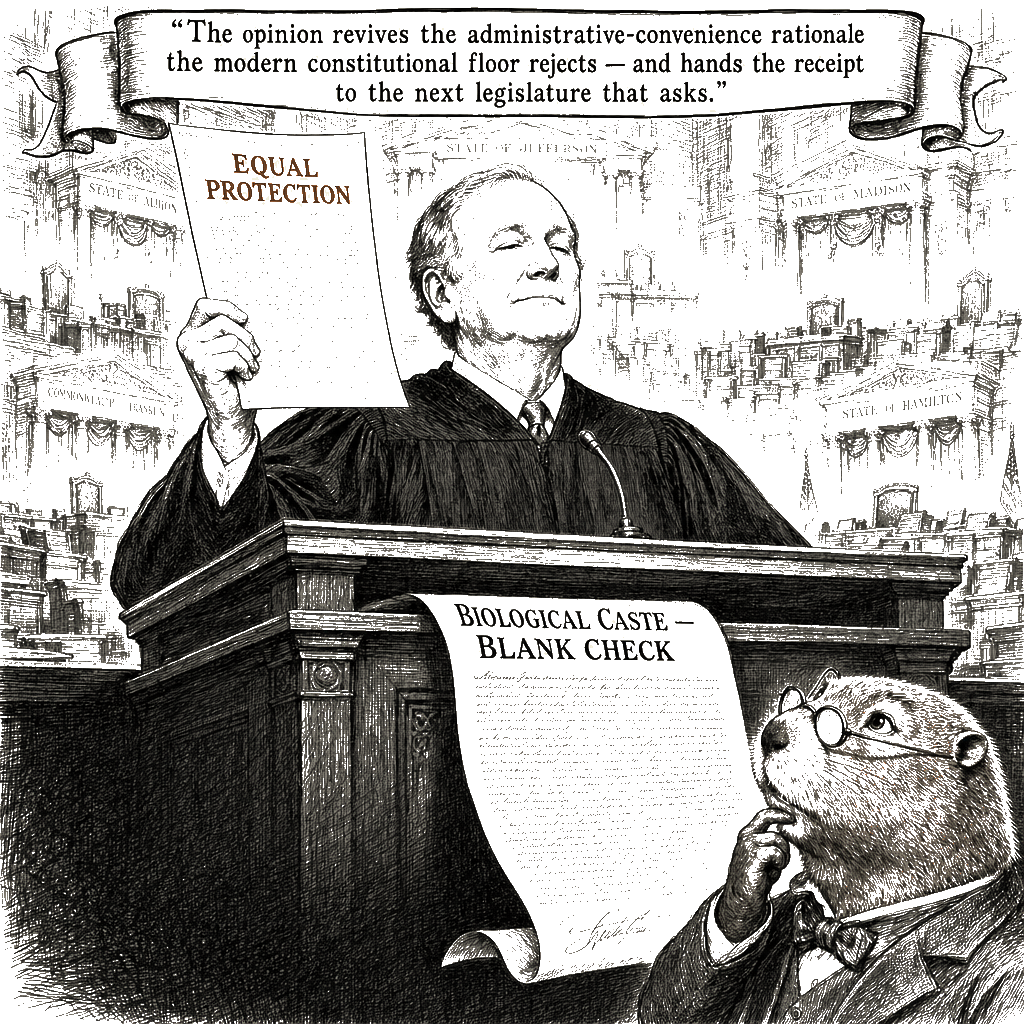
Now turn the screw. The opinion’s premise that administrative convenience justifies categorical exclusion is the exact rationale the Court deployed in Goesaert v. Cleary, the 1948 decision that upheld a ban on women bartenders because enforcing individualized exceptions was too burdensome. Goesaert is a constitutional relic; the Court has not formally overruled it, but it has not been relied upon in nearly eighty years, and the modern constitutional floor against categorical sex-based exclusion rejects its premise. The opinion’s revival of the administrative-convenience rationale, in a case where the administrative burden was self-manufactured by the legislature, is the constitutional mistake.
The record is here. West Virginia’s athletic association already maintained a case-by-case exemption policy, a policy B.P.J. satisfied, before the state legislature swept it aside with a categorical ban to manufacture the very conflict now before the Court. The administrative burden the majority invokes was not a feature of the regulatory landscape; it was a feature of the legislature’s choice to dismantle a regulatory landscape that had been working. B.P.J. herself, the named plaintiff, won a state championship in girls’ shot put this year, on the very treatment the majority’s framing would exclude. The “individualized hearings” the majority says were unworkable were producing outcomes the legislature found inconvenient, so the legislature eliminated the hearings and produced a plaintiff. The constitutional floor against categorical sex-based exclusion does not dissolve because a state legislature decides it is easier to ban a class of people than to evaluate them.
The textual argument compounds the error. The statutory text prohibiting sex discrimination is identical in Title VII and Title IX; both prohibit discrimination “on the basis of sex.” The majority’s contextual distinction between employment and athletics is a sociological observation, not a textual one. By declaring that biological sex overrides gender identity on the playing field, the Court has established a Bostock exclusion zone, directing lower courts that civil rights protections evaporate the moment a transgender person enters a locker room, a bathroom, a women’s shelter, or a women-only scholarship. The opinion’s own acknowledgment that all nine Justices agree Title IX’s “sex” does not include “gender identity” in this context is the doctrinal hinge; the lower courts will read the hinge as the holding, and the holding will travel.
The regime-level effect is the normalization of a two-tiered equal protection framework. The Trump Administration is already arguing, in pending federal enforcement actions, that separating sports by biological sex is not merely permitted by Title IX but required. The Administration’s reading, ratified by the majority’s textual analysis, will reach every Title IX-regulated program in the country: sexual-assault proceedings, single-sex bathrooms, dormitory assignments, Greek-life membership, intimate medical care. The Court has not just answered a question about West Virginia high school athletics. It has handed every state legislature, and the federal executive, a blank check to draw biological caste lines wherever the political pressure is sufficient.
This is not a resolution of the tension between inclusion and opportunity in athletics. It is the judicial ratification of a biological caste, handed down to whatever legislature is most motivated to wield it. The constitutional floor against categorical sex-based exclusion was built over generations; the B.P.J. majority has handed the receipt for its demolition to the next legislature that asks.