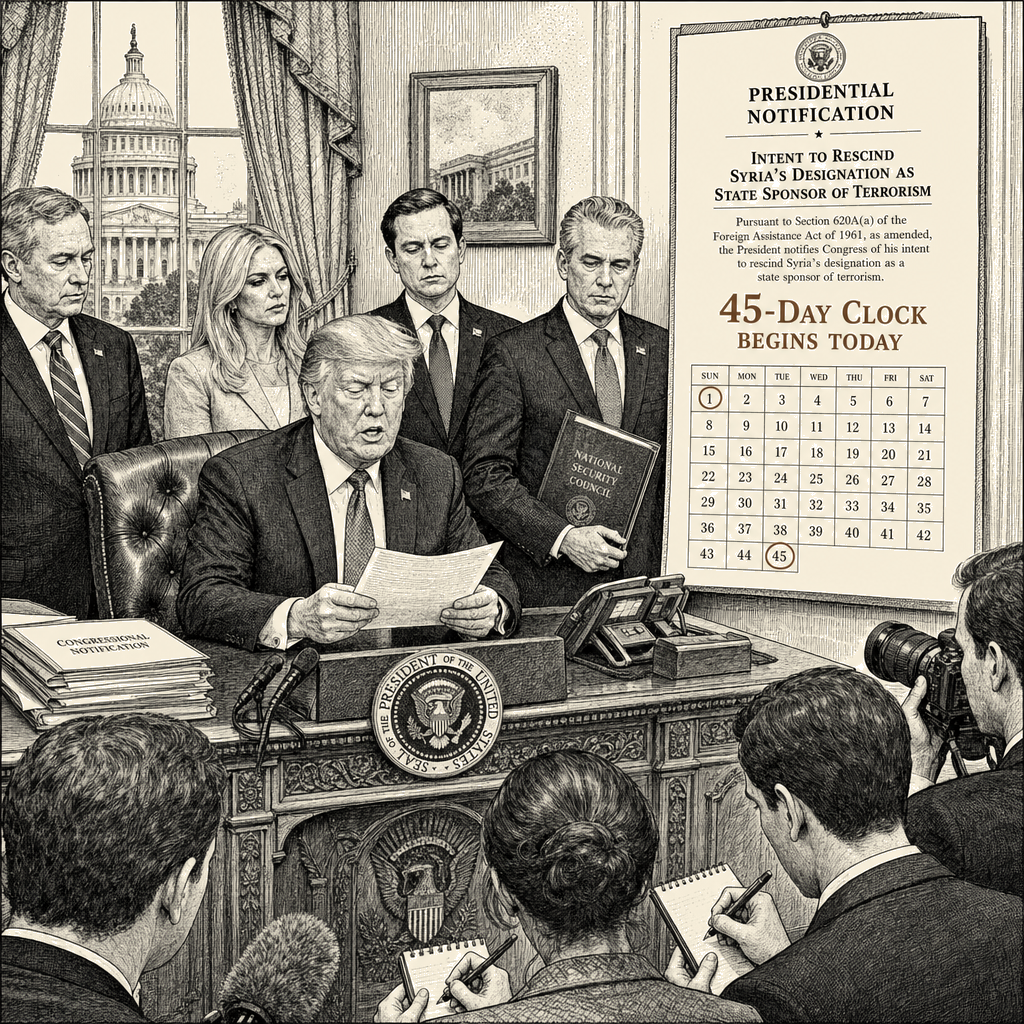
Trump and Rubio are laundering a former al-Qaeda commander and calling it diplomacy. The scene at the NATO summit in Ankara last week required a particular kind of blindness. The President of the United States sat beside Ahmed al-Sharaa and praised him as a highly respected leader. The Secretary of State shook his head in assent, confirming the executive intent to open a forty-five-day review period and drop Syria from the State Sponsor of Terrorism list. Al-Sharaa is the same man the U.S. government once designated as the head of a Foreign Terrorist Organization. He led the Syrian branch of al-Qaeda during the years it carried out the worst of the country’s suicide-bombing campaign.
Before he was the head of an interim government, al-Sharaa was Abu Mohammed al-Julani, emir of Jabhat al-Nusra, an organization that pledged loyalty to Ayman al-Zawahiri and murdered Syrian civilians, executed Syrian rebel rivals, and fought the very Free Syrian Army factions the United States had spent hundreds of millions of dollars training and arming. That al-Nusra later rebranded itself and dropped the al-Qaeda brand in 2016 does not change what it was. A mechanic who has rebuilt enough engines knows what a fresh coat of paint on a busted block smells like. That is what we are watching here. The bipartisan consensus behind it is the part that ought to make working people furious. Democrats on the Senate Foreign Relations Committee are celebrating the removal of the terrorism designation, eager to show they can engineer a pro-Western Damascus just as effectively as the Republicans. They believe a press conference in Turkey rewrites a decade of what happened on the ground. The Senate panel advancing legislation to repeal remaining Syria sanctions was the legislative wing of this same maneuver.
The men who actually paid the costs of the Syrian war are not at the press conference. Those of us who rolled into Iraq in 2003 in armor crews learned what happens when the political class decides to dismantle an existing structure and hand the keys to whoever has the most guns. The dissolution of the Iraqi army did not produce a secular democracy. It produced the very jihadist apparatus al-Sharaa rose through. The architects of those original failures are now celebrating the leader of that apparatus as a statesman. The betrayal of what is right by those who hold legitimate authority, that is the moral weight our generation of soldiers carries, and it is being deepened in real time by the men who sent us.
And while the President sits in Ankara praising a former al-Qaeda commander, his administration is simultaneously proposing an F-35 sale to Turkey despite the legal barriers. That is how this thing actually works. The same week the country certifies a former terrorist as a legitimate head of state, the military-industrial machine converts a former adversary into a new customer. Lockheed Martin’s stock does not care whether the man shaking hands in Ankara was on the terrorism list last year. Lockheed Martin’s stock cares that a new buyer is coming online. The contractor wins. The taxpayer picks up the difference. The veteran who came home with the weight of that war does not get a check. The small town that sent its kids does not get a refund.
Eisenhower warned us about this. In his farewell address of January 1961, three days before he left office, the general who had commanded the largest military force in human history stood up and told the American people to watch the machinery. The conjunction of an immense military establishment and a large arms industry, he said, could in time threaten the liberties and democratic processes of the republic. He was not warning us about a single administration. He was warning us about an operating system that survives whoever sits in the chair. The system is still running. The Syria designation is being lifted. The sanctions are being repealed. The F-35 is being offered to the country that bought Russian air defense systems and pushed our allies out of the F-35 program once already. The man in Ankara is being elevated. The contractors are lining up. The forty-five-day clock is running.
The 1979 designation of Syria as a state sponsor of terrorism was, whatever you think of the original list, a real document. It cited Syria’s support for terrorist groups, its weapons programs, its occupation of Lebanon, its alignment with Iran. Several of those features have shifted since the Assad government fell in December 2024. But the new feature, the one that defines the present Syrian government, is precisely the one the original designation’s logic would seem to apply to with the greatest force. The head of that government is a man who led an al-Qaeda affiliate. We are not, as the rhetoric suggests, ending a relic of an older Middle East. We are certifying as legitimate a man the United States once formally called a terrorist. As a matter of basic accounting, that does not pencil out.
The pattern has a name ordinary people can understand. The United States uses militants as tools against its enemies, then faces the question of what to do with them after the enemy is gone. In Afghanistan in 1979, we funded the mujahedin. Their successors flew planes into our buildings on September 11, 2001. In Libya in 2011, our bombs cleared a dictator and left the country overrun by the very militias that had been on the ground fighting him. In Syria, the CIA’s billion-dollar Train and Equip program built a vetted Syrian opposition force that was largely defeated on the battlefield by the organization al-Sharaa led. The al-Qaeda affiliate the United States had been funding its rivals to fight is now the government of the country. The tool did not just slip out of our hands. It took the throne.
What the moment requires is a serious accounting with the question of what the terrorism designation was for in the first place. If the answer is that al-Sharaa has changed, that his organization has moderated, that the Syrian people are better off, then the country is owed evidence, not a press conference. The Syrian people killed by al-Nusra’s suicide bombers, the families of the FSA fighters killed by al-Sharaa’s forces, the millions of Syrian refugees who lost their homes, those people are owed something more than a handshake and a forty-five-day clock. The veterans who served in the war on terror, the working families whose taxes paid for the bombs and the contractors, the country is owed an accounting.
The forty-five-day review period will pass. The designation will be removed. The Central Bank of Syria will welcome the financial reintegration. The civilian cost of the war, the hundreds of thousands of dead, the millions displaced, will remain exactly where they are. The ledger of the bipartisan foreign-policy establishment closes. The men who actually paid the costs are left to watch the new partners shake hands. And the operating system Eisenhower named keeps running.