
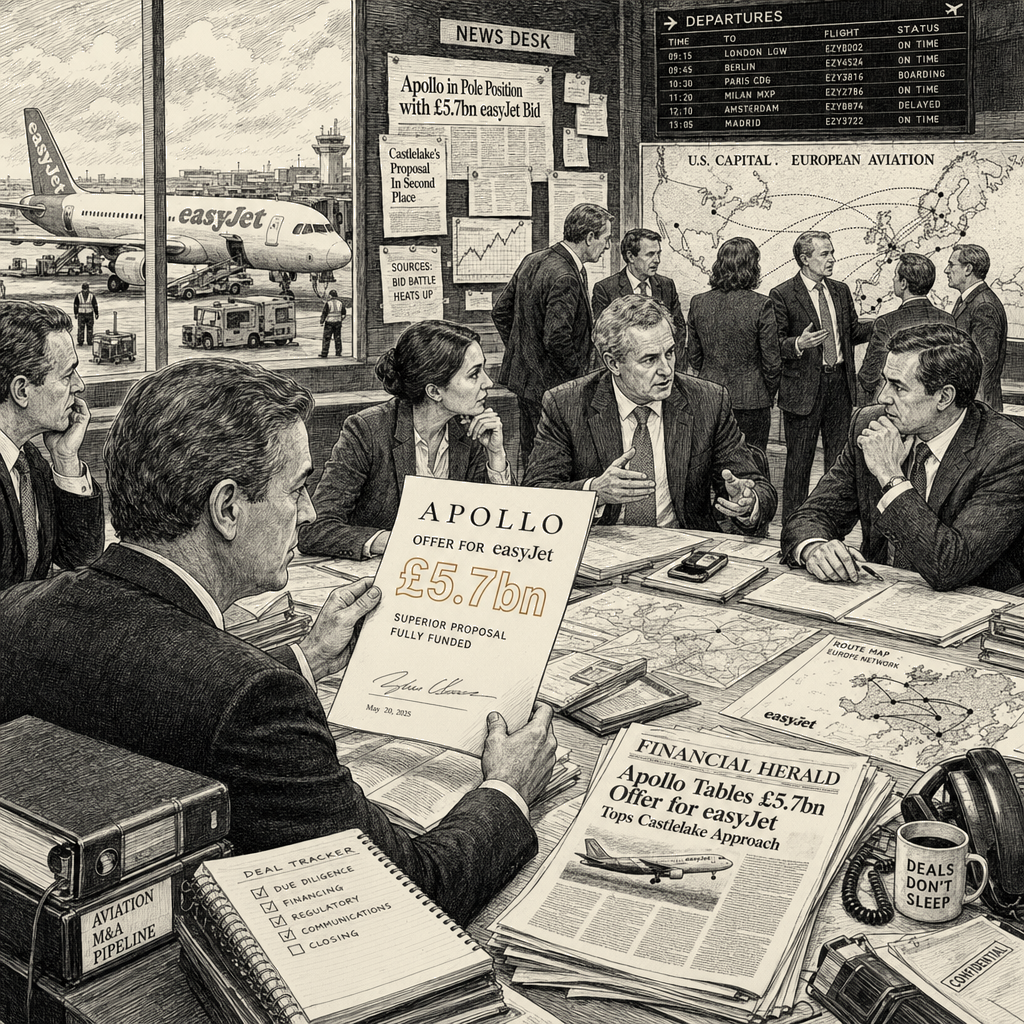
The free market they spent sixty years defending became a rentier’s auction. Two American private equity firms — Apollo and Castlelake — have spent the last week trading billions of borrowed pounds over easyJet, which the Guardian reported Friday is “minded to recommend” Apollo’s £5.7 billion all-cash bid at £7.15 a share, having earlier in the week backed Castlelake’s £5.5bn bid that analysts said undervalued the carrier. That is not a fight over strategy. It is a fight over who extracts the value the workers and passengers produce. They are not buying the airplanes. They are not building a single new route. They are buying the right to squeeze a few more pounds out of baggage fees and loyalty programs, and they are doing it with money they do not have.
I’ll grant Apollo its honest case. Public-market airlines are punished quarterly for things that take years to fix: a fleet renewal, a labor settlement, a base restructuring. Patient capital under private ownership can take the longer view. The premium to shareholders is real. And to be fair to the conservative intellectuals who have spent decades arguing that shareholder value is the only metric that matters, the logic is supposedly internally consistent. If a corporation is nothing more than a bundle of cash flows and the job of management is to optimize those flows for whoever holds the equity, then Apollo is acting perfectly rationally. They have correctly identified that easyJet has a captive audience, a brand, and a network. Apollo says it will back the current strategy and management, will not break the company up, and will let existing shareholders roll their stakes into the new private vehicle. That is the courtship. It is also the part of the script I know from inside the machine.
But the playbook is the playbook. The private-equity record in airlines is not a record of stewardship. It is a record of debt-loaded takeovers, special dividends, sale-and-leaseback of the planes, renegotiated labor, deferred maintenance, and eventually a bankruptcy filing that empties the pension fund and strands the workers. The history is short and ugly, and the men who run the playbook know the history. That is why they keep promising, in the courtship, that this time will be different. When Apollo boasts of “enhancing the ancillary and loyalty offering” to create a “structurally differentiated earnings stream,” they are not describing product innovation; they are describing yield extraction dressed in management-consultant patois.
This is what your movement now means by a healthy economy: an airline put up for auction between two bidders who will not set foot in Luton, and whose loyalty is not to the carrier but to the fund’s life cycle. The community that depends on the airline — the Luton ground crews, the airport hotels, the cabin crews based in Naples and Lisbon and Geneva — has no seat at the table and no representation in the spreadsheet. The bid is for the cash flows. The workers are the cost base. The passengers are the throughput.
An airline is not a futures contract. It is a living institution, built by the sweat of mechanics and the nerve of pilots, connecting real people to real places. The men in the boardrooms of Apollo and Castlelake do not make anything. They do not fly the planes. They do not fix the engines. They move numbers on a spreadsheet, and they call it value creation. The conservative movement spent sixty years telling us that free enterprise meant the builder, the maker, the man who risked his own capital to create something real, would be rewarded. We were told that the market would discipline the lazy and elevate the productive. What we got instead was the exact opposite. We got a financialized economy where the most profitable thing you can do is take on massive debt to buy an existing asset, load that debt onto the asset itself, and then strip it for parts.
This is the Servile State Hilaire Belloc warned us about, mapped precisely onto the modern leveraged buyout. Belloc predicted that the concentration of property and the rise of a property-less wage-servitude would destroy the free citizenry; the modern private equity firm is the engine of that concentration, using LBO debt-loading to achieve the monopolistic capture he foresaw. Apollo’s pledge to allow current shareholders to remain invested under its ownership, rather than forcing them to divest upon delisting, is not a concession to legacy capital. It is the ultimate rentier trap, keeping shareholders hooked on the yield while the debt is loaded onto the operating airline itself. When Apollo says it places a “high value on people” and retaining “key staff,” what they mean is that they have calculated the exact cost of replacing those people, and they will pay that cost only until it becomes cheaper to fire them. The men in the buildings on Park Avenue and in the City of London are not stewards. They are tenants, with a defined exit.
The honest conservative objection here is not the procedural one — that PE is bad in the abstract. It is the institutional one. Selling easyJet to whichever bidder will load it with the most debt and extract the most value over the shortest window is not a market transaction. It is a dissolution. It severs the bond between a productive enterprise and the communities that depend on it, and treats those communities as a disposable abstraction owned by people who will never visit them.
The antidote is not the centralized state, though the progressive left will always reach for the regulator. The antidote is the one thing the financialized right has spent its whole life trying to destroy: the distributed, rooted institution. There is a better answer, and it is older than either Apollo or Castlelake. It is the model John Lewis built in Britain and that Mondragon has shown scales industrially across the Basque Country: an employee-owned company, governed by the people who work in it, with the customer and community stake written into the charter and protected from the cycle of quarterly extraction. John Lewis has run for nearly a century on the principle that those who do the work should own what they build. easyJet is harder to reorganize than a corner shop, but the principle is the same, and patient capital exists when public pension funds and regional banks are willing to back a workers’ majority and a community seat in the governance.
The conservative tradition I was raised in used to believe that widely-distributed ownership was the foundation of a free society. That is not a slogan. It is the only architecture that survives the cycle of bidders. When the funds have moved on — and they will move on — what will be left in Luton and Naples and Lisbon is the operation, or it will be the wreckage. The choice is being made now, with Apollo’s clock expiring on 7 August, by people who do not live there. They should be told what is being sold, and to whom it belongs.