Alberta separatists are selling out rural Alberta to defend the oil multinationals.
The Calgary Stampede runs ten days every July, and the chuckwagon races and rodeo grounds are again this year the staging ground for a fight that has been building for five years. The BBC reports that Albertans will vote in October on whether to hold a binding referendum on leaving Canada, a vote forced by a separatist petition that gathered enough signatures under provincial law. The pro-unity camp and the separatist camp are both at the Stampede. Prime Minister Mark Carney is on his way. Polls put independence support at around twenty per cent. In the rural village of Mirror, a town of about four hundred two hours from Calgary, a separatist organizer named Chris Scott told the BBC he could count the opponents on both hands. A man there who runs a cafe and a truck stop told the BBC independence is “inevitable” and bought a camper van. Justin Perkins, fueling his truck in the same country, told a reporter he is “the hated redneck” who has done nothing wrong except be born in the wrong place. Up here, we know that exact posture. It is the same resentment that follows every time an urban regulatory board blocks a rural energy project or a rural broadband line, and then the people who consume the power from a safe distance dismiss the response as backwardness.
I write from Adams County, Wisconsin, and I recognize the exact shape of this structure because it is the structure I live inside every day. Adams County sits on the central Wisconsin sand plain, the same country Aldo Leopold wrote about in A Sand County Almanac. The corporate consolidation that hollowed the county arrived first as dairy, then as corn, then as potatoes, then as energy generation that mostly went elsewhere. What stayed was the trade. The potato acres around us are run by Heartland Farms, a fifth-generation operation that plants roughly a hundred center pivots and ships the harvest to Frito-Lay. The corporate parent at the end of the chain is PepsiCo. PepsiCo does not live here. The wealth the potato crop produces leaves the county overnight, on an electronic-transfer schedule I do not see but understand, because Wendell Berry has been writing about this structure for fifty years in essays I keep at the bench. A community’s economy is its membership. The membership is the people and the land and the institutions. The corporate parent is not a member. The corporate parent is an interested party with interests that are not the community’s interests.
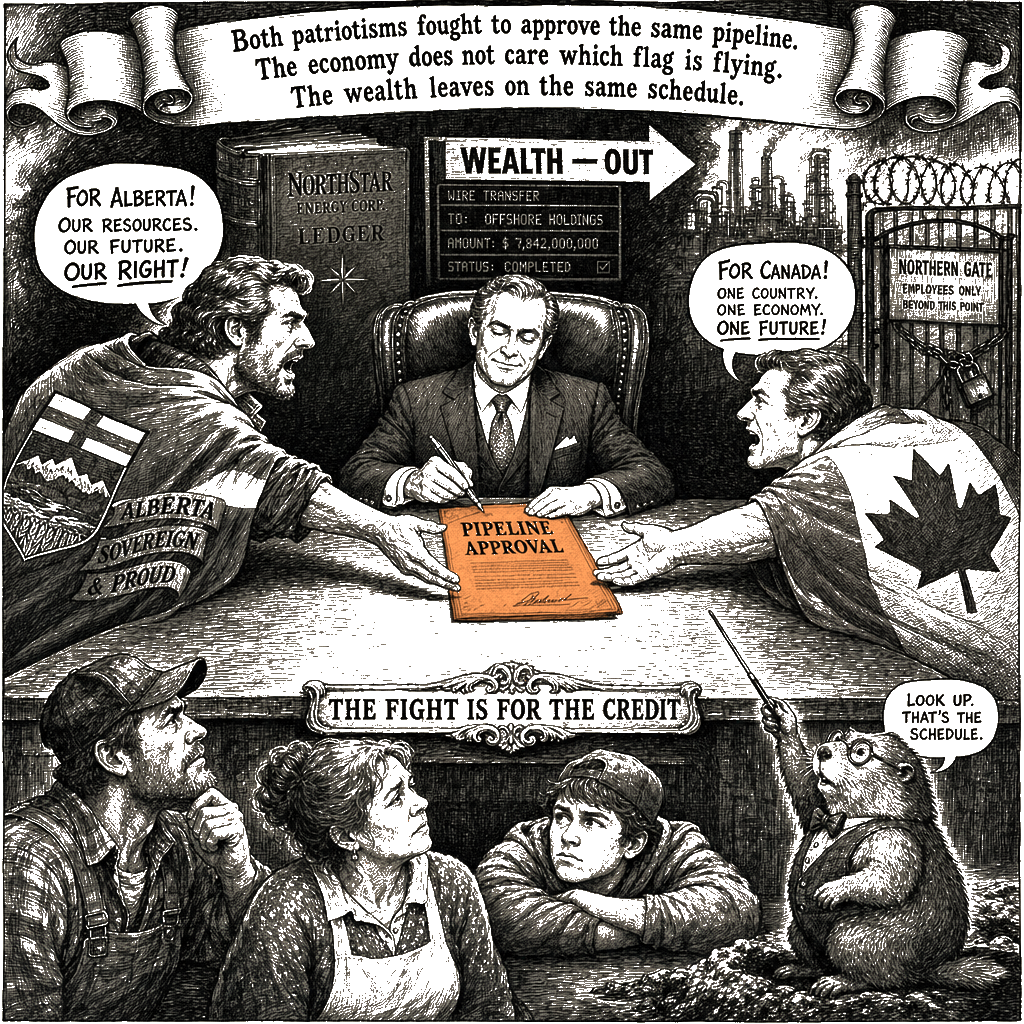
The Alberta referendum is a fight inside that same structure. The separatists want Alberta to run the oil economy directly, free of Ottawa. The federalists want Ottawa to keep the seat at the table. Neither side is challenging the underlying structure of the oil economy. Both sides accept that the corporate entities which move Alberta’s oil to tidewater, to refineries, to the global market, are neutral parties whose interests are not at issue. The BBC reports that Carney’s main appeal to the province is a west-coast pipeline. Carney and Premier Danielle Smith announced the pipeline last week. The pipeline’s beneficiaries, named in the corporate filings of the firms that will operate it, are not Alberta families. The pipeline is built because the corporations need a route. The pipeline is approved because both levels of government need a reason to keep the corporate negotiations going. The pipeline is a demand of the oil multinationals. The pipeline is a demand of the federal government. The pipeline is a demand of the provincial government. The pipeline is a demand of the separatist movement, expressed in the rhetoric of grievance and Ottawa overreach. Every position in the fight agrees on the pipeline. The fight is about who gets the credit for approving it.
The Nationalist Shell Game is the name for this move. The structure is: name a country, name a flag, name a grievance, let the named patriotism do the rhetorical work, and let the actual structure of the economy go unexamined. It does not matter whether the country is Canada, the United States, the United Kingdom, or Hungary. The structure of the move is the same. Nationalist rhetoric is most reliable in the places where the multinational economy is most entrenched. The places where the rhetoric is loudest are the places where the locals have the least say over the actual decisions. The grievance is real. The proposed cure is the same cure the grievance requires the locals to refuse to examine. The unity camp’s Brexit parallel is the right one — but the Remain camp warned of economic disaster too, and the warning didn’t save them a decade of political chaos. The country has had seven prime ministers since. The economy did what the economy was going to do. Brexit did not reshape the British economy. Brexit reshaped the rhetoric around the British economy, so that the structural arguments the Remain side wanted to make could be dismissed as elite condescension, and the structural arguments the Leave side wanted to make could be carried into power under the flag.
Chief Samuel Crowfoot of Siksika First Nation, just east of Calgary, told the BBC his nation’s future is more secure inside Canada. Chief Troy Knowlton of Piikani First Nation said he would rather deal with the devil he knows. The First Nations launched a court challenge to the binding referendum and won at trial, on the grounds that they were not consulted and their treaty rights were placed at risk. The decision is under appeal. The sovereignty the separatists claim is not the sovereignty of the territory. Treaty 7 was signed in 1877, between the British Crown and five First Nations, at a place a few feet from where Crowfoot stood when he gave the BBC his interview. The treaties pre-date the province of Alberta. The treaties pre-date the Canadian state in its current form. The treaties pre-date Confederation. A referendum on whether Alberta should leave Canada is, among other things, a referendum on whether the treaties still bind whoever governs the territory the treaties cover. Crowfoot says no separatist group has reached out to his nation, or to any of the nations he speaks with. The sovereignty on offer is sovereignty over a territory whose actual sovereignty is shared with peoples who have never been asked to consent to the new arrangement.
I write from a county whose own treaty history is well documented and ongoing. The Ho-Chunk Nation has managed these lands since long before Adams County was organized in 1853. In northern Wisconsin, the Ojibwe retain off-reservation hunting, fishing, and gathering rights under the 1837 and 1842 treaties, as the Seventh Circuit held in Lac Courte Oreilles Band v. Voigt in 1983 and as the courts have been working out the implementation of ever since. The point is not that treaties are easy. The point is that the question of who governs a piece of North American land is older than the question most separatists want to ask. The question cannot be settled by a petition. The treaties will be honored by whoever is governing, or they will not. The history of the last two hundred years on this continent is the history of the answer.
The BBC reports that the unity campaign’s Thomas Lukaszuk says the dispute has reached the point where neighbors in rural Alberta are watching which flag is flying on which house. “This has to end,” Lukaszuk said. He is right that it has to end. The way it ends matters. The way it ends is not in October. The way it ends is in whether the actual economy that runs Alberta — the oil economy, the pipeline economy, the corporate economy that consolidates wealth out of the province and concentrates costs in the province — gets named in the campaign, or whether the campaign stays at the level of flags and referendums and the Nationalist Shell Game.
Wendell Berry’s The Unsettling of America has a chapter called “The Body and the Earth.” The chapter is about what happens to a community when the body is treated as a unit of production, separate from the land it lives on and the household it feeds. The chapter is about rural communities. The chapter is about Adams County. The chapter is about Mirror, Alberta — the village of four hundred where the man who runs the cafe and the truck stop looked at the BBC and said independence is “inevitable” and bought a camper van.
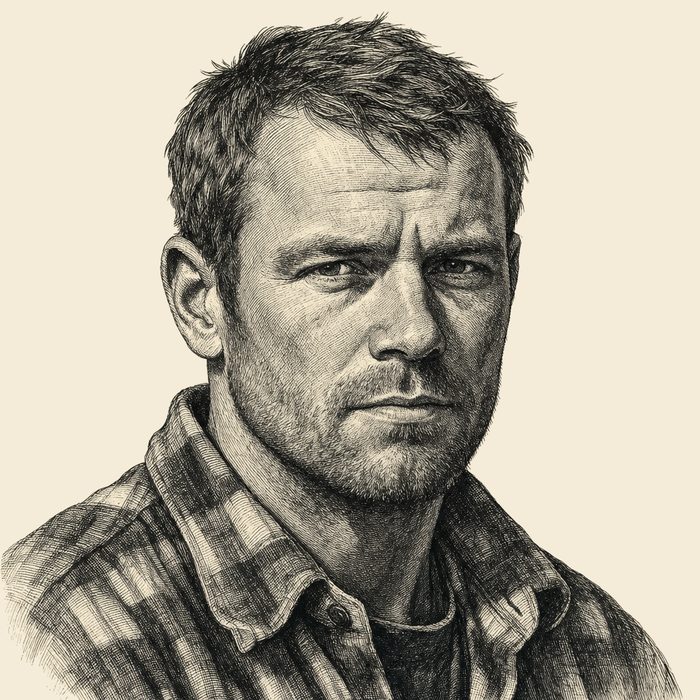
I do not know Chris Scott. I know that the man in Mirror is the man in Friendship. The corporate parent that pulls wealth out of Mirror is the same kind of corporate parent that pulls wealth out of Adams County. The separatist frame will not fix that. The federalist frame will not fix that. The only frame that fixes it is the frame that names the actual extractor and demands the actual accounting.
The first step in naming the actual extractor is to stop letting the flag do the work.