
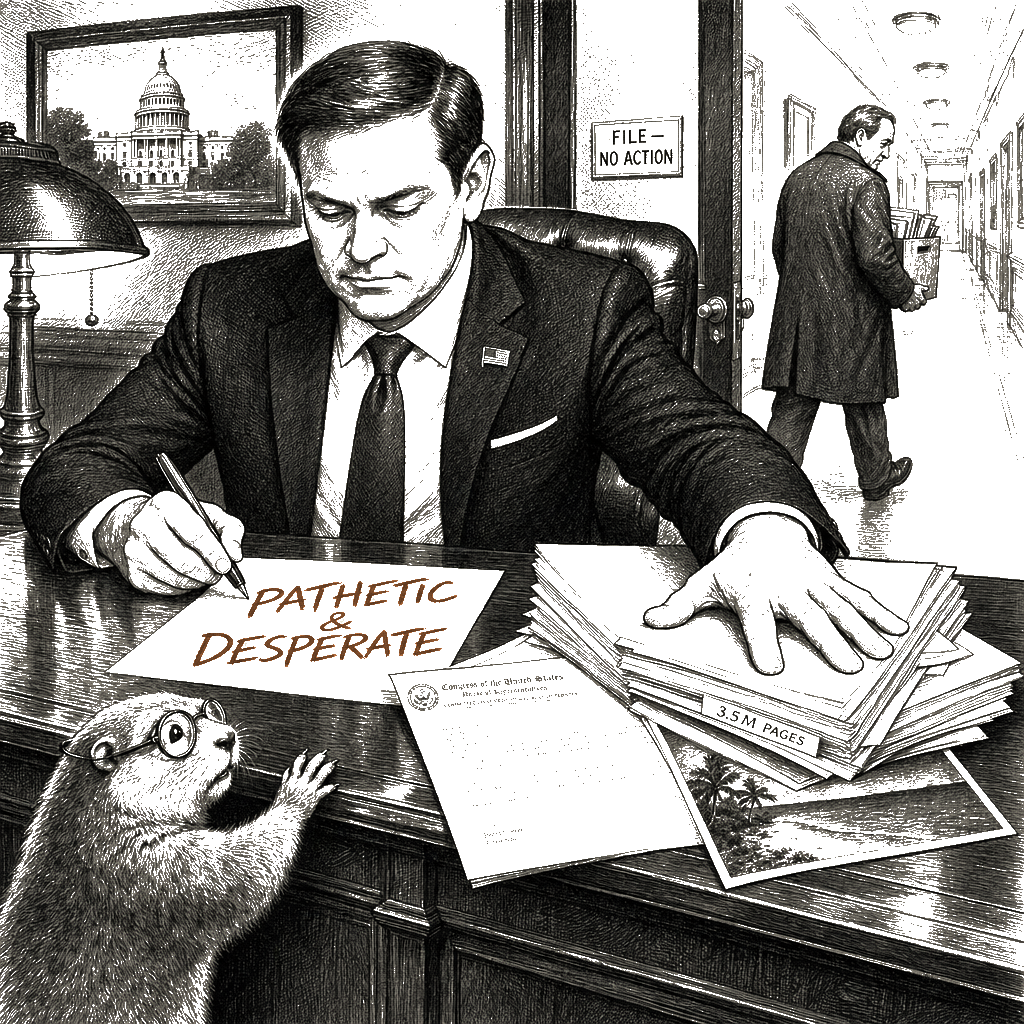
The current United States commerce secretary had a business relationship with a financier who died awaiting federal sex-trafficking charges — a relationship he told Congress did not exist, until a whistleblower who crawled through 3.5 million pages by searching for initials rather than names proved it did. Nobody has charged anyone with anything.
Howard Lutnick’s story has already changed twice. First he said he met Epstein once, twenty years ago, thought his behaviour “gross.” Then a photograph surfaced of him on Epstein’s Caribbean island in 2012 — four years after Epstein served time on solicitation charges, including one involving a minor. Now the Epstein files show Lutnick emailing with Epstein in 2018 about a start-up they had both invested in, and Lutnick answering the man’s direct question about its prospects as if they were ordinary business partners having an ordinary Tuesday. To the House Oversight Committee in May, Lutnick said he did not know until this year that Epstein had been a co-investor. Twenty-one Democrats signed a letter calling him a liar. The administration’s response calls the evidence “a desperate partisan distraction” and points to his own denials as though repetition were the same as truth.
This is the part where the pattern does the work. The commerce secretary is not the first powerful man caught in Epstein’s orbit who told a tidy story about a single handshake twenty years ago that the documentary record then dismantled. He is not the first to face a congressional letter and no charge, no subpoena, no consequence. He is the latest in a pattern — another whose relationship with Epstein the public would never have seen if a private citizen had not done what the FBI declined to do. The calculation is the same every time: tell the minimising story, hold the line, wait for the news cycle to drown in its own volume. The administration has spent months refining this very playbook.
And under it runs the second pattern, the one that does not make headlines. Simon Andriesz flagged accounting irregularities at Lutnick’s firm in 2016. He was fired. He went to the FBI about Lutnick’s Epstein ties in 2020. The FBI did not investigate. He won a whistleblower award from a regulator. The firm denies everything, says his claims lack credibility, says his employment ended because he refused medical advice and abandoned his role — the boilerplate that every fired whistleblower in America has heard in some version, the script that costs nothing because the retaliation case will take years and the man is already broken.
The whistleblower lives in a Cornish seaside village now, his career gutted, his health damaged, his finances drained by a decade of litigation against an employer that can outspend him forever. He discovered the evidence that the commerce secretary’s story does not hold. He fed it to Congress. And the commerce secretary is still the commerce secretary, and the firm is still the firm, and the FBI’s inaction is still the FBI’s inaction, and the White House called the reporting “pathetic and desperate.”
That last part is the tell, really. When the reply is not “here is why the evidence is wrong” but “you are pathetic to ask,” the question has already been answered.