
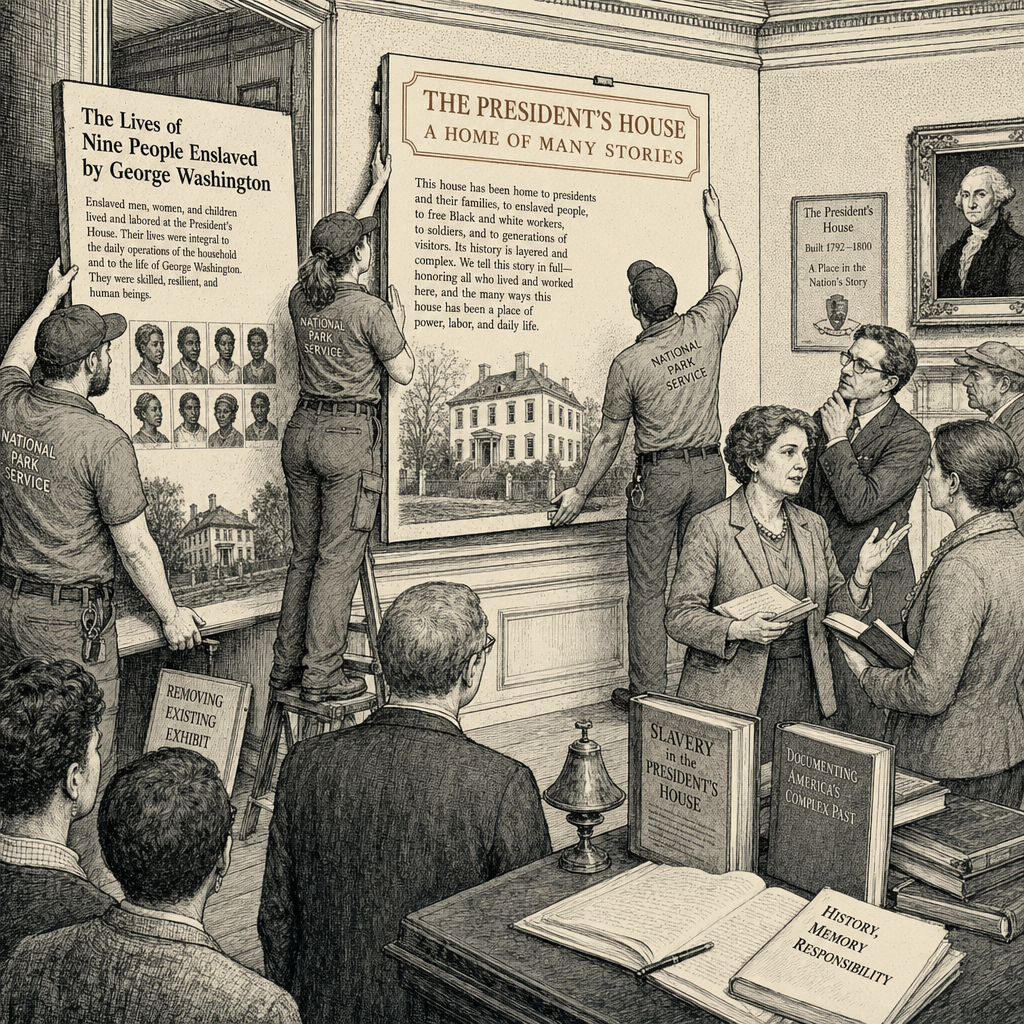
The Trump administration erased nine enslaved people from a federal memorial and installed a panel saying they experienced autonomy.
In the early morning of July 15, the National Park Service replaced the exhibit at the President’s House in Philadelphia — the site where George Washington and John Adams lived during the 1790s, and where Washington kept nine enslaved people in bondage. The original panels, installed in 2010 after years of advocacy by the Avenging the Ancestors Coalition, told those nine people’s stories by name. The replacement panels, installed under the executive order “Restoring Truth and Sanity to American History” of March 27, 2025, tell a different story. One panel states that enslaved people in the President’s House “experienced a greater modicum of autonomy than elsewhere in the South such as to explore the city and sometimes even attend the theater, with Washington buying the tickets.”
The steel-man of the administration’s position is straightforward. The President’s House is a National Park Service site. The executive has authority over NPS operations. The Third Circuit, ruling on the city’s lawsuit, authorized the replacement — overriding Judge Cynthia M. Rufe’s February 16 reinstatement order. The Interior Department says the new panels “acknowledge the evils of slavery” while providing what it calls a fuller picture of the nation’s origins. Federal authority over federal sites is a real doctrine, and the Third Circuit accepted it.
The departures from that steel-man are three.
The first is the content. “Autonomy” applied to enslaved people is not context. It is the vocabulary of the slaveholder’s self-justification, installed at a federal site by the government of the United States in 2026. The administration chose the word the enslaver would have chosen. That is the substitution at the core of the executive order: the historian’s language replaced by the slaveholder’s language, installed as federal truth. The nine people Washington held in bondage at the President’s House included Ona Judge, who fled to New Hampshire to escape Martha Washington’s plan to give her as a wedding gift. Washington spent years trying to recapture her. The replacement panels do not foreground that story. They foreground Washington’s “unease” with the institution — the enslaver’s discomfort as the narrative center, the enslaved person’s flight as a footnote.
The second is the timing. The NPS acted before dawn, after the Third Circuit’s July 3 order authorized replacement. Philadelphia’s mayor, Cherelle Parker, said the overnight execution “shows it understands this action is shameful.” The federal government had the court’s authorization. It did not have the community’s.
The third is the regime. This is not an isolated exhibit-management decision. The executive order of March 27, 2025, directed that federal historic sites not display exhibits that “disparage Americans past or living.” That framing treats a truthful account of enslavement as disparagement — a category-level confusion between historical accuracy and disrespect. The same executive branch has dismantled diversity initiatives across the federal government. The pattern is: the executive using federal authority to rewrite how federally presented history accounts for race.
The administration’s legal authority to replace the panels is not in dispute. The question is whether authority equals legitimacy when authority is used to install comfort over truth at a site whose purpose is memory.
The substitution test confirms the regime-level frame. Replace this cluster with the removal of a different exhibit at a different federal site and the pattern holds. Replace it with the rewording of a different historical marker and the pattern holds. The President’s House is the occasion. The regime of executive historical rewriting is the subject.
Philadelphia attorney Michael Coard, who founded the Avenging the Ancestors Coalition in 2002 and spent eight years pushing for the original installation, called the administration’s actions “the first step to fascism.” Coard compared the removal to George Orwell’s 1984 and raised the logical extension: if the president does not like the Liberty Bell, does the Liberty Bell move? If the Statue of Liberty offends on immigration, does the Statue come down? They are structural. The executive claim that authorizes this panel authorizes any panel.
Matt Hall, the Temple University professor who founded Old City Remembers in February, has stationed more than 100 volunteers at the site with informational packets carrying the original panels’ text. The volunteers give visitors the original words and ask them to compare — to see what they are being told against what was there before, and to think about why a particular government might want to present the history in a certain way.
The city retains legal options: en banc rehearing before the full Third Circuit, or an appeal to the Supreme Court. Coard is pursuing them. “Simply because he came in like a thief in the night and put up new panels,” Coard said, “doesn’t mean that a court can’t remove those mythological panels.”
The administration replaced nine enslaved people’s stories with a panel about their enslaver’s discomfort and called it context. The courts authorized the swap. The community did not. The volunteers will keep showing up.