
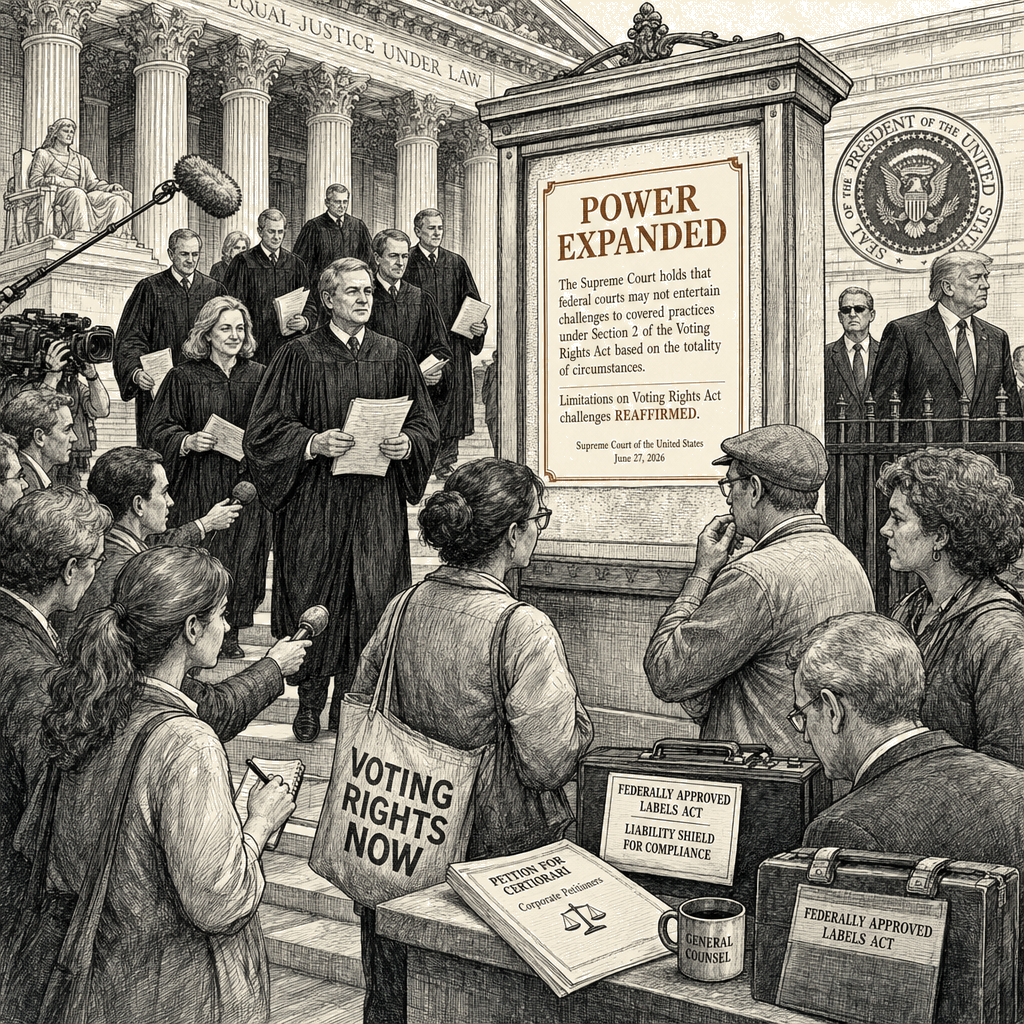
Six Republican-appointed justices are dismantling every judicial check on presidential power.
The U.S. Supreme Court’s 2025–2026 term ended last week, and the wire-service roundup published Wednesday — “Presidential power, immigration rulings highlight Supreme Court’s term” — treats the docket as a collection of discrete doctrinal events. That frame is wrong. The term delivered a single constitutional program across five majority opinions: the construction of a presidency that can fire any officer who refuses an order, cloak any decision in race-neutral language and escape judicial review, capture a federal agency once and immunize its decisions from every state-law claim, govern the administrative state without interference, and shrink the Voting Rights Act so that no state may do more than the bare minimum to protect minority representation. The five rulings are not separate holdings. They are the load-bearing walls of one structure.
The structure begins with subordinates. In Trump v. Slaughter, the Court held that the president may fire a Democratic FTC commissioner at will, overruling Humphrey’s Executor v. United States, 295 U.S. 602 (1935), and eliminating for-cause removal protection for independent-agency officers. Chief Justice Roberts, writing for the six-justice majority, declared that “subordinates who exercise the President’s power are subject to removal by him.” Sotomayor’s dissent named what the majority was doing: “In granting the President this unbridled authority, the Court upends its precedent, misconstrues our history, and sheds any pretense of judicial modesty.” Humphrey’s Executor was not a footnote. It was the doctrinal keystone of the independent-agency architecture Congress built across the New Deal and the post-Watergate period. By removing it, the Court eliminated the legal basis on which every inspector general, every ethics officer, every commission member who refuses a presidential directive relies. The opinion is the clearance for the termination of anyone, at any time, for any reason.
The structure continues with evidentiary foreclosure. In Mullin v. Doe, Justice Alito’s six-justice majority upheld the Trump administration’s termination of Temporary Protected Status for over 350,000 Haitian and 6,000 Syrian refugees, and — critically — applied the Arlington Heights v. Metropolitan Housing Development Corp., 429 U.S. 252 (1977), standard in a way that functionally requires plaintiffs to prove that racial animus was practically the sole reason for the decision. Alito wrote that none of Trump’s repeated public comments demeaning Haiti and Haitians were “overtly racial” and that the comments alone were “insufficient to show that the termination of Haiti’s TPS designation was based on the race of the Haitian people.” The Court did not formally overrule Arlington Heights; it hollowed it out. The same logic that insulates the TPS termination from review will insulate any race-neutral-justification government action from equal-protection scrutiny — a message the Court sends directly to every administration official who now knows to cloak decisions in policy language rather than racial language.
The structure extends to agency-capture immunity. In Monsanto v. Durnell, Justice Kavanaugh’s majority held that Monsanto cannot be sued under state tort law for failing to warn consumers that its weedkiller Roundup may cause cancer, because the Environmental Protection Agency approved the product’s label. Kavanaugh: “Federal law requires Monsanto to sell Roundup with the label that EPA approved. Durnell’s state tort claim, by contrast, would require Monsanto to add a cancer warning to its labels.” The doctrinal axis is federal preemption — the principle that valid federal law displaces contrary state law — not direct presidential power, but the holding belongs in the same architecture. The Court told the federal bureaucracy that its regulatory approvals are final: no state jury, no state legislature, no state tort system may second-guess an agency’s determination that a product is safe enough to sell without a warning. Capture the federal regulatory process once, and every future victim’s state-law claim is preempted. The agency becomes an immunity shield.
The structure tightens on the Voting Rights Act. In Louisiana v. Callais, 608 U.S. ___ (2026), Alito’s six-justice majority struck down a majority-Black congressional district in Louisiana on the ground that race-conscious redistricting violates equal protection when it is not compelled by Section 2 of the Voting Rights Act. Alito: “Because the Voting Rights Act did not require Louisiana to create an additional majority-minority district, no compelling interest justified the State’s use of race in creating SB8, and that map is an unconstitutional gerrymander.” The holding does two things at once. It raises the bar for proving racial gerrymandering. And it converts Section 2 from a floor into a ceiling — states cannot do more than the VRA minimally requires to ensure minority representation. Kagan’s dissent named the trap: the ruling encourages states to “announce a partisan gerrymander” to avoid race-discrimination litigation, because the Court has now made race-conscious redistricting presumptively unconstitutional while simultaneously gutting the evidentiary tools needed to challenge partisan gerrymanders that accomplish the same racial result.
And then the structure draws its outer boundary. On June 30, in Trump v. Barbara, the Court ruled 6-3 that Trump’s executive order ending birthright citizenship violated the 14th Amendment. Roberts, joined by Kavanaugh and Barrett, wrote: “Citizenship then and now, was the right to have rights — to freely participate in our political community. We keep that promise today.” This is the holding the wire services lead with, and it is real. But reading it as a check on the unitary-executive program is a mistake. What the opinion actually does is define what the president cannot do — rewrite the Constitution by executive order — and confirm that everything else is his. It is a release valve, not a restraint. The ruling draws a bright line around the 14th Amendment and leaves everything outside that line to presidential discretion.
The six-justice majority that wrote this term’s administrative-law docket is the same coalition that decided Dobbs v. Jackson Women’s Health Organization, 597 U.S. 215 (2022). The outputs are not coincidental. They are a constitutional program. And after this term, the program is nearly complete. The only remaining institutional check on the presidency is the Senate — and Slaughter has now made clear what happens to any agency head, inspector general, or independent officer who tries to obstruct a president who has the Court’s permission to fire them at will.
An honest constitutional order would defend the for-cause protection Humphrey’s Executor established, the Arlington Heights evidentiary standard, and the principle that federal regulatory approval is not by itself a tort shield. The Court has now refused to defend any of them.