
The economy that burned the boreal forest sent the smoke bill to Adams County.
The smoke was smellable before it was visible Tuesday morning. By nine o’clock the sun over Friendship Mound had gone the color of a navel orange. The air tasted like a campfire somebody left burning. What the studies say wildfire smoke does to the human body — cardiovascular, respiratory, neurological — runs through the whole system. PM2.5 particles, small enough to cross from the lungs into the bloodstream. There is no safe threshold. The air over the Midwest has been hazardous for days.
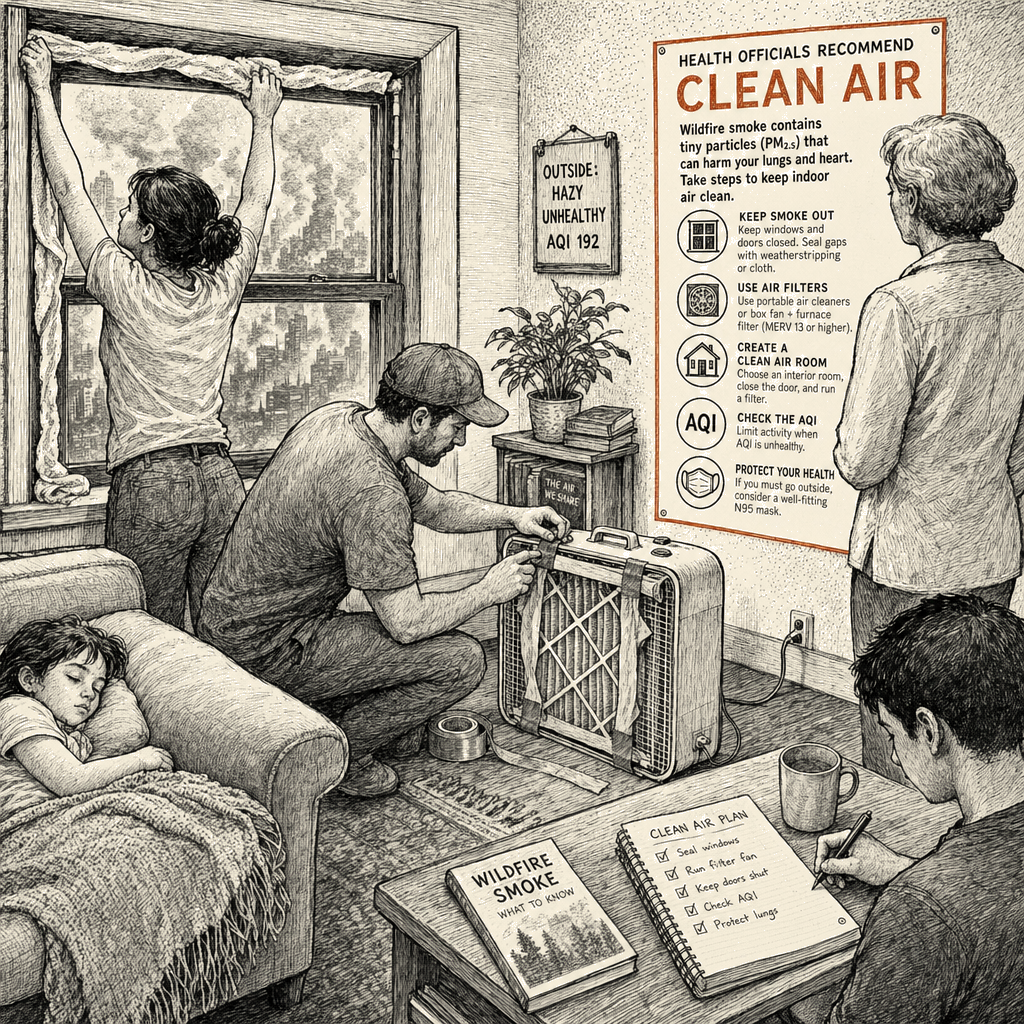
The guidance is straightforward. The University of Oregon’s Center for Wildfire Smoke Research and Practice says to set your central air to recirculate, close the outside vents, and run the fan through the whole smoke event, not just when the compressor is cooling. Filters rated MERV 13 or higher. For households without central air, a portable HEPA unit — one that does not generate ozone.
A MERV 13 filter runs $15 to $40 depending on the size, and during a smoke event you replace it more often. After two days of this kind of air, one comes out gray. A portable HEPA unit runs $100 to $300. The guidance assumes a household budget that can absorb those numbers. In Adams County, that assumption is wrong for a lot of kitchens.
The median household income in the City of Adams is about $43,000. According to the most recent census estimates, one in four residents lives below the poverty line. The county’s labor-force participation rate was 48.6 percent the last time anyone checked — lowest in the state. The people most exposed to the smoke — working outside, living in older houses without central air, running window units that do not take a MERV 13 filter — are the ones least able to follow the guidance.
That is not a failure of the guidance. That is a failure of the economy that put those households where they are.
Wendell Berry wrote in The Unsettling of America that the extractive mind treats land and people as expendable inputs — uses them up and moves on. The boreal forest is burning because the planet has warmed, and the warming is documented. Wisconsin has warmed about three degrees Fahrenheit since 1950, according to the state’s own climate assessment. The winters have warmed fastest. The fire seasons are longer. The forests of northern Canada are drier than they were a generation ago. The smoke is not a surprise. It is a receipt.
The receipt is arriving in a county that has been hollowing out for fifty years. The Sand Hill mill closed in 2009. A regional chain bought the bank and closed the branch. The Dollar General replaced the hardware store. The veterinary clinic was bought by a corporate chain that shut the small-animal practice. Adams County’s median household income runs about 80 percent of the state median. The people the smoke finds when the wind shifts south are the same people the consolidation economy already took the margin from.
Five years ago a bad smoke day in central Wisconsin was unusual. Now it is becoming seasonal. The DNR data on air-quality advisories tracks the trend. The same counties that lost their mills and lost their Main Streets are the ones where the household budget cannot absorb a $200 HEPA filter and a replacement MERV 13 every few days.
Aldo Leopold wrote in the foreword to A Sand County Almanac that there are two spiritual dangers in not owning a farm. One is to suppose that breakfast comes from the grocery. The other is to suppose that heat comes from the furnace. The modern version is to suppose that clean air comes from a filter you can afford. For a quarter of the households in the City of Adams, that supposition is wrong.
The people who delayed climate policy for forty years — a documented architecture of funded doubt — did not send the smoke to Adams County on purpose. But they built the economy that burned the forest and they left the bill with the people least equipped to pay it. The filter guidance is real. The health science is real. The smoke is real. And the bill, as always, lands on the kitchen table in a county where the income does not cover it.
The school district in Friendship — Sara’s school, where she works as a paraprofessional in the special-ed program — has a portable filter running in the classroom. They bought it with a grant. Not every building in town has one. Not every household can buy one. Adams-Columbia Electric Cooperative, headquartered right here in Friendship, has been talking about a program to help households get filters. That is the cooperative tradition doing what it does — stepping in where the market and the policy left a gap.
The smoke will lift. It always does. The question is what happens next fire season and the one after that, because the planet is not going back. Living well on this sand-county place Leopold wrote about and Berry has been asking about for fifty years now includes breathing the air the combustion economy made, in a county the combustion economy already hollowed, and finding a way to buy the filter anyway.