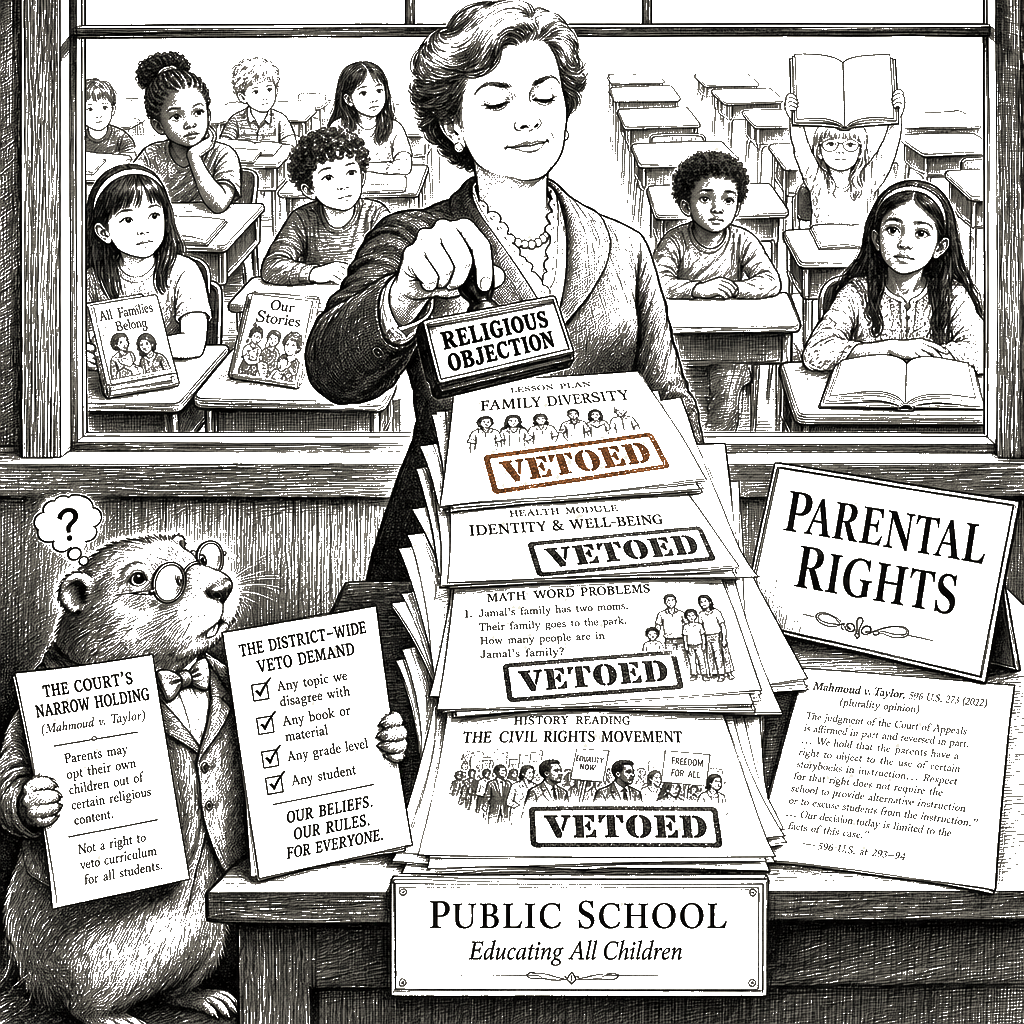
A public school district near San Jose is doing something quietly extraordinary: refusing to let one family’s theology dictate what every child in its classrooms learns about the world they live in. The Sunnyvale School District should be applauded, and its position should hold.
Justin and Rose Taylor, members of the Church of Jesus Christ of Latter-Day Saints, are suing the district in federal court. They allege that Sunnyvale is denying them the right to pull their two elementary-age children from lessons that include LGBTQ+-inclusive material, and they invoke last year’s Supreme Court decision in Mahmoud v. Taylor as authority for the demand. They are overreading that decision by a wide margin, and their theory, if accepted, would do far more damage than any lesson plan.
The facts of the complaint are not in dispute. A county teaching guide used in Sunnyvale’s schools says health and science lessons should “explicitly teach about gender identity and sexual orientation.” A sample history lesson reportedly frames a unit around identities that “disrupt traditional definitions of the family.” Even math teachers are encouraged to weave in problems touching on marriage equality and equal access. The district assigns books such as Born Ready, about a child who knows who he is, and texts that were at issue in the Maryland case the Taylors now lean on.
The Taylors asked to excuse their children. The district considered the request and said no. Officials wrote, the Taylors allege, that the Mahmoud ruling “addressed a specific set of facts in another state” and “does not override California’s statutory requirements governing instructional content.” They were right.
The Taylors’ reading of Mahmoud treats the 6-3 decision as a blanket license to withdraw children from any classroom material that touches on gender or sexuality when a parent has a religious objection. But that is not what the case decided. The Maryland dispute involved a narrow, specific set of storybooks and a district that offered no process for accommodation. Justice Samuel Alito wrote that the books at issue “impose upon children a set of values and beliefs that are ‘hostile’ to their parents’ religious belief.” The Taylors are extrapolating from that language a right to reshape an entire curriculum — history, health, science, even mathematics — around their theology. The First Amendment does not require it. The compelling interest of the state in equal, inclusive public education overrides it.
Sunnyvale already accommodates religious families where it can. The district lets families opt out of comprehensive sexual health education and HIV/AIDS prevention education. That is a narrow, topic-specific carve-out that does not gut the educational mission. What the Taylors are asking for is something categorically different: the ability to pull their children out of any instruction that acknowledges LGBTQ+ people and families exist, across subjects, across grades, year after year. Granting that demand would effectively hand a veto over public curriculum to whichever parent shouts the loudest about theology. Every family in the district would live under that veto.
The district board understood the stakes. After the suit was filed, it passed a resolution pledging to “ensure that inclusive curriculum—including LGBTQIA representation” would remain “integral to the District’s equity and inclusion efforts.” That is not defiance of the Supreme Court. It is a statement of educational purpose. The state has a compelling interest in preparing children to live in a pluralistic society, and inclusive curriculum is how public schools fulfill it. A school that teaches children that some of their classmates’ families are too dangerous to discuss has failed its most basic obligation.
None of this is hostility toward religion. The Taylors are free to teach their children whatever they wish about gender, sexuality, and family at home and at church. The First Amendment protects their right to do so absolutely. What it does not protect is the right to demand that a public school, funded by every family in the community, reshape its instruction around one family’s convictions. The establishment clause runs in both directions: the state may not impose religion, and religion may not commandeer the state’s educational apparatus.
This case is ultimately about who gets to decide what public school children learn. The Taylors’ theory says parents do — not just over their own children’s exposure, but over the curriculum itself, because any lesson that acknowledges LGBTQ+ people becomes subject to religious opt-out demands that would hollow out the program for everyone. The district’s theory says the state has a legitimate, indeed compelling, interest in equal education, and that no single family’s theology gets to override it.
Sunnyvale is holding the line. The court should let it.