
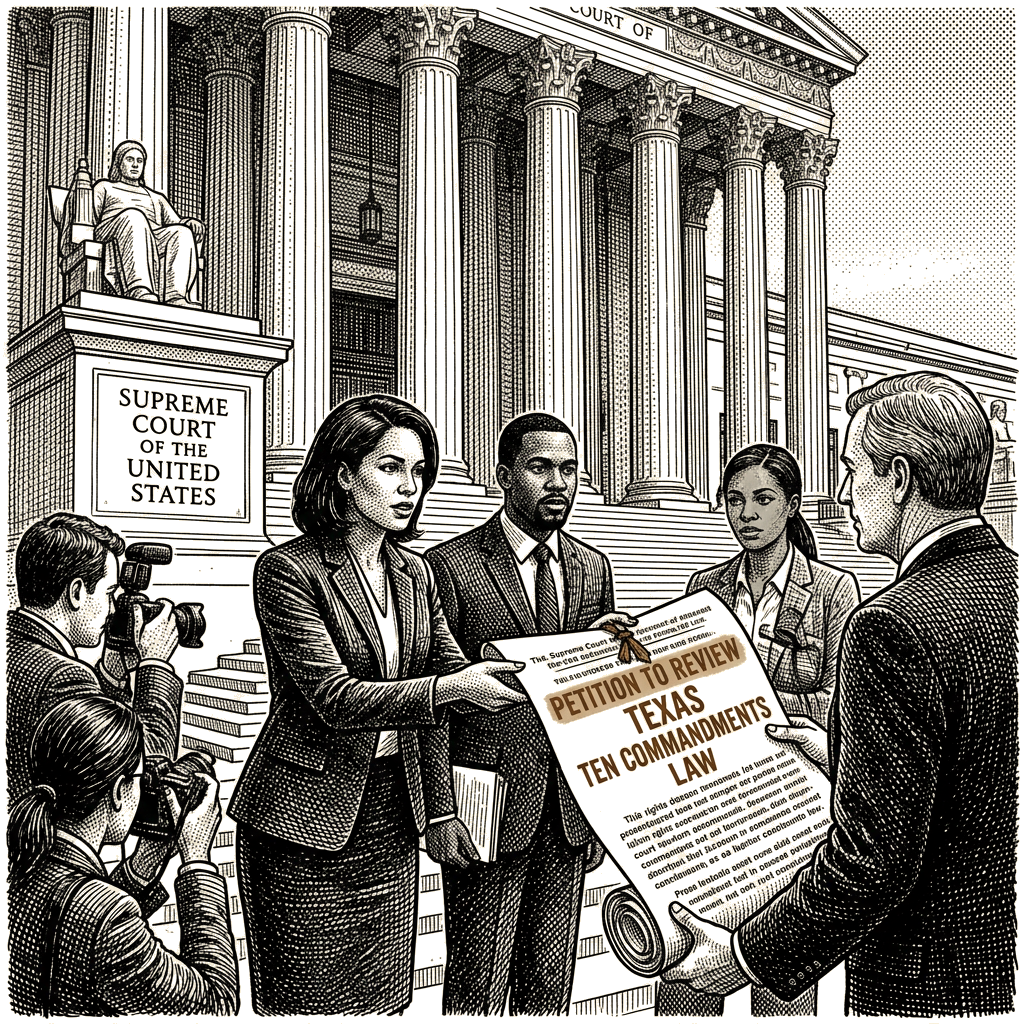
That is the named injury the Texas Legislature and Governor inflicted when they required every public-school classroom to display a state-selected poster of the Ten Commandments, drawn from the King James Bible, under compulsion of attendance. The case arrived at the Supreme Court on Monday because the 5th Circuit Court of Appeals ruled 9-8 in April, splitting sharply along ideological lines, to uphold the law — and the families the ACLU and co-counsel represent now ask the justices to do what forty-five years of Establishment Clause doctrine already requires.
Let me show you what the statute specifies, because the specification is the injury.
The Texas law does not require a translation-neutral posting of an ancient text. It requires a poster of the Ten Commandments drawn from the King James Bible. The King James Version was commissioned by King James I of England and produced under royal authority between 1604 and 1611. It was a project of crown-and-pulpit fusion, produced by a confessional state for a confessional state — precisely the architecture the First Amendment’s Religion Clauses were designed to dismantle. When Texas specifies the KJV in its statute, it recapitulates the model the Establishment Clause rejected. It reaches back to the seventeenth century for a Bible made by a king, and posts that king’s Bible in every classroom.
The same King James Bible was the Bible of the slaveholding South. The same King James Bible was opened on courthouse steps to bless segregation. The same King James Bible was the text the captured operation used, from the pro-slavery pulpits of the 1830s through the segregationist churches of the 1960s, to read against the plain language of the prophets in defense of the social order the prophets condemned. That is not incidental history. It is the same translation, deployed by the same operation, against the same populations.
Now notice who must look at the poster. The classroom contains Jewish children, Muslim children, Hindu children, Sikh children, Buddhist children, agnostic children, atheist children, and just plain Christian children like me. The Ten Commandments in the KJV open: I am the Lord thy God, which have brought thee out of the land of Egypt, out of the house of bondage. Thou shalt have no other gods before me. That sentence is a confession. It declares exclusive allegiance to one God and presupposes a confessing community who utters it. To require children of every tradition to look at the sentence every morning under compulsion of attendance is to require them to live inside someone else’s confession. The Bible’s plain language forbids the state from making that requirement.
The Supreme Court has already said so. In Stone v. Graham (1980), the Court struck down a Kentucky statute nearly identical to the Texas one. The pre-amble and the first commandment, in many ways, conflate religion and government, a union the First Amendment forbids. The bar in Stone did not depend on which translation was posted — the Kentucky statute said nothing about the KJV. Even a translation-neutral posting would face Stone’s bar; the choice of the KJV is the insult layered on top of the Establishment Clause injury, not the injury itself. The 5th Circuit majority cites nineteenth-century American practice, as if nineteenth-century practice settled the question of what the Establishment Clause means in 2026. The tradition the majority invokes has been on the wrong side of the Supreme Court for forty-five years.
The Decalogue in plain language has a structure the statute cannot honor. The first table is God-ward. The second table is neighbor-ward. The prophets read the gap with a fury that should leave a person unable to sit still in the pew. What doth the Lord require of thee, but to do justly, and to love mercy, and to walk humbly with thy God. Micah 6:8. The text does not separate worship from neighbor-justice. The statute posts the first table. The same statute cannot post the second. The state has chosen display over obedience, and the Bible’s plain language is the reason it had to.
I taught the Ten Commandments in Sunday school for fifteen years, and I never read the two tables as a single piece until the statute made me. The workbook I was handed did not require it. The teachers’ manual did not propose it. My own pastor never raised it from the pulpit. I am telling you now, plainly: the captured operation skipped the second table, used the very text that names the prophets’ critique, pinned it on a wall, and called it obedience.
I would name the same injury if a governor of any other party tried it with any other confession. If a Democratic governor required classrooms to display the platform of a progressive religious caucus, the principle would be the same. The state is not a confessional authority. The Bible’s plain language forbids what the captured operation is now requiring. The First Amendment’s plain language forbids it too. The two are not in tension here. They agree.
The petition now sits in the justices’ lap. The case will set a national standard for the limits of state-sponsored religious expression in classrooms. May the Court remember what the Bible and the Constitution both plainly say. May the tradition I love recover the texts it has forgotten.