
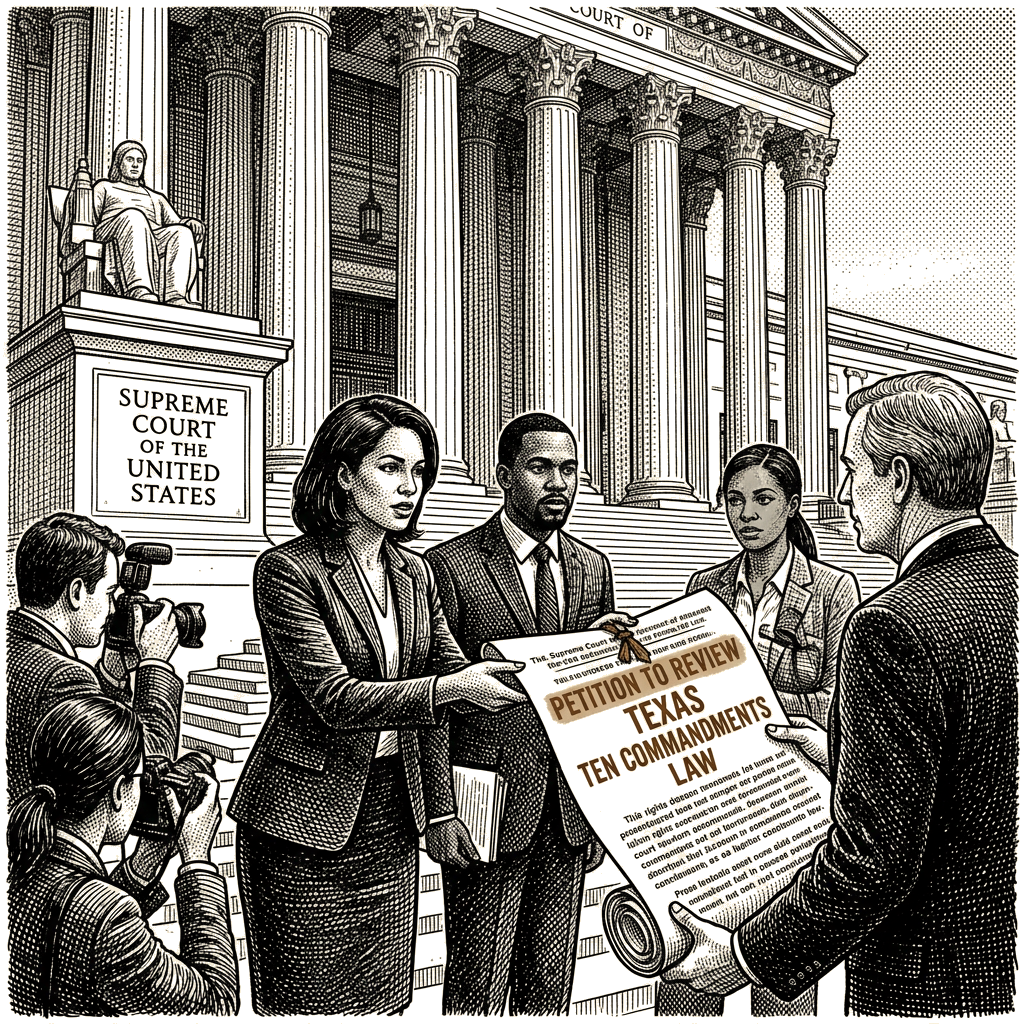
Texas is forcing a state-selected King James Bible text on captive public-school children. The Fifth Circuit upheld the law 9-8 en banc in April, and on Monday the ACLU and allied counsel representing over two dozen Texas families filed a cert petition asking the Supreme Court to overturn.
The strongest defense runs through American Legion v. American Humanist Association, 588 U.S. 29 (2019). The display is passive — children are not required to recite the text, affirm belief, or engage in religious exercise. The Ten Commandments have a recognized role in American civic and legal history. American Legion declined to apply the Lemon test strictly to a longstanding cross memorial, treating such monuments as presumptively permissible because of their historical provenance. A classroom posting of a state-selected text, the majority reasoned, fits comfortably within that tradition.
The steel-man has weight. It does not survive Stone v. Graham, 449 U.S. 39 (1980), which struck down a materially indistinguishable Kentucky classroom-display statute. Stone held that the Ten Commandments are “pre-eminently a sacred text” and that posting them in classrooms is state-sponsored religious exercise the Establishment Clause forbids, regardless of any “secular” disclaimer the legislature attaches. The Fifth Circuit distinguished Stone on grounds Stone itself foreclosed.
The history-and-tradition audit is where the majority’s case collapses. The American tradition in public schools — the tradition the Court has actually enforced in its school precedents — is one of separation. Whatever the American Legion and Kennedy majorities said about cross memorials on government land, that history does not extend to a state-selected Protestant text posted in a classroom where attendance is compulsory. The Supreme Court has struck down school prayer. It has struck down compulsory Bible reading. It has struck down the classroom Ten Commandments display. It has struck down moment-of-silence-for-prayer statutes. That is the tradition. The “tradition” of state-sponsored religious posting in public schools is, on closer inspection, a tradition of courts striking down state-sponsored religious posting in public schools.
That the audit collapses is not an accident. It is the regime. Lemon v. Kurtzman, 403 U.S. 602 (1971), set the operative test for half a century: a statute must have a secular purpose, must not have the primary effect of advancing or inhibiting religion, and must not foster excessive government entanglement with religion. Lemon’s three-part framework governed Establishment Clause analysis for two generations of schoolchildren.
Kennedy v. Bremerton School District, 597 U.S. 507 (2022), dismantled that framework. The Court there replaced Lemon’s tripartite test with a “history and tradition” inquiry — the same framework the Fifth Circuit majority deployed here. The cert petition now before the justices fits the religion-in-schools cert-grant pattern the Court has been running on this docket — American Legion granted, Kennedy granted, both religion-in-classroom cases producing rulings the conservative majority authored; cases that would set a coalition-unfavorable precedent, the Court denies.
A constitutionally adequate course would teach the religious influences on Western law and literature in a comparative frame, presenting multiple traditions alongside their critics. Texas chose neither comparative teaching nor critical context. Its statute requires public-school classrooms to display a state-selected version of the Ten Commandments drawn from the King James Bible. That is not neutral history instruction. It is a government command to place a particular sacred text before every child.
The constitutional command is categorical: “Congress shall make no law respecting an establishment of religion.” U.S. Const. amend. I. That command applies to Texas through the Fourteenth Amendment. U.S. Const. amend. XIV, § 1. A student can study religion, encounter competing beliefs, and reject them. The state cannot make a particular sacred text the required visual background of compulsory public education.
Religious neutrality cannot be achieved by selecting one tradition’s text for universal display. If every state may require its own preferred sacred text in every public-school classroom, the rule is not neutrality. It is statewide preference wearing the label of historical education. The government chooses the words, pays for the display, and commands its presence. The child receives no equivalent choice. Teaching preserves religion as a subject for examination. A compelled display makes the state the selector of sacred truth.
The 9-8 vote divided the judges. It did not make the King James Bible translation cease to be state-selected, nor does it create a historical practice that predates the statute. The near-even division proves only that the legal question is contested. It does not alter the command imposed on the student.
The Roberts Court built the doctrinal machinery that lets Texas put a state-selected Protestant translation of scripture in front of children the state requires to attend school. The Court will now decide whether to use that machinery, or whether the captive children of Texas will keep reading a religious text the state has chosen for them. That is establishment by mandate — and the families are asking the Court to do what the Constitution requires: strike the mandate and return the classroom to religious neutrality.